
Working together to build a strong and comprehensive homeland.
(Baonghean) - During the process of construction and development, generations of cadres, Party members, and people of Nam Giang commune (Nam Dan district) have made many worthy contributions to the struggle and defense of the Fatherland. Now, that spirit is being revived and actively promoted, creating a comprehensive resource to bring the commune to all-round development.
Implementing the National Target Program for New Rural Development, Nam Giang commune was selected as one of the pilot communes in Nam Dan district. This is both a great honor and a significant challenge, requiring all officials, Party members, and people of the commune to strive to achieve each criterion. Recognizing this, the commune Party Committee promptly issued Resolution No. 15-NQ/DU on focusing resources on new rural development. The commune People's Committee developed a plan, reviewed the current situation, and prepared a project proposal for approval and implementation by the competent authorities.
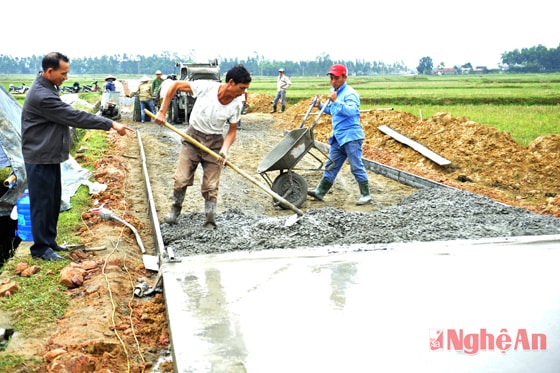 |
| People in Nam Giang commune are building internal field roads. Photo: Sy Minh |
Immediately after the Resolution was issued, the Party Committee, government, mass organizations, and social organizations of Nam Giang promptly organized propaganda to help all levels of the population understand the importance of the national target program for building new rural areas; clearly analyzed the content of the 19 criteria and 39 contents of building new rural areas for the people, as well as implementing them through specific methods. Accordingly, the leading role of each citizen and each household was affirmed. To ensure that the policy is implemented voluntarily and actively, each cadre and Party member set an example by taking the lead, while also mobilizing the people to voluntarily implement it.
Nam Giang has focused on planning, publishing and implementing plans in accordance with guidelines, such as: land use planning and essential infrastructure for the development of commercial agriculture, industry, handicrafts, and services; planning for the development of socio-economic and environmental infrastructure; planning for the development of residential areas, etc. Based on the plans, the commune has focused on directing the completion of "land consolidation and exchange" according to Directive 08 of the Provincial Party Committee and Resolution No. 26 of the District Party Committee, creating favorable conditions for the rational transformation of crop structure. People in the hamlets have applied many production methods that bring high economic efficiency in various fields such as: a 120-hectare aquaculture model; a garden-based economic development model on the existing 47 hectares, mainly consisting of fruit trees such as lychee, mango, sapodilla, longan, apple, jackfruit, etc.
Simultaneously, the commune has attracted the development of industrial production facilities, drawing in a large workforce, thus creating favorable conditions for the rapid development of the service economy, especially food and beverage services and souvenir sales. The total value of production in the service and trade sector has increased significantly annually, reaching 15.9 billion VND in 2014 alone, a 69.7% increase compared to 2010, with an average GDP growth rate of 17.4% per year. The commune has 302 trading households, 8 construction enterprises, 42 transport vehicles, and 1 agricultural service cooperative operating effectively in 3 areas: irrigation, seeds, and fertilizers. Particularly after land consolidation and reallocation, people have boldly introduced mechanization into agricultural production; currently, the commune has 26 tillage machines, 640 hand-held harvesters, 26 rice threshing machines, and 5 combine harvesters.
Alongside economic development, socio-cultural aspects have also seen significant progress. The quality of teaching and learning has improved, with all preschools, primary schools, and secondary schools in the commune meeting national standards; annually, 45-50 students are admitted to universities and colleges. The promotion of education and talent development is prioritized, with 12 out of 12 hamlets and 35 family clans establishing scholarship funds. The movement for national unity in building a cultured life has received enthusiastic support; all village roads are illuminated, and all 12 hamlets have spacious cultural centers. Significant results have been achieved in poverty reduction and job creation. In over three years of implementing the national target program for building new rural areas, the commune has leveraged support resources to build and renovate six houses for poor households, and facilitated loans totaling nearly 11 billion VND for poor and near-poor households for production and business. As a result, the poverty rate has decreased from 13.8% in 2011 to only 2.8% today; the percentage of well-off and wealthy households has increased significantly. Environmental sanitation work has been carried out quite seriously; the commune has established a centralized waste collection team; 98% of households have access to clean and hygienic water; and the cemetery has been built according to the plan and managed in accordance with regulations.
Regarding infrastructure development, the Party Committee and local government focused on mobilizing internal resources and attracting external resources, including state budget funds, government bonds, people's credit funds, enterprise capital, and other sources. Thanks to high levels of consensus and agreement, the people in the villages contributed tens of thousands of man-days and hundreds of billions of dong to build a two-story primary school with 10 classrooms; pave 6 km of commune roads; 6.5 km of village roads; upgrade 13.5 km of internal field roads; construct 2.5 km of canals; and upgrade the commune cultural center, the cultural centers of 12 villages, playgrounds, and sports fields to serve the people's needs and contribute to the local economy, with a total mobilized capital of 104 billion dong. During the construction process, 750 households donated 140,400 m2 of garden and rice field land, valued at 4.4 billion dong, and contributed tens of thousands of man-days.
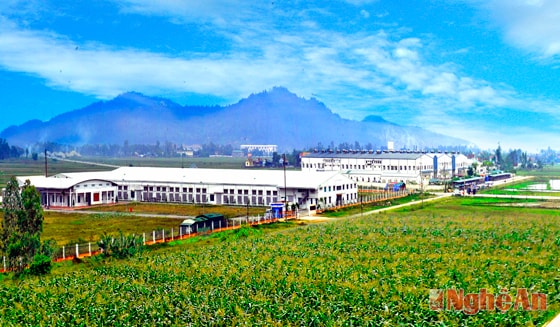 |
| Nam Giang Industrial Park. Photo: SM |
Along with promoting infrastructure development and economic growth, in recent years, Nam Giang has focused on ensuring political security and social order. Annually, it coordinates security for hundreds of high-ranking Party and State officials and thousands of visitors paying respects at the tomb of Mrs. Hoang Thi Loan (President Ho Chi Minh's mother). The commune's People's Committee, together with businesses, has established a coordination mechanism to ensure security and order in the area. As a result, no complex incidents or hotspots have occurred.
Recognizing the efforts and dedication of officials and people in patriotic emulation movements, Nam Giang commune was awarded a flag and certificate of merit by the Prime Minister; and for many consecutive years, it received flags from the Provincial People's Committee and the District People's Committee as a leading unit in emulation movements. From the practical experience of leading and directing the implementation of the New Rural Development program, the Party Committee and government of Nam Giang commune have drawn the following lessons:
- Party committees and government authorities must pay attention to leadership and guidance through specific resolutions, projects, and plans. They must base their actions on practical realities to formulate appropriate tasks and solutions, and provide decisive, consistent, continuous, and flexible guidance in implementation.
- The leadership and guidance process must be specific, synchronized, practical, and effective, adhering closely to the set criteria for prioritizing tasks. All matters must be thoroughly discussed and debated democratically, creating high levels of consensus from within the Party committee, among cadres, Party members, political and social organizations, and the people, based on the principle: tackle the easy tasks first, then the difficult ones.
- The implementation process must take into account the opinions of the people, promptly resolving difficulties for the grassroots and the people; difficult issues require direct guidance from the head of the organization. A specific inspection and monitoring plan must be developed; shortcomings and weaknesses must be promptly addressed. Annual reviews, evaluations, commendations, and plans for the following year should be organized.
Nam Giang's recognition as a New Rural Area standard commune is a great honor and source of pride. It also serves as a foundation and motivation for the commune's officials, Party members, and people to continue striving to sustainably and effectively improve the criteria, meeting the needs of social development in the new era. Building on this achievement, Nam Giang will continue to vigorously promote socio-economic development and successfully implement the plan to build Nam Giang into a model commune of Nam Dan district. Therefore, the Party Committee and the commune government will focus on the following tasks:
Firstly, we must build a civilized and courteous cultural environment, with friendly and hospitable people; ensure a clean, green, and beautiful environment; and provide excellent service to tourist groups visiting the tomb of Mrs. Hoang Thi Loan - the mother of President Ho Chi Minh.
Secondly, we must leverage the advantages of a strong economic restructuring towards: Services - Industry and Construction - Agriculture. We will prioritize the development of trade and tourism services; develop small-scale industries and handicrafts to serve tourists; focus on vocational training to enable young people to work in industrial zones and factories in the area; transform the crop structure towards high-tech agricultural production and fruit orchards to serve tourists; and produce high-quality vegetables and crops for industrial zones and factories.
Thirdly, we must build a truly strong political system, enhance the capacity and responsibility of officials and civil servants in handling affairs for the people; promote administrative reform, creating conditions for all citizens to participate in building a clean and strong government; regularly conduct self-criticism and criticism in accordance with Resolution No. 4 of the 11th Central Committee on "Some urgent issues concerning Party building today," combined with promoting the study and emulation of Ho Chi Minh's moral example; pay attention to the work of developing Party members; ensure national defense and security, social order and safety, and create conditions for sustainable socio-economic development.
Tran Huu Van
Chairman of the People's Committee of Nam Giang Commune


