
The issue of the screw was brought up for discussion by a Member of Parliament.
The story of Vietnamese businesses being unable to even produce a screw for Samsung was mentioned by Delegate Le Minh Thong (Thanh Hoa delegation) during the discussion on the socio-economic situation in 2014 and the tasks for 2015.
Mr. Le Minh Thong cited the example of Samsung supplying 150 types of components, which domestic businesses then abandoned to produce. The question arises: why can't our businesses participate in the value chain of a large corporation? Samsung has a presence in Vietnam and they are willing to cooperate with us, but we can't. So, what direction is the economy, economic structure, industry, specifically supporting industries, developing in? An economy that can't even produce a small detail in a value chain doesn't understand the direction of industrial development.
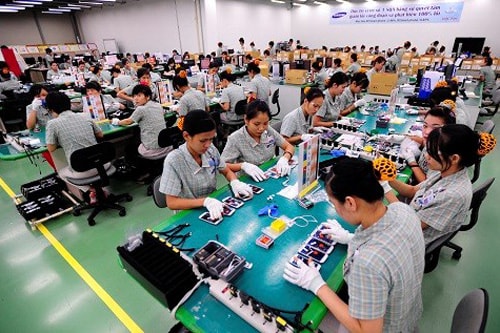 |
| Samsung's manufacturing plant |
| RELATED NEWS |
|---|
Another aspect, according to Mr. Le Minh Thong, is that the government has not paid enough attention to researching labor productivity, which means we are "proudly" at the bottom of the rankings. Where is labor productivity, and how should we invest? The government needs to seriously analyze this indicator. We must find the reasons why labor productivity is so low in order to find ways to boost it. The government can invest and restructure the economy, but without improved labor productivity, it's a waste.
"It's time we seriously examine where labor productivity is weak in order to find ways to organize production to achieve the highest possible productivity and ultimately succeed. Without thoroughly analyzing the causes of low labor productivity, it will be difficult to find practical solutions," said Mr. Le Minh Thong.
According to the government report, among the 14 targets set by the National Assembly, the target for trained labor was not met. However, according to Representative Le Minh Thong, even if it were met, it would not satisfy the requirements because vocational schools train students in professions that businesses and society do not use.
Sharing concerns about the current state of vocational training, delegate Tran Ngoc Vinh (from Hai Phong delegation) stated: "With our current facilities, vocational training institutions cannot provide the skills society needs, which is a great waste. I propose that the Government reorganize vocational training based on market demands. In reality, many graduates cannot find jobs. The goals we set are correct, but the implementation is not yet effective," said delegate Tran Ngoc Vinh.
Labor productivity is indeed low, but is it the lowest in the world?
Representative Bui Sy Loi – Vice Chairman of the National Assembly's Committee on Social Affairs – assessed the economic situation from a social perspective. According to Mr. Bui Sy Loi, the current economic difficulties stem from the heavy burden of social issues. For example, the policy for war veterans and their families: 25,000 billion VND was paid out in 2012; 30,000 billion VND in 2013; and 32,000 billion VND in 2014… “These issues cannot be evaluated by labor productivity alone. Our total social security spending is 18% of GDP,” said Mr. Bui Sy Loi.
The Ministry of Planning and Investment and the General Statistics Office have released statistics showing Vietnam's unemployment rate at 1.84%, the lowest in the world and the region. "Methodically, this figure is correct, but it's not accurate when applied to the characteristics of the Vietnamese labor market," said Mr. Bui Sy Loi.
Elaborating on the International Labour Organization (ILO) calculation method, Mr. Bui Sy Loi stated: The ILO conducts surveys over 7 days, targeting entirely unemployed workers who are willing to work and actively seeking employment. Other countries use 90% of the labor force in their labor relations to arrive at the overall unemployment rate. However, Vietnam has 47% of its workforce in agriculture, accounting for only 18% of its GDP. Therefore, when we add the two indicators of labor relations and the informal sector and divide by the total workforce in the national economy, the rate appears low.
An ILO report also stated that Vietnam's labor productivity is the lowest in the Asia-Pacific region. When asked if this was true, Mr. Bui Sy Loi replied: "It must be affirmed that Vietnam's labor productivity is indeed low."
According to Mr. Loi, this is because 47% of our workforce is currently in agriculture, and the productivity of this sector is only one-third of that in industry and one-quarter of that in the service sector. Other countries have a very low proportion of agricultural labor but a high proportion of industrial value. The ILO calculates labor productivity using the method: total GDP divided by the total employed workforce. If Vietnam were to divide total GDP by the number of employed workers, it would be incorrect because the rural workforce in Vietnam is high. Dividing it that way would naturally result in low labor productivity in Vietnam.
"Vietnam's labor productivity is indeed low, but we need to reassess what constitutes the lowest or lowest level. If we consider labor productivity in Vietnam's information technology sector, we could actually rank highly. However, using this method would lead to a very pessimistic outlook on socio-economic issues," said Mr. Bui Sy Loi.
In its report on the socio-economic situation in 2014, the National Assembly's Economic Committee stated that: While the overall unemployment rate decreased, this was actually due to workers in the formal sector shifting to the informal sector, resulting in many underemployed, unemployed, and low-income workers with unstable jobs. Social labor productivity was low and showed a tendency to slow down. Many opinions suggested that, given the current economic situation and the numerous difficulties faced by businesses in recent years, the fact that employment and unemployment figures did not show significant changes does not accurately reflect reality. A more thorough assessment is needed to clarify the relationship between economic growth, business difficulties, and employment and unemployment indicators.
According to VOV


