
Thuy's story
(Baonghean) - Living in darkness since the age of 5, no one could have imagined that visually impaired girl Nguyen Thi Thuy could complete high school and graduate from university. Now, at over 25 years old, Thuy is trusted by everyone and was elected Vice President of the Provincial Association of the Blind. Most recently, she won third prize at the ONKYO Braille writing competition organized by the World Association of the Blind Asia-Pacific region in 2013.
(Baonghean) - Living in darkness since the age of 5, no one could have imagined that visually impaired girl Nguyen Thi Thuy could complete high school and graduate from university. Now, at over 25 years old, Thuy is trusted by everyone and was elected Vice President of the Provincial Association of the Blind. Most recently, she won third prize at the ONKYO Braille writing competition organized by the World Association of the Blind Asia-Pacific region in 2013.
I met Thuy in her modest room at the provincial Association for the Blind headquarters, just as she had received two pieces of good news: a promotion and the Onkyo Award. The happiness and pride spread to the other members of the Association, as it had been a long time since the province had won such a prestigious award.
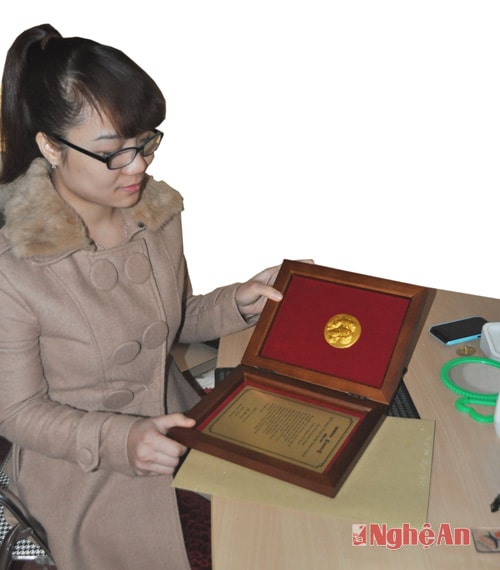 |
| Nguyen Thi Thuy with the award presented by the World Association of the Blind. |
“Born into a poor family in Hien Son - Do Luong, at the age of 5, my eyesight gradually deteriorated and then I went completely blind due to uveitis. My family had six siblings; my father was a war veteran, my mother was a farmer, and I grew up surrounded by the love and care of my family. But it seems I didn't realize how serious my eyesight was at that time. As the years passed, one day I realized the difference between myself and my peers: I couldn't see anything; everything around me was just black. For a long time, I lived in darkness, everything was gloomy and uncertain…”
"Insecurity… inferiority… shame… I yearn to be a normal person, to see the light, to see people, at least to see the people who gave birth to me… But no… that wish is so far away for me" – These first words Thuy wrote to participate in the ONKYO Braille writing competition began from her own feelings, a little girl who suddenly realized she was visually impaired at the age of 5. The immense pain made Thuy look older than her peers. Her physical disability also forced Thuy to strive, even though she always had to work twice or three times harder and endure far more pain than a normal person.
Thúy told me a lot about the days when she started school and learned Braille at the Vocational Training Center for the Disabled: “When I first started learning to read and write, everything was so difficult for me. To get used to it, I had to practice using my hands instead of my eyes, getting used to the blackboard, the writing awl, getting used to touching, reading, and feeling with my fingertips… It was hard work, there were days when I had to hold the writing awl, my hands were sore and swollen, but those were also happy days for Thúy because thanks to knowing how to read and write, she could perceive the world around her and also realized that “her life could change if she received a proper education.”
Despite her determination, completing middle school, high school, and then university was a long journey, and Thuy had to struggle many times to be able to study and be treated like a normal person. For example, when she first started middle school, the provincial vocational training center only taught up to the primary level. To continue her education, Thuy's only option was to attend the local middle school. Seeing Thuy's eagerness to learn and her consistently good grades in primary school, getting into Hien Son Middle School (Do Luong district) wasn't difficult. However, because she couldn't see clearly and needed constant assistance, Thuy had to skip grades, from 5th to 7th. This was because her younger brother was in that grade, and without him, without someone to take her to and from school, and without someone to copy notes and read to her, Thuy couldn't learn. Initially, people were very curious about Thuy carrying her pencil and whiteboard, and the clicking sounds she made. For Thuy, making noise felt like "I had just committed some terrible crime." This difference also made Thuy feel "like an eccentric, making me lose confidence, always feeling isolated in my own world at a school meant only for normal people."
Thúy also noticed the "unusual" treatment from her teachers. She felt sad when everyone thought, "Thúy comes to class just for fun, and since she's visually impaired, there's no hope." So, whenever there was a test and she heard her classmates whispering about their scores, she would go home and "bury her face in a blanket and cry." Later, not wanting such preferential treatment and wanting to assess her own abilities, Thúy directly contacted each teacher, requesting that they allow her to take tests and exams like her classmates. Some teachers were initially skeptical when Thúy made this request, but later they got used to the image of a test room with only one teacher and one student, the teacher reading each question for the student to copy, and the student answering and then reading the results back to the teacher. Or sometimes, the teachers would have a younger student read the test questions and copy the solutions for Thúy. A test could last two or three hours, but Thúy never lost heart.
In high school, Thuy's learning and exam methods were similar. She said the most difficult subject was Literature, because while everyone else wrote down what they thought, she had to think and dictate to others. Similarly, with English, she couldn't rely on others to spell out each word for her like with Vietnamese, so she struggled to keep up with her classmates. Then, during the university entrance exam, while her friends were still deciding which university to choose from dozens, Thuy had to go with her parents from one university to another trying to get permission to take the exam. However, both Vinh University and the University of Labor and Social Affairs refused, citing the reason that they "couldn't set up a separate examination board for visually impaired people." Fortunately, through a friend she met online, Thuy learned that Hue University of Science accepted visually impaired candidates. Not wanting to disappoint anyone, in that year's exam, Thuy was the top scorer among the 12 candidates. The only problem is that because the university only has two departments, History and Literature, I had to choose the wrong major, even though my greatest desire was to study social work so that I could work for the blind later on.
The essay submitted to the Onkyo Braille Writing Contest, themed "Braille Changes My Life," organized by the Asia-Pacific region of the World Association of the Blind, was written during Thuy's final days at Hue University of Science. At the time, Thuy simply thought of it as a contest to write about herself, so she participated with a relaxed attitude and never imagined she would win. The judges, perhaps impressed, couldn't believe that a young girl from a poor rural area in Nghe An province could possess the strength to overcome adversity, despite a failed surgery that had left her permanently blind in one eye.
Perhaps they couldn't believe that a middle school student, despite her parents' reluctance to undergo another surgery to save her remaining eye, was determined to have the operation, even going so far as to "train herself for a month to live in complete darkness" in case the "second surgery failed again." They might also be moved by the story of a younger brother who, thanks to his sister's tutoring and note-taking, transformed from a mischievous and stubborn boy into a high-achieving student who passed the entrance exam to the University of Transport and Communications. They also couldn't believe that a family with a war veteran father, a farmer mother, and a visually impaired child could raise six children to graduate from university and find stable jobs…
For Thuy, the unexpected results gave her strength and motivation. Immediately after graduating, she was hired by the Provincial Association of the Blind as Head of the Women's Committee, and after only two months, she was trusted and elected as Vice President. Holding the award she received in January 2014, Thuy said: "When I became Vice President, there were many different opinions, many people worried because I was so young (Thuy was born in 1988). But I believe that if everyone trusts me, I can do it…" Then Thuy told me about her future plans, about the fund to help poor women that she has been nurturing for a long time and is gradually raising funds for… The road ahead will be very difficult, but with her youth and confidence, Thuy will surely bring a breath of fresh air to the visually impaired in Nghe An.
Text and photos:My Ha


