
Crop diversification - The right direction
(Baonghean)Recognizing that improving income per unit area is core to the local production and socio-economic development guidance process, since 2005, the Nghi Loc District Party Committee has issued Resolution No. 05 on crop variety conversion and increasing income per unit area. Implementing this resolution, Nghi Loc district has applied scientific and technical advancements, introducing high-yield and high-quality crop varieties into production…
Nghi Loc District has over 12,000 hectares of agricultural land but only about 40 large and small reservoirs with a total water storage capacity of 20 million cubic meters. Therefore, during the dry season, only about half of this area can have a temporarily reliable irrigation system (dependent on the Nam Dan dam system), while the rest is entirely dependent on rainfall. During the rainy season, the district frequently faces localized flooding. All of this has created significant difficulties for farmers in cultivating and producing agricultural products. To improve agricultural production efficiency, Nghi Loc must choose to shift its crop structure to suit each type of soil, climate, and even the farming practices and skill levels of the local workforce.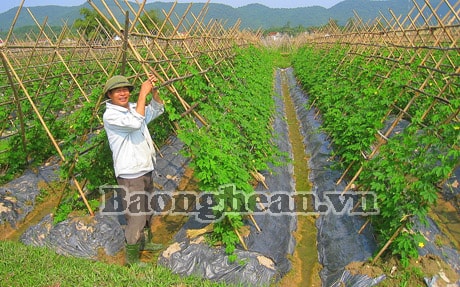
Bitter gourd - a highly profitable commercial vegetable crop in Nghi Loc.
For rice-growing areas, Nghi Loc has gradually replaced older (high-yield) rice varieties with high-quality, commercially viable varieties. The district has collaborated with units such as Nghe An Agricultural Materials Company, Nghe An Seed Company, and the Central Seed Company to implement a model field development mechanism (establishing a linkage between managers, businesses, scientists, and farmers). To date, Nghi Loc has established over 50 model fields, each covering more than 30 hectares. These fields are all planted with high-quality rice varieties.
In the recent spring crop alone, Nghi Loc district had nearly 1,000 hectares of high-quality rice (out of a total of 7,000 hectares). These rice varieties have proven highly effective, according to farmer Trinh Van Linh from Nghi Dong commune, who shared his findings after trying the new varieties: "Compared to previous varieties, the RVT and AC5 rice varieties that the district introduced to us only yield 2.8-3 quintals per sao (approximately 1000 square meters), but the advantage is the higher price; hybrid rice sells for 50, while these commercial rice varieties fetch 80, increasing production value by 1.5 times, and the market for these rice varieties is also very easy."
In fertile areas, Nghi Loc district has recently focused on introducing improved peanut varieties such as L23 and L26, while also expanding the cultivation of vegetables and corn. Specifically, since 2006, the watermelon cultivation model was first introduced on a trial basis on 5 hectares in Hamlet 13, Nghi Long commune. Initially, the people were not very enthusiastic about watermelons because they were unfamiliar and had not yet adapted. However, with support from the district, such as electricity, wells, seeds and fertilizers, technical training, and high selling prices, watermelons quickly took root in Nghi Long (excluding two years of crop failure due to natural disasters - 2008 and this year, each crop yielded a profit of at least 7-8 million VND/sao, or 100-150 million VND/ha). From the initial 5 hectares, the area planted with watermelons in Nghi Long commune has now reached 50 hectares. The watermelon cultivation model quickly spread to Nghi Thinh, Nghi Truong, and Nghi Khanh communes. Watermelon cultivation has been focused on on a large scale; in the last two years, during the spring and summer seasons, Nghi Loc district has had over 200 hectares of watermelon.
During the winter season, Nghi Loc focuses on developing high-quality hybrid glutinous corn varieties such as MX2 and MX4 on double-cropped rice land to sell to markets near Vinh City and Cua Lo Town. In addition, there have been many other successful models such as growing cantaloupe and cucumbers in Nghi Dien commune, various vegetables in Nghi Thach, cabbage in Nghi Khanh, bitter melon and shallots in Nghi Thuan. All of these yield profits 2 to 3 times higher than rice cultivation. Mr. Nguyen Van Cuong, a farmer in Nghi Hoa commune, said: "Last winter, my family planted 3 sao (approximately 0.3 hectares) of cucumbers, with 1,000 plants per sao, resulting in a net profit of 8 million VND per sao. As for glutinous corn, each ear sold directly in the field fetched 2,000 - 2,200 VND."
The heavy rains caused by Typhoon No. 2 in late June have ruined most of the watermelons that were almost ready for harvest. It is estimated that the rains destroyed about 75% of the watermelon crop for farmers in Nghi Loc district, with total economic losses in Nghi Long commune estimated at 4-5 billion VND, and over 15 billion VND for the entire district. While this natural disaster is unavoidable, farmers in particular and Nghi Loc district in general have not been discouraged.
Mr. Nguyen Duc Tho, Head of the Agriculture Department of Nghi Loc District, said: In the coming time, Nghi Loc will continue to implement solutions to mitigate risks caused by natural disasters, such as applying scientific and technical advancements in new varieties, shortening the production cycle, and implementing measures such as growing corn and watermelons in seedbeds so that they can be harvested before the usual storm and flood season. In addition, the district will continuously build and repair river and sea dikes and drainage systems to minimize damage to people's production.
Zen Thanh


