
Stories from My Son
(Baonghean) - The truth is, I've been to My Son (Do Luong) so many times that I don't need signposts. Every time my car accelerates up the nearly one-and-a-half-kilometer-long Ba Cap slope, right when the endless pine trees rustle on the sun-drenched hillside, I smile with joy, knowing I've finally reached that semi-mountainous land. Yet, these chilly days at the end of October still can't stop me from returning to that place – where every inch of land, every blade of grass, every branch of a tree... carries a story, a soul of its own, whispering sacredly day and night from Mother Earth...
(Baonghean) - The truth is, I've been to My Son (Do Luong) so many times that I don't need signposts. Every time my car accelerates up the nearly one-and-a-half-kilometer-long Ba Cap slope, right when the endless pine trees rustle on the sun-drenched hillside, I smile with joy, knowing I've finally reached that semi-mountainous land. Yet, these chilly days at the end of October still can't stop me from returning to that place – where every inch of land, every blade of grass, every branch of a tree... carries a story, a soul of its own, whispering sacredly day and night from Mother Earth...
That breathtakingly beautiful, semi-mountainous land has been both so close and so far to me, even in my dreams. Its beauty is so ethereal that, even after traveling extensively through villages and hamlets, visiting Triều Dương, Ngọc Mỹ, Ngọc Luật, and Trung Thôn—four villages according to the administrative boundaries of Mỹ Sơn hundreds of years ago—I still haven't truly grasped or fully experienced the essence of this place and its people. Many wise elders, well-versed in classical Chinese, still recount the story of a wise geomancer who, hundreds of years ago, passed through this area. Moved by the pure and simple beauty of the land and its people, he bestowed the Qian-Kun hexagram, predicting the land's topography and the convergence of the spiritual energies of heaven and earth. The story has become a legend, and whether legends are true or false, real or fictional, later generations like myself cannot know for sure. All I can do is marvel that, amidst the dazzling splendor of the new era, the land of My Son still retains the beauty of a mountain village, imbued with the shimmering grandeur of history. Standing tall through the vicissitudes of time, the temples, communal houses, and ancestral churches remain intact, carrying immense historical, cultural, and revolutionary value, further enriching the traditional foundation of this land.
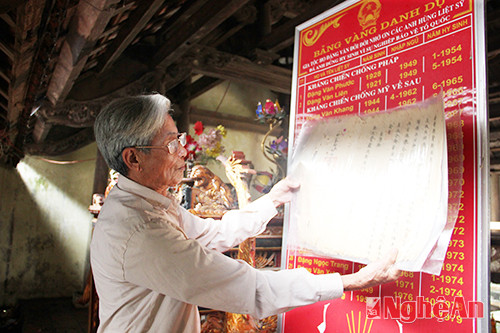 |
| Mr. Dang Van Son is proud of the history of the Dang Van family lineage, as evidenced by the royal decrees. |
In My Son, I have an old acquaintance, Mr. Dang Van Son (Hamlet 3). Like other heartwarming beginnings, a cup of green tea from Nghe An province brought people from far away closer together. He is a native of My Son, and for over 27 years, he has steadfastly served as the head of the Dang Van family council – one of the most deeply rooted and diverse families in the commune. Talking to him is very enjoyable, because he has a very figurative and witty way of speaking! He said that his 80 years of connection with My Son have been 80 years of complete warmth and comfort in this simple village, and he has never once considered leaving. And it's not just him; many generations of his descendants, having achieved success in their studies far away, have also returned to contribute to their homeland.
To give an example, within the large Dang Van clan, according to the family tree, it has been 667 years since they first settled on this land. Over eight centuries, through countless upheavals and changes, sixteen generations and more than 500 households have successively established their livelihoods, built and developed this land. Throughout all these years and generations, the Dang Van clan has preserved their precious heritage: the ancestral temple with its gleaming, aged lim wood columns and the exquisitely carved four-mythical-creature motifs still vividly visible on the stone walls. It's a pity, however, that the temple is situated on low-lying land. During the rainy season, the red brick courtyard in front is often flooded, somewhat diminishing the solemnity of this place of worship.
Mr. Dang Van Son led the way, and I tiptoed behind, bending down to pass by the rafters, beams, and pillars, gazing around the space and immersing myself in his resonant story: “For generations, the people of My Son in particular, and the descendants of the Dang Van family in general, have remained loyal to the tradition of patriotism and revolution. Many other family ancestral temples, including that of the Dang Van family, became bases for hiding weapons and equipment, and safe havens for many cadres and soldiers during various periods of resistance.”
This story is clearly recorded in the history of the Party Committee and the people of the commune: the Provisional Committee of Nhan Luat commune (in 1946, renamed Nhan My commune, and later, according to the Government's decision on administrative boundary division, separated into two communes, Nhan Son and My Son) had its headquarters at the Dang Van family's ancestral temple for several years. The descendants of the family followed this tradition of strictness and loyalty, wholeheartedly devoted to the revolution. Throughout the two national resistance wars, countless members of the Dang Van family joined the torrent of hatred against invaders to defend their homeland. 26 martyrs from the Dang Van family were among the 89 martyrs of My Son commune who fell for the aspiration of complete victory. Today, the ancestral temple still proudly displays a golden plaque commemorating these Dang Van family members, as a testament to their lessons and gratitude for generations to come.
No matter how you approach the story of My Son and its people, it always revolves around the pride of revolutionary tradition and patriotism. Mr. Dang Van Son expertly guided me to the home of Mrs. Dang Thi Que – former Vice Chairman and then Chairman of the My Son Commune People's Committee from 1967-1970. According to him, she would tell me many interesting stories about the war-torn land of My Son during the bombings. The former female chairman, now Mrs. Que, is simple and endearing to her neighbors, her house hidden behind a winding alley shaded by green trees. Expressing surprise that "it's been so long since anyone came to ask about the old days," Mrs. Que quickly set out a few chairs in the spacious courtyard, hastily handing me a sweet, fragrant guava still damp with dew, as genuinely kind and simple as so many other unpretentious people I've met along the way. After hearing me express my desire to learn more about My Son, a steadfast fortress amidst the flames of war, Mrs. Que suddenly fell into pensive silence...
She said that nearly 40 years have passed since the homeland was united, and peace has spread throughout the villages and hamlets. But beneath every inch of land and every stream in My Son, the lingering pain and brutality remain, hidden behind the pride and happiness of the day of complete victory—the silent scars of years of bombs and bullets. Ms. Dang Thi Que was a commune official during the most brutal period of the war against the American imperialists. Still vivid in her memory are the endless nights and days of intense American artillery fire, the digging of tunnels and trenches winding through the foothills and mountains; and how could she forget the misty dawns between deadly bombing raids, when commune officials and people would ring the bells to go to the fields, working hard to ensure the supply of provisions was sent to the South.
Simultaneously producing, fighting, studying, and training amidst extreme hardship, the people of the Ho Chi Minh era still shone brightly with their qualities and self-sacrifice for the common cause. Place names like Ky Lon Slope, Truong Bon Slope, Mong Ga Mountain, Cot Co Mountain... and countless other hills and ravines... remain etched in the minds of the people of My Son because of the extreme ferocity of the American bombs and bullets. In particular, the Truong Bon intersection, located on the strategic Highway 15A, was considered a focal point of intense fighting. Though only 5km long, connecting intersections such as Milestone 0, National Highway 1A, Highway 7, and Highway 34, it never ceased to be ravaged by bombs and bullets. “Despite the hardships, we never heard any complaints or tears; instead, there was always the lively atmosphere of voices, laughter, and encouragement to strive for even better results. Not only the people of our commune, but also the soldiers and Youth Volunteers stationed in the area shared the same spirit. The army and the people were as close as brothers and sisters, like children and grandchildren in one family,” recalled Mrs. Dang Thi Que.
And then, quietly wiping away tears of remembrance, Mrs. Que said, recalling that time, how could she forget the memorable moment of the last day of October 1968? At that time, she was serving as the Vice Chairman of the People's Committee of My Son commune. That morning, she was with other officials going down to the villages to check on the harvest and the digging of civilian trenches and shelters. Suddenly, a series of deafening explosions rang out from the Truong Bon strategic point. Bombs! Everyone shouted, banging gongs to sound the alarm and tell the people to run to the shelters. The series of bombs on the morning of the 31st, in Mrs. Que's memory, was quite unusual compared to the usual bombing raids of the enemy air force. Normally, bombs and rockets were dropped continuously, creating a huge bomb field, arriving and departing quickly.
But on the morning of the 31st, the first series of bombs exploded with a deafening roar at exactly 6:10 a.m. About ten minutes later, before the civilian labor teams, Youth Volunteers, and villagers could even reach the scene to check for casualties, the second, third... series of bombs were dropped. Mrs. Que and countless others silently endured their pain in the small bunkers, knowing that the hope of survival for the Youth Volunteer squad on duty outside was very slim. When the bombing stopped, everyone rushed out. And amidst the ruins, there were fragments of desperate screams. Dang, Vinh, Hoa, Hap... Where are your bright smiles, your sparkling eyes, your warm hands? And the cluster of fragrant soapberries drying in the kitchen, the broken mirror still reflecting the youthful memories? All of it had merged with the loving embrace of Mother Earth...
Now, every detail of that morning of October 31st has been clarified, and history has dedicated its most beautiful accounts to the 13 young men and women who sacrificed themselves on the Truong Bon battlefield. For Mrs. Dang Thi Que and countless other people of My Son, their youthful years have been immortalized, contributing to the vibrant energy of this land. Truong Bon and My Son, their personal experiences have merged into a shared sacredness. Whoever passes through or returns to this land, please tread softly, so that you may hear the whispers of past stories echoing in the clear, crisp October sky!
Text and photos:Phuong Chi - Nguyen Le


