
A story from Yunnan
During a study tour of the Nghe An Newspaper staff to Kunming City (Yunnan, China), we recorded these "unusual" things we saw and heard. They were unusual because it was the first time we'd seen them. Unusual, but also obvious, and we can learn from them...
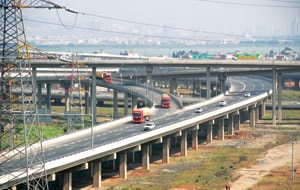 |
The second ring road is 64km long in Kunming City (Yunnan, China). |
Everyone thinks that China has a high population density because it has over 1.5 billion people. It turns out that in Yunnan Province, the density is much lower than many provinces in Vietnam's midland and mountainous regions. Yunnan Province covers 650,000 square kilometers (twice the size of Vietnam) but has a population only slightly more than half of Vietnam's (45 million people). We saw very few children along rural roads and in city parks. Ms. Hue, our Yunnan tour guide, explained that in China, family planning is taken very seriously. In rural areas, families can have two children, while in cities, it's usually only one. She has a 12-year-old daughter. Having more children would mean losing household registration, and not having household registration is like losing citizenship rights. Thanks to population planning, socio-economic development has been very rapid.
Yunnan is a mountainous province with many ethnic groups (25 minority groups). Its socio-economic ranking is 27th out of 34 provinces and municipalities. Recently, a minority ethnic group (Moso) of only 600 people was discovered living in a cave. They operate under a clan system; children have no fathers, only knowing their mothers and uncles. However, Yunnan is also a relatively economically developed province compared to many provinces in Vietnam. Its strengths, as recognized by China, include the development of the tobacco industry (two large factories, mainly exporting to Southeast Asian countries), the herbal medicine industry, and tourism.
Thanks to the cool climate and year-round sunshine of the highlands, as well as inheriting many traditional Chinese medicine healing methods from the Tibetan Autonomous Region, Yunnan is a famous source of raw materials and processed medicines in mainland China. Many multinational pharmaceutical companies are located here, such as Yongcheng Traditional Chinese Medicine Company, Baoshutang, and Huangchuan Gui Pharmacy and Clinic... They have a huge sales volume, especially catering to tourists. Many rare and precious herbs are found here, such as "Cordyceps sinensis." In winter it resembles a caterpillar, in summer it transforms into a plant, and it is said to cure... 99 diseases! Even cancer patients can be kept alive for years, and even bald people undergoing chemotherapy will have hair regrowth! Yunnan's Panax notoginseng and Ganoderma lucidum are said to have high concentrations of these herbs. Their price in Kunming is five times higher than in Sapa, Vietnam. Cordyceps is even more expensive, with each gram (three dried pieces the size of a chopstick tip) costing 398 yuan (over 700,000 Vietnamese dong). Rare and precious medicinal herbs are one of the factors that attract tourists.
But perhaps the stronger attraction lies in the fact that this place boasts a World Natural Heritage site (the Stone Forest) and a system of ancient temples and pagodas, containing many extraordinary achievements of ancient people. For example, the historical and cultural relics complex on Mount Xishan (including four temples and the Huading Temple); and the Tongjin Temple and Pagoda. It's considered extraordinary because Wu Laiqing, in 72 years, painstakingly carved a stone path to the mountaintop to express his love for his beloved, who committed suicide in Dianchi Lake. From the mountaintop, one can see Dianchi Lake (580 hectares), which occupies a large part of Kunming city; nearby, Huading Temple has a massive and vivid statue of Buddha and four saints. Tongjin Temple is equally large and constructed of copper (including the flag). It also displays artifacts of the famous historical figure Wu Sangui – considered to have contributed significantly to Kunming and Yunnan in the 17th century...
These historical sites and the Shilin Stone Forest have enhanced the city of Kunming, making it a popular tourist destination. The Shilin Stone Forest alone attracts millions of visitors annually (Yunnan receives 14 million visitors annually, primarily domestic tourists; Kunming is one of the top ten tourist destinations nationwide). Shilin is located just 58 km southeast of Kunming and is also a county (one of the city's four districts and eight counties). Tourism revenue in Shilin is 400 billion VND per year.
The road system, especially urban roads, national highways, and expressways, is still far behind many countries in the region. Expressways are four-lane, two-way; at intersections and beyond, there are overpasses. As a result, there are three or four levels of traffic at these junctions. On the expressways, you rarely see pedestrians or motorcycles traveling side-by-side. Currently, Yunnan has completed the 64km-long Second Ring Road around the city center and is proceeding with the construction of the 210km-long Third Ring Road. Kunming, with a population of 5 million, benefits from its excellent transportation system, experiencing minimal congestion and very few accidents. On the other hand, they also have a policy to restrict motorcycles in the city center. This restriction is achieved by offering cheap motorcycles (you can buy one for 5,000 yuan) but expensive registration fees (up to 15,000 yuan). Meanwhile, the city has a comprehensive, convenient, and punctual bus network.
One modern transportation project related to our country is the Trans-Asian Highway (expressway) from Kunming to Hekou (bordering Lao Cai province). This highway, 560 km long, has nearly 300 km completed, reaching Mengzi on National Highway 126. The old route from Mengzi to Hekou (270 km) takes 8 hours by passenger car, but the 300 km of expressway can be completed in less than 4 hours smoothly. They estimate the road will be completed in 2008, with the Kim Thanh bridge over the Red River being half-built on each side (Lao Cai province has already completed the Tran Hung Dao boulevard to accommodate this expressway, but is now working on the central road of the new urban area; this is due to their slow progress). Ms. Hue stated that the reasons for the delay are corruption and poor road quality (nearly 100 people involved in this Trans-Asian Highway project have been prosecuted and imprisoned).
The prospects for economic cooperation between Vietnam and Yunnan are very bright. At the end of October, Prime Minister Nguyen Tan Dung visited and worked in Kunming. Currently, besides the capital Kunming, cities along the Trans-Asian Highway such as Mengzi, Tonghai, Yuxi, etc., have many Vietnamese investors and students studying there. When this expressway is completed, the Hanoi-Kunming trip will only take a day (similar to the Hanoi-Dong Hoi trip), which will certainly lead to even stronger economic cooperation. In our province, we currently have the Nghe An Friendship Joint Stock Company, which is cooperating in tourism.
Hoang Chinh


