
The story of a general
(Baonghean) - Having served in the military for 50 years, participating in three wars, and facing death countless times, his life has been filled with both joy and sorrow. His memories are of fierce battles, the sounds of bombs falling and bullets flying, and the warm camaraderie of his fellow soldiers. His everyday life is filled with the joy of gathering with his children and grandchildren, and tending to his fish pond and vegetable garden. He is Nguyen Xuan Chi, a general who is about to turn 84…
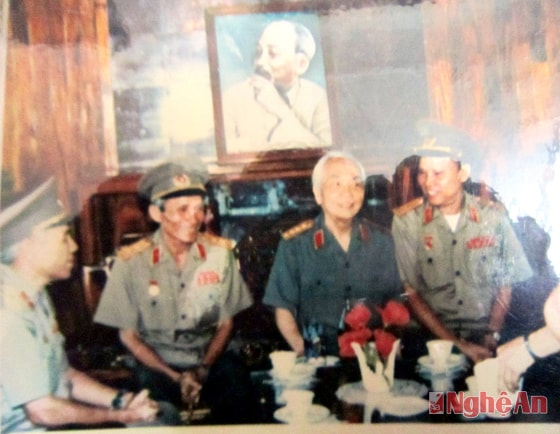 |
| Major General Nguyen Xuan Chi (far left) receives General Vo Nguyen Giap. |
When asked about the house of Major General Nguyen Xuan Chi, former Deputy Commander of Military Region 4, many residents of Doi Cung ward (Vinh City) enthusiastically pointed the way. His house isn't large, but there's enough land to grow a few vegetable patches, dig a small fish pond, and plant a few mango and pomelo trees to hang bird cages. At his age, tending to the garden has become a daily joy. His hair is white, but his gait remains quick and lively. “I have so many stories, mostly about fighting the enemy, marching, hardship, and sacrifice…” Indeed, with his memories, Major General Nguyen Xuan Chi could write a fascinating and substantial memoir!
Born into a family with a Confucian tradition in Truong Loc commune, Can Loc district (Ha Tinh province), young Chi was early enlightened by revolutionary ideals and received attentive education from his parents. He learned both French and Vietnamese, and was exposed to like-minded individuals and Party propaganda materials. Thanks to this, Nguyen Xuan Chi quickly became aware of the suffering of enslaved people and nurtured the aspiration and ambition to contribute to driving out those who sowed suffering and misery. At the end of 1949, the 18-year-old from Truong Luu volunteered to join the army and fight the French. From then on, the footprints of this soldier were imprinted on countless battlefields. Those feet crossed the Truong Son mountain range in 1950, a grueling six-month journey to fight the French in the southeastern region, facing daily hunger, disease, and wild animals. Nine years later, Vietnamese people followed in those footsteps, opening supply routes to the southern battlefields during the resistance war against the US to save the nation. The soldier's only possessions for the long march were a backpack, inside which were a notebook given to him by his older brother, a bottle of concentrated Quynh Luu fish sauce, and some dried rations. His sandals were broken, so he used woven bark to replace them. His torn shirt was mended with vines from the forest. Despite the hardships and difficulties, the soldier remained eager to advance; no one lost heart or became discouraged. After defeating the French, that soldier returned to the North for regrouping, and then went to Nghe An to work as a staff officer in the 31st Regiment (341B Division).
In 1966, fighting intensified on the other side of the 17th parallel. The 341B Division was ordered to march into Route 9 (Quang Tri) and Southern Laos to replace the 324th Division, which had withdrawn to consolidate its forces. From there, Nguyen Xuan Chi embarked on the long march against the Americans, directly confronting the enemy. His footsteps continued to leave their mark across the battlefields of Military Regions 4 and 5, and throughout the vast central region of Vietnam. These were truly arduous, fierce years filled with sacrifices, as the enemy possessed advanced weaponry while our troops faced immense shortages. Major General Nguyen Xuan Chi recounted the fierce battles in which his soldiers fought bravely and heroically. One such battle was the capture of Liet Kiem Hill (Da Nang), aimed at drawing enemy reinforcements to destroy them and expand the base area in 1972. As Chief of Staff and Deputy Commander of the 31st Regiment, he directly commanded the battle. With a strategy of surprise and boldness, coupled with thorough preparation and careful study of the terrain and geographical features, they quickly achieved victory, capturing a Lieutenant Colonel, the deputy provincial governor of Quang Chinh, and a Major, the battalion commander of the puppet army.
At the Nong Son battle (Quang Nam), he personally infiltrated the enemy base to scout, assess the situation, and develop a battle plan. After passing through six layers of barbed wire fences, on his way out, he tripped over a landmine. Fortunately, he only lightly touched it, not enough force for the enemy to detect and detonate it. On the day of the battle, thanks to the seamless coordination with the reinforced artillery unit, they achieved a resounding victory, catching the enemy off guard. In this battle, Nguyen Xuan Chi's unit eliminated two battalions (capturing nearly 600 enemy soldiers), and he was awarded the First Class Military Merit Medal. He then directly commanded many subsequent battles, achieving victories against the enemy. Among these, the Spring of 1975 is unforgettable, when Nguyen Xuan Chi, then Chief of Staff of the 2nd Division, commanded the unit liberating Tam Ky. The enemy panicked, abandoning their tanks and weapons to flee. Following orders from General Chu Huy Mân (then a Lieutenant General and Commander of Military Region 5), the 2nd Division divided into three columns to liberate Da Nang. Wherever our troops advanced, the enemy laid down their weapons, fled in disarray, and surrendered. The people of Da Nang welcomed the liberation army with flags, flowers, and fragrant, crispy bread. A few years later, his footsteps led him to the southwestern border, into Cambodia, fulfilling his international duty, defeating the Pol Pot regime and saving the people of that country from genocide. At that time, Nguyễn Xuân Chí was the Chief of Staff of Front 579 of Military Region 5.
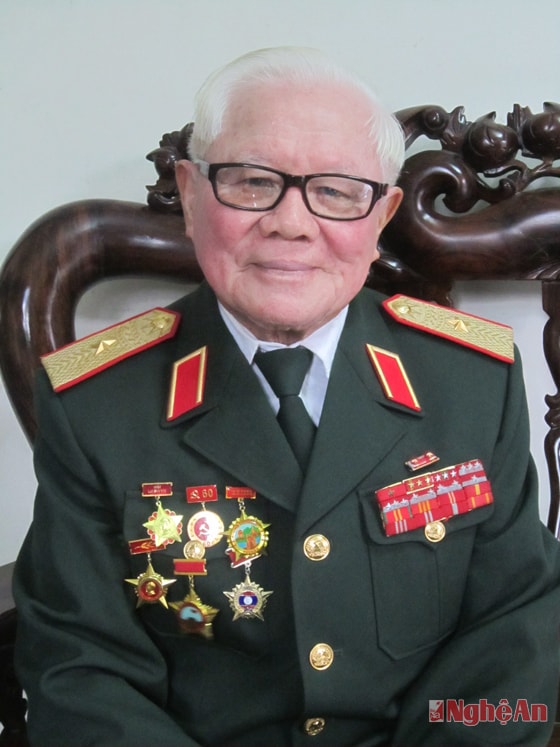 |
| Major General Nguyen Xuan Chi. |
In our conversation, Major General Nguyen Xuan Chi often mentioned his comrades and fellow soldiers, those who saved his life and allowed him to return home. One battle took place in 1970, when he was Deputy Head of Operations at Front 4 (Military Region 5). His unit was stationed halfway up a hill and was unexpectedly surrounded by the enemy. Everyone else went to the outer perimeter to fight the enemy, leaving only him and a guard behind at the command post. The enemy was numerous and was crossing a narrow wooden bridge to advance. He occupied the mound in front and prepared to fire. Sensing that the enemy might have spotted him, the guard signaled him to retreat. Immediately, his comrade was shot in the head and fell. Taking advantage of the enemy's artillery barrage and the thick smoke and dust, Nguyen Xuan Chi retreated to safety in a bunker. On another occasion, he led a special forces unit from the mountains and forests to fight in the plains of Dien Ban district (Quang Nam province). The battle ended just as dawn broke. There wasn't enough time to retreat to the forest, so they had to take shelter in a village until nightfall. Late that afternoon, the enemy discovered them and dropped bombs. One soldier used a dagger to dig a small bunker. Seeing the commander passing by, he pushed him inside and said, "There are many soldiers like me; I'm only afraid that if the commander dies, there will be no one to lead." Fortunately, he was only slightly wounded in the bombing. Later, when the unit retreated to the mountainous forest area of Da Nang and faced a food shortage, they had to mix rice with chopped forest plants to cook, making it very difficult to swallow. One day, returning from a mission, he was given plain rice by his comrades. He asked why, and they explained, "Seeing how thin and weak you are (at that time he only weighed 43 kg), we reduced our rice rations and contributed some to cook for you." The commander was so moved that tears welled up in his eyes, and he realized that the camaraderie and brotherhood were truly incomparable. According to Major General Nguyen Xuan Chi, all victories belong to his comrades, including those who perished on the battlefield or suffered lifelong injuries. At this point, his heart ached, his eyes welled up with tears, and the wrinkles on his face deepened. This was because, to achieve victory, his 2nd Division alone lost approximately 13,000 men, and about 12,000 became wounded.
And Nguyen Xuan Chi also had another stroke of luck: he had the opportunity to meet, interact with, and receive the kind guidance and instruction of top military leaders such as Vo Nguyen Giap, Pham Hung, Tran Van Tra, Le Duc Tho, Chu Huy Man, Le Duc Anh... In his eyes, they were truly excellent generals with compassionate and selfless hearts.
During his time in the army, preoccupied with battles, his parents back home arranged a marriage for him with a young teacher from the same village. Their love blossomed primarily through letters. The wedding took place in 1958, during a 10-day leave. However, they had to wait another four years for their first son to be born. The long, arduous journey of war meant that his wife, Nguyen Thi Mai, was constantly on the battlefield, and it wasn't until 16 years later that their second son was born. Despite decades of marriage, their time together could only be counted in days and months; his wife had to raise two children and manage her school and teaching duties. It wasn't until 1983, when he was transferred to the 4th Military Region Command, that he had the opportunity to be close to his wife, children, and family. When he finally retired and they could have enjoyed their old age together, she passed away from a serious illness. For the past 10 years, he has lived without a life partner, and although his children and grandchildren are around, they cannot fill the void in the old general's heart. But as someone who has fought in battles and faced life and death situations, he knows how to suppress his feelings and understand the laws of nature.
After seeing the guests off, the old general resumed his work tending to his vegetable garden and fish pond. I suddenly remembered his words: “Being a general is only for the battlefield; when you return to ordinary life, you are just an ordinary person like everyone else. That is my dream, my aspiration…” We also heard from the soldiers and comrades of Major General Nguyen Xuan Chi about the compassionate and benevolent heart of their commander. And we heard from the people in the neighborhood about the exemplary and dedicated nature of this elderly Party member and model citizen.
Cong Kien


