
Funny stories from the white rocky region
(Baonghean) - A day in the remote Nam Son area (Quy Hop), bordering Xieng My (Tuong Duong) and Binh Chuan (Con Cuong). It was delightful to hear the local farmers talk about the "Cattle Bank" project...
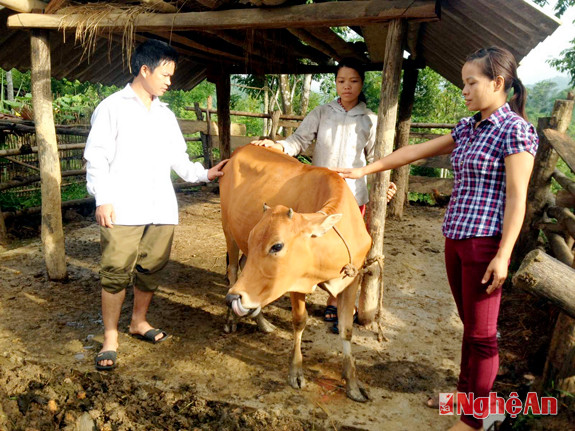 |
| The family of Mr. Vi Van Ngo and the Chairman of the Farmers' Association of Nam Son commune stand beside a breeding cow that was raised with funding from the "Cow Bank" project. |
Just like the "Golden Rattle"
"Oh! Just like the 'Golden Bell' program on TV..." - Mr. Lo Van Huyen, 60 years old, from Quang village, gently stroked his newborn calf with its glossy, velvety golden coat, and began his story with a warm smile. About two months ago, Mr. Lo Van Huyen was informed by the commune's Farmers' Association about the "Cattle Bank" project, implemented by the district's Farmers' Association. Through this, he learned that the district's Farmers' Association would train the people on how to raise the local golden cattle breed, including disease prevention and barn construction. More importantly, selected households would receive a loan of 16,625,000 VND (interest-free) to buy and raise a breeding cow. The project would run for two years; after that, the cow would be returned or the principal amount repaid, and the Association would transfer it to another family. "Previously, I also raised local yellow cattle. After one of them died in an accident, I didn't have the capital to raise another. We have nearly 2 hectares of planted forest, plenty of grass, and my wife and I are still healthy, so it's a real shame we don't have any cattle to raise. When I learned about the 'Cattle Bank' loan program, I was so excited that I immediately applied. The District and Commune Farmers' Associations came to my house to inspect, found my request legitimate, and since I had some experience, they approved my participation..."
According to the implementation schedule of the "Cattle Bank" project, the funds for the households in Nam Son are not due until early September. Because he had been waiting for this for so long, and because he was so excited, Mr. Lo Van Huyen found and bought a mother and calf pair of cows on credit from a family in Ham village, less than 1km from his house, for 18,500,000 VND. He used a measuring tape to determine the mother cow's chest circumference, height, and body length to calculate its weight, then said: "The project requires the cows to be of reproductive age, have the required height and weight, and be local cows from the same commune. I've met all these criteria. I'm so happy, I just hope the money comes in so I can pay it back..." And he said emotionally, "The 'Cattle Bank' project has many great goals. But what's important to my family is that having breeding cows provides us with employment and income. Our local cows are easy to raise, highly disease-resistant, and their diet consists only of grass and plants; they give birth once a year. I expect to have two calves and one adult cow after the project is completed. I will build barns and take good care of the cows to ensure the project is implemented successfully..."
In Ham village, the story of the "Cattle Bank" project and the purchase of a pregnant cow worth 18 million VND on credit by the family of Vi Van Ngo (1979) is being discussed quite enthusiastically. Vi Van Ngo got married in 2005. With 1,500m2 of rice paddies and 3,000m2 of garden land, thanks to hard work and raising pigs and chickens, Ngo and his wife, Lo Thi Huong (1986), gradually built a house and bought a buffalo. Like Mr. Lo Van Huyen's family, after hearing about the project, he immediately registered. Recognizing them as a young couple with ambition, who could become a model for household economic development, the Farmers' Association selected them to participate in the project. Knowing they were selected, Ngo was overjoyed and immediately discussed with Huong about finding and buying a cow on credit. Ngo said he had raised cattle before and developed them very well. However, to have a stilt house for his "wife and children to live in," he had to sell them. According to Ngo, "I plan to try to keep the mother cow. Raising yellow cows in my hometown isn't complicated. Moreover, now that I've been guided on building barns, caring for them, and preventing diseases, I feel even more at ease. The cow I bought is almost due to give birth. After raising it for the full two years, it will give birth two more times. By then, the first calf will be mature, and I will sell it to repay the principal to the Association..." Ngo's calculations, according to Nam Son officials, are not just "counting crabs before they hatch." Ms. Luong Thi Hong, President of the Nam Son Farmers' Association, happily remarked, "Ngo says it and does it. Not every young family is as dedicated as Ngo and Huong!"
To empower the people.
The Chairwoman of the Nam Son Farmers' Association, Luong Thi Hong (30 years old), jokingly said that Nam Son has 99.9% Thai ethnic minority population, with a natural area of over 6000 hectares, but only 73 hectares of agricultural land. The rest is forest and mountains. The vast forests and towering green mountains connect with Xieng My and Binh Chuan, becoming part of the Pu Huong Nature Reserve. Therefore, raising buffalo and cattle to develop the household economy has been a source of livelihood and has been associated with the people here for generations. However, due to outdated farming methods, such as free-range grazing and even self-feeding, the economy remains underdeveloped and faces many difficulties. Out of over 330 households in the commune, only 155 own buffalo and cattle. Therefore, the "Cattle Bank" project is truly very significant.
With investment from the District People's Committee, the District Farmers' Association has developed a project aimed at helping families develop their economy, while also preserving the genetic resources of the local yellow cattle breed and strongly developing the cattle herd. Many families in Nam Son want to participate in breeding cattle. However, with an initial budget of 300 million VND, only 16 households were selected. "According to the Association's directive, the first criterion for selection was families with a strong desire to develop their economy. Special attention was paid to newly established young families with aspirations. Because so many families applied, the selection process was very difficult. The Association selected 64 households. The first 16 households implemented the project for 2 years, then the project was passed on to the next 16 households, and so on until the last 16 households. The project cycle is 5 years..." - Luong Thi Hong revealed.
"Are there any concerns in implementing the project?" I asked, and the Chairman of the Nam Son Farmers' Association shook his head slightly: "I'm overjoyed, there's nothing to worry about. As Mr. Huyen and Mr. Ngo said, the breeding cows were purchased locally, are accustomed to the terrain and soil, are well-suited to the climate, and have access to natural food sources like leaves, vegetables, and grass in Nam Son. Moreover, consumers highly appreciate Nam Son beef, so there's no fear of a lack of market demand. Before implementing the project, district officials provided thorough training on breeding methods and disease prevention. The district will soon conduct quality checks on each family's cows, and only those meeting the standards will receive payment. The breeding process will continue with monitoring and assistance as needed. I only hope that the district will allocate more funding annually to expand the 'Cow Bank' project so that more families can participate in breeding cows..."
The "Cattle Bank" project of the Quy Hop District Farmers' Association details the specific characteristics of the local yellow cattle breed. Quy Hop yellow cattle are smaller than hybrid cattle. They have smooth coats, thin skin, a light head, and a moderately developed body, with adult cattle weighing a maximum of 200-250 kg. Their high-quality meat makes them economically valuable. The project also mentions Resolution No. 10 of the District Party Committee, affirming the need to leverage the existing potential of the locality, prioritizing the development of large-scale native livestock farming to create distinctive, high-quality products with high prices, bringing economic benefits to the people, while simultaneously protecting the valuable genetic resources of the yellow cattle breed.
I accompanied engineer Ngo Van Quyen from Yen Thanh, a rice-growing region, to inspect the quality of breeding cows at several families' farms in Nam Son. I listened as the Vice Chairman of the Quy Hop Farmers' Association instructed them on building barns, from raising the foundation and roofing to constructing waste pits and planting banana trees around them, ensuring hygiene, warmth in winter, coolness in summer, and a reserve of feed. I also heard Mr. Nguyen Que Hung, Chairman of the District Farmers' Association, recount the origins of the project and future plans for developing the "Cow Bank." It turns out that not only the Farmers' Association but also the Women's Association were assigned by the district leadership to implement this program. The Quy Hop District People's Committee allocated 600 million VND from its budget to carry out the project. With this amount, 32 households participated. The Quy Hop Women's Association chose Bac Son commune (next to Nam Son commune) to implement the project. Mr. Hung affirmed: “Officials from both associations will closely monitor and assist families to ensure the successful implementation of the project. Annually, the district will evaluate the results, and then we will propose to the district leadership to consider supplementing funding to further expand the 'Cattle Bank'...”
Watching how Mr. Quyen interacted with the people, listening to Mr. Hung's thoughts, I suddenly pictured the kind-hearted farmer from Nam Son commune with his saying, "Like the 'Golden Bell' program on television...". I've watched the 'Golden Bell' program on VTV1 many times, and each time I witnessed the scene of people giving cows, people receiving cows, the program organizers, and the audience... all shedding tears of joy. And I thought, the feelings of the people participating in the "Cow Bank" project in Nam Son and Bac Son, and those implementing the project, must be similar. This made me think about the national target program for building new rural areas. Although the government has shown interest and provided investment support, for success, the prerequisite is to unleash the people's internal strength. What can be done to empower the people? The "Cow Bank" project is a good approach. And, we need many more similar programs and projects!
Text and photos:Nhat Lan


