
"There's a way for our village to become more prosperous."
Despite being a hardworking farmer burdened with worries and hardships, when the new rural development movement was launched, Mrs. Lang Thi La (born in 1932) in Duong Le hamlet, Nghia Dung commune (Tan Ky district) performed a very noble act: she donated 5,000 square meters of land to the State for road construction.
(Baonghean)Despite being a hardworking farmer burdened with worries and hardships, when the new rural development movement was launched, Mrs. Lang Thi La (born in 1932) in Duong Le hamlet, Nghia Dung commune (Tan Ky district) performed a very noble act: she donated 5,000 square meters of land.2Land allocated to the State for road construction.
Holding the list of exemplary individuals in Tan Ky district who have studied and followed Ho Chi Minh's moral example, the district Party committee leaders concluded: "Our people are so unique and precious! That preciousness and uniqueness all stem from their voluntary spirit, exemplified by the act of donating land for road construction. The donation of 5,000 square meters of land by Mrs. Lang Thi La is a prime example of donating land to the locality for the construction of new rural roads. And the story of Mrs. La's land donation is as long as the road for transporting materials that runs through Duong Le hamlet, crossing Khe La hill, which the district invested in building a few years ago. Without the people's support and participation, who knows when this project would have been completed? And who knows when the nearly 40 out of 120 households in Duong Le hamlet, living in isolation in the Khe La mountains, would have been freed from the constant struggle of wading through streams year-round?"
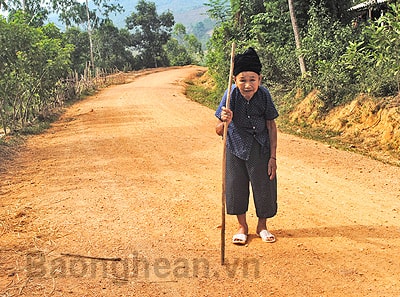
Ms. Lang Thi La proudly walks on the road that she and many families in the neighborhood donated land to build.
The reality in Duong Le hamlet is that the fields are barren, and land is scarce. Therefore, the villagers struggle to make ends meet, let alone contribute to rural development. They also believe that building roads for the people is the responsibility of the State, and that forcing people to donate land for such projects would be the mark of the State.
Many times, Mrs. Lá thought, if she hadn't donated her land, she didn't know when her children and grandchildren would have a decent road to travel on. For a long time, the villagers had been using a narrow path, which was extremely difficult during the rainy season. Without a road, harvesting rice and potatoes was also hard, and after cutting down the acacia trees, they had to sell them cheaply because of the difficult road conditions. So when the government launched a campaign to encourage people to donate land for roads, Mrs. Lá volunteered immediately.
Seeing people come to measure and mark boundaries right up to her house and the hillside where she had planted acacia and eucalyptus trees for so long, Mrs. Lá felt very regretful. She had been attached to this land for so many years, planting trees and raising her children, and now she had to cut down the trees so that machinery could come in to excavate, level, and bulldoze. Her eight children felt sorry for her, but seeing that their mother had made up her mind, they let the people do their work. Mr. Ngân Văn Tân (the head of Dương Lễ hamlet), sitting next to me, said: “Who wouldn’t feel regret? A farmer who doesn’t regret their land is essentially giving it up. Just as people in the lowlands cherish rice paddies, people in the highlands cherish orange trees, pomelo trees, acacia, and melaleuca trees. It’s a real shame, but if everyone regretted it and refused to give up their land, where would the road be built?”
The entire road, nearly ten kilometers long, stretched through Duong Le hamlet deep into the mountains, with many sections requiring the clearing of the mountain slopes. Before long, the entire acacia and eucalyptus forest was transformed into a wide, beautiful, and smooth road, looking quite impressive. Families who had lived in isolation behind Khe La hill for so many years now had a road, and many bought motorbikes for transportation. Because Mr. La donated the most land, many people call this road "Mr. La's road."
Looking at her family circumstances, no one would guess that Mrs. Lang Thi La is the person who has donated the most land in Tan Ky district since the government launched the nationwide movement to build new rural areas. Her husband passed away more than 20 years ago, leaving her alone with 11 sons and daughters; her eldest son was killed in action (she is the mother of a fallen soldier). For many years, she has suffered from a skin disease, and despite seeking treatment everywhere, she hasn't found a cure. Now she lives with her youngest son, and their circumstances are still difficult. Despite all this hardship, when commune and district officials came to explain the reason for donating land to the government for the construction of a raw material supply road, she immediately agreed without asking for anything in return. At this point, she proudly mentioned that the district recently presented her with a certificate of commendation for her achievements in "Studying and following the moral example of Ho Chi Minh."
Now, when the topic of land comes up, Mr. Lá still feels regret. But then he thinks this way: We're poor, so be it. If we suffer a little loss, who knows, maybe with a road, our people can become more prosperous. The donation is for our children and grandchildren, for the future of Dương Lễ village.
Mr. Ngan Van Tan said that to have this road for building materials, 14 families in the hamlet donated more than 14,000 square meters of land. After completion, this road will also serve as the main access route for the villagers. In the near future, with the support of cement from the State in the new rural development program, Duong Le hamlet will propose to the higher authorities to pave this road with concrete.
Text and photos: Xuan Hoang


