
A preschool teacher in a H'Mông village.
Huoi Tu commune in Ky Son district, Nghe An province, with nearly 100% of its population being ethnic minorities, mainly H'Mong, Khmu, and Thai people, is considered one of the poorest areas in Vietnam today. The lives of teachers in the mountainous Huoi Tu area are also fraught with difficulties, especially preschool teachers.
(Baonghean.vn) -Huoi Tu commune in Ky Son district, Nghe An province, with nearly 100% of its population being ethnic minorities, mainly H'Mong, Khmu, and Thai people, is considered one of the poorest areas in Vietnam today. The lives of teachers in the mountainous Huoi Tu area are also fraught with difficulties, especially preschool teachers.
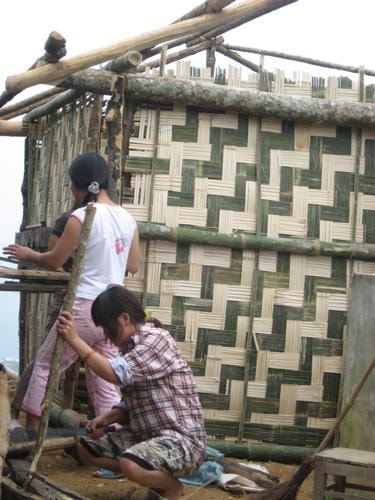 |
The journey of spreading literacy includes building classrooms and schools in remote mountainous areas. |
The teacher set up the class herself...
The Huồi Tụ commune kindergarten, newly established in August 2001, was built on the highest hill in Huồi Đun village. We arrived just as the teachers were constructing the kitchen. The kitchen was quickly completed in one afternoon. It was just a small cooking shed covered with a roof and enclosed by bamboo panels.
"The teachers are taking advantage of the weekend, Saturday, to 'work on building infrastructure'," Vice Principal Nguyen Thi Hai happily shared. Seeing them doing strenuous work that shouldn't be for women, we couldn't help but feel concerned. I asked why they didn't ask the village youth union for help. Teacher Tran Thi Anh looked at me sympathetically. "Perhaps you're from the lowlands and don't know. It's not that the ethnic people here don't want to help. But it's harvest season, and most of them are out in the fields until late at night."
Every year, these frail and delicate teachers have to build or renovate classrooms for the children themselves. Many of them are from lowland districts but have been long-time residents of Ky Son, such as Ms. Nguyen Thi Hien, originally from Do Luong district and currently the principal of Huoi Tu Kindergarten. She has worked in Ky Son for 12 years, and for all those years, she has had to build makeshift shelters so that she and her colleagues have a place to teach.
At the beginning of each school year, the villagers in the hamlets participate in a labor effort to build classrooms for their children. This has become a tradition, and the teachers always work alongside the villagers. However, classrooms built with thatch, bamboo, and leaves often deteriorate quickly, and repairs must be undertaken by the teachers. Ms. Tran Thi Anh, who has been teaching in Ky Son since 2003, couldn't hold back her tears. She said, "Sometimes when it rains, the roof leaks, and I feel so sorry for the children, so the teachers help each other climb up to repair the thatched roof." Ms. Anh's house is in Con Cuong district, nearly 160 km from the Huoi Tu kindergarten. She has to bring her 4-year-old daughter along to help care for her while also being able to focus on teaching the young children in the hamlet. Ms. Anh continued, "I'm still relatively lucky. The hardest thing here is probably Ms. Hai and Ms. Hien, the principals. Ms. Hai's husband and children are in Anh Son, and Ms. Hien's family lives far away in Vinh City. Sometimes they only get to visit their husbands and children once every six months."
...And "bring" students to school.
Ms. Hai, originally from Long Son (Anh Son - Nghe An), has been working as a childcare provider in Ky Son since 1999. When she first came to Ky Son, she had to work very hard to adapt to the terrain and climate of the high mountains, which are often cold at night and early morning, and intensely hot at midday. In some winters, the temperature drops close to 0°C.0On such cold days, the children can't even come to class. Winters here are usually rainless, and the teachers have to carry water from lower areas just to have something to cook with. Despite these hardships, the teachers remain determined to stay in the profession.
Ms. Hai confided, "I'm getting older. And I realize that teaching suits me best, so even though I know it's difficult, I have to stick with it for life." Usually, without anyone telling them, every morning they have to get out of bed at the second rooster crow, cook breakfast, and then head down to the villages and hamlets around 5:30. Each village is 5 to 6 km away from the main base through the forest. The Huoi Thang village base, run by Ms. Vi Thi Tam, is 8 km away from the main base. Ms. Tam told us, "Going to teach so far away makes me discouraged. I'll probably have to buy a motorbike soon. I've been walking for three years now. The roads are really hard, but having a motorbike would make it less tiring. But I'm hesitant to buy a motorbike. My monthly salary is almost 2 million VND, but the price of gasoline is so high now. I'm just afraid I won't be able to afford the gas."
 |
We have to carry water for daily use from the foot of the mountain. |
One reason why the kindergarten teachers in Huồi Tụ have to arrive at the school early is because they have to go to each house in the village to pick up the children and bring them to class. If they don't go to pick them up, the children will stay at home instead of going to class. The villagers are used to the sound of the kindergarten teachers calling the children to school every morning. Many families only let their children go to school when the teacher comes to call them. This has become a common practice in Huồi Tụ commune. Ms. Vi Thị Tắm recounted her experience when she first started at the Huồi Thăng school. One day, she gathered all the children at the end of the village and went to call the children at the beginning. When she returned to the classroom, there wasn't a single student left. She had to go to each house to talk to the parents before the children would agree to go to school. One 5-year-old child named Muế Chơ, a Khơ Mú ethnic minority, casually said, "That's not my teacher, I'm not going with her." It turned out the children were not yet used to the new teacher.
Our conversation had to stop because it was time for the teachers to go fetch water. Two of them carried 20-liter plastic containers down to the lower streams to bring back water for dinner. Only Ms. Tran Thi Anh remained with us. She confided, "It's so lonely here, gentlemen. But I can't leave, partly because although the job is a bit hard, it's relatively stable, and partly because I feel so sorry for the children here. Most of them come from difficult circumstances; their parents spend all day in the forest and have no time to care for them. Being here with my colleagues to raise these children is also contributing to doing the work of their parents."
On that stormy October evening, we said goodbye to the kindergarten teachers of Huoi Tu commune and returned to the lowlands with a hopeful expectation: that soon a paved road would be built to the center of the commune, and that the teachers and students of Huoi Tu kindergarten would no longer have to teach and learn in thatched huts. This was also the dream not only of the 19 kindergarten teachers of Huoi Tu but of all the people in this mountainous commune.
Ha Phuong


