
An opportunity to affirm the brand and quality of training.
In mid-June, the Vocational School of Economics, Industry and Handicrafts held a competition for self-made vocational training equipment. The competition provided an opportunity for schools to exchange ideas, learn from each other, and update their teaching methods with new and advanced equipment.
(Baonghean)In mid-June, the Vocational School of Economics, Industry and Handicrafts held a competition for self-made vocational training equipment. The competition provided an opportunity for schools to exchange ideas, learn from each other, and update their teaching methods with new and advanced equipment.
As a provincial-level competition held every three years, the meticulous and elaborate preparation of the participating units is evident. With 47 entries from 9 vocational schools across the province, this year's competition brought together many schools with a tradition of high-quality vocational training, such as: Vietnam-Korea Industrial Technical College, National Defense No. 4, Vocational College of Economics, Industry and Handicrafts, Vietnam-Germany Technical Vocational College… The entries focused on key vocational fields such as welding and automotive technology; refrigeration technology, fine art woodworking, fashion design, agriculture; electrical and electronics technology, etc. To reach this competition, the contestants had to go through rigorous selection processes at the grassroots level. The Vietnam-Korea School even organized a large-scale competition to select the best entries for the provincial-level qualifying round.
At the welding and automotive technology equipment competition area, the team of teachers Phan Van Lien, Nguyen Quang Quynh, and students from the Mechanical Engineering Department of Viet Duc Technical Vocational College were very satisfied with the "HL380 Lathe Tool Speed Box" model that they had diligently designed for nearly two months. The model not only facilitates teaching for teachers but also allows students to easily visualize typical machine parts, especially in their training fields: metal cutting, mechanical equipment maintenance, and mechatronics.
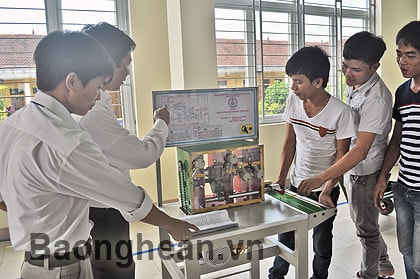
This is the competition entry model from Viet Duc Vocational Technical College.
The "Vehicle Electrical System Display" model submitted by a group of four students from the Automotive Technology department of the Vietnam-Korea Vocational Technical College also made a good impression on many people. This was partly because the "equipment" competition, which is usually for lecturers and teachers, featured a product entirely made by the students themselves. Nguyen Cong Nguyen, the group leader, said: "The idea for this device stemmed from our practical learning experience. We wanted a visual device that could help students understand the overall operating principles of the systems. This is especially important in the automotive assembly and repair industry, because it's difficult to learn effectively if you only imagine the details without seeing, examining, and analyzing each system and machine in detail."
Participating in this competition also gave me and my classmates a chance to review our three years of study at school. I also gained some extra points to be considered for a position at Hung Nghiep Formosa Ha Tinh Steel Company Limited.” Teacher Nguyen Trong Thuyen – Head of the Mechanical Engineering Department – College of Vocational Technology No. 1, author of the work that won second prize nationwide in 2005, said: “The technical skills and level of the contestants have improved significantly compared to previous years, with the strongest fields of study such as automotive technology, electrical engineering, and electronics being the most competitive…”
Observing the judging panel's evaluation sessions also clearly demonstrated this, as each of the 47 entries possessed unique characteristics and advantages. Mr. Cao Danh Chinh – Head of the judging panel – commented: “Compared to previous years, this year's entries show a breakthrough in technology, and the devices' applications are broader, fully meeting the criteria of the current trend of integrated teaching. The judging panel had a very difficult time selecting the outstanding entry.”
As a province with 62 vocational training institutions, the competition for self-made vocational training equipment is an important opportunity for schools to promote the creativity of both collectives and individuals, effectively maintain the emulation movement of good teaching and good learning, and contribute to improving the quality of vocational education. With dozens of entries in each round, including many winning first and second prizes at the national level, the quality and effectiveness of the provincial-level competitions for self-made vocational training equipment are evident.
However, alongside these achievements, a frank assessment of the competition reveals several existing problems. These include a low number of entries and a limited number of participating schools, representing only 1/6 of the total number of vocational schools in the area. The absence of established schools such as the College of Tourism and Commerce, Vinh Vocational School of Economics and Industry, Nghi Loc Vocational School, Bac Nghe An Vocational School, and the Ethnic Minority Vocational School in the mountainous regions demonstrates a lack of responsibility on the part of these schools.
It's time for clear regulations, a rigorous system of documents to define the participants, or serious action, as Mr. Bui Nguyen Lan - Director of the Department of Labor, Invalids and Social Affairs - stated at the opening ceremony: Schools that do not participate in the competition should reconsider their year-end performance rankings and review their priorities and budget allocations… Mr. Nguyen Xuan Phuong - Principal of the Vocational School of Economics, Industry and Handicrafts - confided: “Participating in the competition only brings ‘gains’ and not ‘losses,’ because even if we don’t win, teachers will have the opportunity to systematize their knowledge, participating students will have a chance to gain experience, and the school will have a useful model to help make teaching and practice more effective and high-quality.”
Text and photos: My Ha


