
Opportunities for near-poor households to access credit.
(Baonghean) - Nghe An province has a relatively large number of near-poor households, with over 109,000. Decision No. 15/2013/QD-TTg dated February 23, 2013, of the Prime Minister on the credit program for near-poor households has helped people in the province develop their economy, increase their income, and improve their living standards.
(Baonghean) - Nghe An province has a relatively large number of near-poor households, with over 109,000. Decision No. 15/2013/QD-TTg dated February 23, 2013, of the Prime Minister on the credit program for near-poor households has helped people in the province develop their economy, increase their income, and improve their living standards.
Since receiving a 20 million VND loan from the Social Policy Bank of Cua Lo for near-poor households, Ms. Nguyen Thi Lien, residing in Block 3, Nghi Thuy Ward (Cua Lo Town), has been able to purchase a freezer to preserve fish, ensuring she has a steady supply to sell at the market every day. Now, she hires two additional workers to assist with processing, cutting, washing, and grilling the fish. Ms. Lien proudly shared: “Thanks to the government's credit program for near-poor households, my family received a 20 million VND loan. Although it's not a large amount, it's incredibly meaningful to us. Before, without a freezer, our business was unstable because we depended on the sea. Now, with the freezer, on calm days, I buy a lot of fish to preserve so that when it rains or the sea is rough, I can still have a consistent supply of goods to sell, increasing my family's income.”
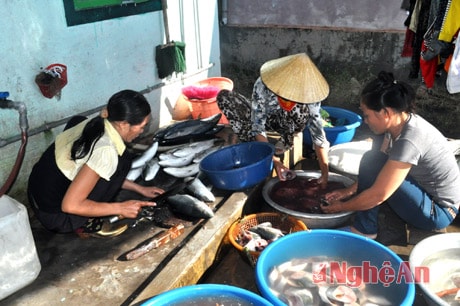 |
| Ms. Nguyen Thi Lien's household in Nghi Thuy ward (Cua Lo town) processes seafood. |
Mr. Le Quang Trung, Director of the Social Policy Bank of Cua Lo, said: Currently, Cua Lo has the highest outstanding loan balance for near-poor households in the province. By the end of October, nearly 20 billion VND had been disbursed to 768 households, with an average loan amount of 25.9 million VND per household. This capital has basically met the needs of near-poor households in the area. The borrowed capital has been invested by people in developing livestock and poultry farming and trading in dried and fresh seafood, contributing to stable income for each household and helping them gradually improve their lives.
Thanh Chuong is a low-lying mountainous district where the lives of the people mainly depend on agricultural production and livestock farming, so many difficulties remain. The entire district currently has 13,258 near-poor households, accounting for 22.5%, of which 10,029 households need loans. Following the issuance of Decision No. 15 by the Prime Minister on credit for near-poor households, the Social Policy Bank of Thanh Chuong district advised the district to send official letters to 40 communes and towns throughout the area to survey the loan needs of near-poor households. When this program was implemented, the people were very enthusiastic.
Ms. Nguyen Thi Nhung, residing in Long village, Thanh Linh commune (Thanh Chuong district), received a 10 million VND loan from the near-poor household credit program. Her family invested in building a biogas digester and raising 10 pigs for meat and 2 sows. Ms. Nhung shared: "As a farming household, our lives depend on three acres of rice paddies, working year-round just to make ends meet, a very difficult life. Thanks to the loan, my family invested in livestock development, utilizing agricultural by-products to reduce feed costs. If things go well, we can raise 3-4 batches of pigs per year, earning a profit of about 10 million VND per year after deducting expenses, providing additional income to support our three children's education."
Ms. Tran Thi Nhung, an official of the Women's Union of Thanh Chuong district, said: "By October, 276 female members in the district had received loans for near-poor households totaling over 6.3 billion VND. The demand for loans from members is very high, but the available funds are insufficient. Since Decision 15 was issued, people have been eager to access capital to develop their family economies and achieve sustainable poverty alleviation. The lives of the people in Thanh Chuong mainly depend on agricultural production. If they only cultivate crops, it is not enough to support their lives. People urgently need capital to develop livestock farming and increase their income, so they are very eager to borrow more capital. Given the limited capital resources, we have to balance our efforts appropriately to create conditions for many women to access the funds."
Previously, near-poor households in Thanh Chuong had no access to loans. Now, with access to capital, people are confidently investing in production development. This capital has had a positive impact on newly lifted-out-of-poverty households, as the boundary between poor and near-poor households is very fragile; a single natural disaster can easily turn a near-poor household into a poor household.
Mr. Le Huu Suu, Director of the Social Policy Bank of Thanh Chuong District, affirmed: By the end of October, the Social Policy Bank of the district had disbursed 18 billion VND to nearly 800 near-poor households, with an average loan amount of 23 million VND per household. However, to ensure the effectiveness of loans to near-poor households, local Party committees and authorities have paid attention to job orientation, integrating agricultural and forestry extension programs, and guiding loan-borrowing households on how to develop their businesses. This is to make the preferential government capital a driving force, helping near-poor households improve their living standards, effectively exploit their potential and strengths, and contribute to accelerating poverty reduction in the locality. In addition, during the lending process, the bank and local authorities at all levels, as well as relevant organizations, regularly inspect and closely monitor the effectiveness of capital utilization in each household, and guide households to use the capital for its intended purpose. Near-poor households have the ability to work, so they are in a position to use capital effectively.
By early November, along with Cua Lo town and Thanh Chuong district, many localities in the province had simultaneously disbursed funds for near-poor households, such as Hung Nguyen with outstanding loans of 17.7 billion VND, Do Luong 19 billion VND, Dien Chau 18 billion VND, Yen Thanh 17 billion VND, and Quynh Luu 14 billion VND… The total outstanding loan balance for the entire province was 246 billion VND, with 10,671 households borrowing capital, averaging 23 million VND per household. However, the proportion of loan capital for near-poor households is still very small compared to other programs, accounting for only over 4% of the total loan capital of the Nghe An branch of the Social Policy Bank, and only 12.3% compared to loan capital for poor households. Although the Government pays great attention to near-poor households, given the relatively short timeframe and limited central government funding, the investment in Nghe An at this level is not insignificant compared to the national average.
Mr. Hoang Son Lam, Head of the Credit Operations Department of the Social Policy Bank of Nghe An, stated: According to central government directives, localities where the demand for loans to poor households has reached saturation (based on a practical review and with the agreement of the Head of the District-level Board of Directors) may consider transferring a portion of the loan capital intended for poor households to near-poor households. Due to limited capital, the selection of eligible borrowers is carefully considered. In 2013, the projected loan amount for near-poor households in the province was 745 billion VND, but by the end of October, only 33% of the people's capital needs had been met. From now until the end of the year, the Nghe An branch of the Social Policy Bank is requesting an additional 34 billion VND from the Vietnam Social Policy Bank, and the provincial branch is allocating 15 billion VND to continue disbursing funds promptly to the people. However, under current conditions, the loan capital for near-poor households cannot yet meet the needs of the people.
Previously, while poor households benefited from many preferential policies, especially credit incentives, near-poor households did not receive such preferential access to loans, even though their lives were not much better than those of poor households. Therefore, when they gained access to capital, near-poor households had the opportunity to develop their family economy, increase their income, and stabilize their lives. Currently, the interest rate for loans to near-poor households has been adjusted down by the Government to 0.78%/month, creating more favorable conditions for near-poor households to reduce borrowing costs and confidently invest in production development, creating more material value for their families and society.
Gia Trang


