
With the arrival of "support pigs," poverty will go away.
The mentality of waiting and relying on others is a major obstacle for mountainous localities, and Tuong Duong district is no exception. To achieve sustainable poverty alleviation, the requirement is to support poor households while simultaneously encouraging them to be diligent and self-motivated in their work. One way to address these requirements is to provide support, such as lending livestock like pigs, cows, and goats.
(Baonghean)The mentality of waiting and relying on others is a major obstacle for mountainous localities, and Tuong Duong district is no exception. To achieve sustainable poverty alleviation, the requirement is to support poor households while simultaneously encouraging them to be diligent and self-motivated in their work. One way to address these requirements is to provide support, such as lending livestock like pigs, cows, and goats.
Following Mr. Vi Thanh Tung, Vice Chairman of Luu Kien commune (Tuong Duong district), we visited the family of Ms. Vi Thi Bua in Con Muong village – a model of raising black pigs to escape poverty. Ms. Bua tapped a bucket, and a herd of several dozen pigs, large and small, ran out of the pen. She said: In August 2012, her family was lent two female pigs, each weighing about 20 kg, and received support in the form of three rolls of B40 steel. Her family built a pen and used the B40 steel to fence it off, creating a sturdy livestock farm.
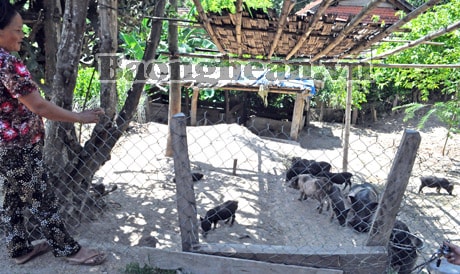
Ms. Vi Thi Bua (Con Muong village - Luu Kien commune) and her herd of black pigs that have been bred.
from pigs provided as a form of support.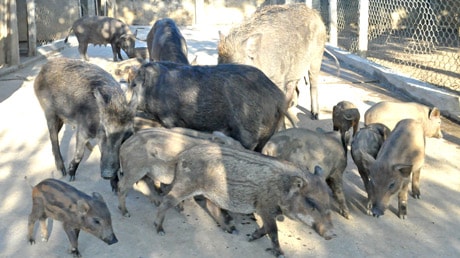
The wild boar herd raised in captivity by Mr. Tong Van Chien's household (Bai So, Tam Quang).
Through research, meetings, and surveys of the aspirations of several poor households, agencies, and units, the majority of opinions suggest that in Tuong Duong currently, the model of supporting pig farming in confinement is the most suitable approach. This is because the model of pig farming in confinement has proven successful and gained the trust of the local people. This model is also easy to implement, and experience can be learned on the spot from families who have already adopted it. Furthermore, the investment level for supporting piglets is also suitable for the capabilities of many agencies, units, and even individual officials and Party members. Each 20kg piglet costs around 2 million VND, a price "within reach" for organizations and individuals to participate. |
Since then, her family has had a herd of 17 black pigs. Currently, the market for black pigs is very favorable; pigs of any weight can be sold, with a price of over 100,000 VND/kg at the farm. Ms. Bua said that because the pigs are raised in confinement, they grow quickly, diseases can be monitored, and hygiene is ensured. Not only Ms. Bua's family, but currently in Luu Kien, there are 18 households implementing the black pig farming model and 6 households implementing the black pig-wild boar hybrid model, which has brought efficiency and helped households escape poverty.
Mr. Tong Van Chien, residing in Bai So hamlet (Tam Quang commune), owns a farm with a spacious area, a solid concrete embankment, and a convenient water pumping system for the pig pens. From the initial three wild boars he borrowed (received on May 7, 2011), his herd has now gone through three breeding cycles. After returning the three breeding boars to the commune and successfully harvesting the first two cycles, his herd currently numbers 31 pigs. Mr. Chien stated that even when raised in captivity, the meat of wild boars is still highly sought after and easily marketable. Wild boars are easier to raise than black pigs, are less prone to disease, and mainly eat bananas, vegetables, and rice flour mixed with water – not requiring cooked feed like black pigs. Their commercial value is high, ranging from 190,000 to 210,000 VND per kilogram.
In June 2012, Mr. Chien decided to raise goats, and his herd now numbers 12. Along with that, he utilized livestock waste to improve his poor garden and rice paddy land, planting watermelons, dragon fruit, and other crops. Thanks to this, his family's income is now sufficient not only to cover the tuition fees for his three children attending university and college, but also to save up for home renovations and modern conveniences. Mr. Chien confidently stated that he has not only overcome poverty but can now even consider becoming wealthy through diversified farming.
“Besides Mr. Lang Van Chien's household, in Tam Quang commune, there are also Mr. Kha Van Dung's household (Tam Lien village) and Mr. Ho Viet Minh's household (Bai So hamlet) who have successfully raised and developed a model of raising wild pigs in captivity. Recognizing that they can utilize feed from the hills and gardens, and use surplus labor in the village, the commune has requested these households to provide local breeding stock to other poor households, thereby changing the awareness and actions of the remaining poor households in the area,” said Mr. Ho Viet Son, Chairman of Tam Quang commune.
In 2012, Nghe An province adopted a policy of assigning agencies and units within the province to support and assist the poverty alleviation efforts of poor communes in the western region of Nghe An. Of the 86 poor communes receiving assistance, Tuong Duong district accounted for 16. The list of agencies and units assisting the 16 poor communes in Tuong Duong is published on page 6. |
It can be said that, over the years, thanks to attracting good investment, programs and projects have supported Tuong Duong district in building many effective poverty alleviation models that have had a widespread impact. According to data from the District Department of Agriculture, from 2010 to 2012, the total number of livestock farming, crop cultivation, forestry, and agroforestry models implemented throughout the district was 290, and as of April 17, 2013, the district still maintained 165 models of various types, invested from programs and projects such as Program 30a (102 models), Project VIE/028 (30 models), Program 135 (15 models), New Rural Development Program (7 models)...
In particular, the models of breeding black pigs and wild boars have yielded good results in the communes of Nga My, Yen Hoa, Yen Thang, Tam Dinh, Tam Thai, Tam Quang, Luu Kien, etc., with more than 200 households participating. From there, many successful models have emerged, built by the people themselves with their own capital, generating incomes of 50 million VND/year or more, such as Mr. Lo Van Phai in Lung village, Tam Thai commune, raising 18 wild boars, 31 black pigs, over 1,000 chickens, 11 cows, and 2 hectares of forest; Mr. Kha Van Toi in Tam Bong village, Tam Quang commune, raising 10 buffaloes and cows, 70 pigs, 7 porcupines, a 250m2 pond, and planting 1 hectare of forest… These models have contributed to changing people's perceptions of agricultural production and livestock farming.
Through our research, we found that while government and organizational support has stimulated demand effectively, the percentage of households receiving assistance remains very low. Some agricultural and forestry extension models, while effective, have not been widely replicated, and many models have been implemented inefficiently.
From 2010 to the present, Tuong Duong has had to dismantle 125 agricultural models. And among the remaining 165 models, some are also very unstable. Typical examples include the hybrid acacia tree planting model in Tam Quang, Tam Thai, and Luu Kien communes... The red banana planting model in Tam Quang, Tam Thai, Tam Dinh, Luu Kien, Thach Giam, Xa Luong, Nga My, and Xieng My communes has only 50% of its original area remaining... Some models such as porcupine farming, Luong Phuong chicken farming, black chicken farming, egg incubation, and beekeeping... lack stability.
Although cattle farming is effective, the high initial investment and slow return on investment make it less suitable for widespread adoption. Therefore, the confined pig farming model is preferred by the local people. These are practical lessons that agencies, departments, units, and schools should note and refer to when implementing the Project assigning agencies and departments at the district level to assist and support poor households in escaping poverty during the 2013-2020 period.
"Poverty reduction" and "poverty containment" The policy of supporting the provision of pig, cattle, and goat breeding stock from the Government's Project 30a is an innovative approach by local Party committees and authorities in effectively utilizing state capital for poverty reduction programs. The model of providing and lending breeding stock is becoming a reality and creating positive and highly convincing changes. The People's Committee of Tuong Duong district has replicated this approach by assigning tasks to agencies, departments, organizations, units, and schools in the area to assist and support poor households in escaping poverty through Project 241/DA-UBND.VX dated February 28, 2013. Accordingly, each organization is required to survey and register to assist and support at least 1 to 2 poor households; cadres and Party members must provide hands-on guidance and are determined to strive to reduce the number of poor households in Tuong Duong district by 5% or more each year, aiming for the poverty rate in the entire district to be below 20% by 2020. |
Ngo Kien - Minh Quan


