
Is there a future India-Japan-Australia alliance?
(Baonghean) - After years of hesitation due to pressure from China, India has officially launched a trilateral high-level security dialogue mechanism with Australia and Japan. The question is whether this first-ever trilateral dialogue will help form a future India-Japan-Australia alliance, and what are the true common interests of the three parties?
It is no coincidence that the trilateral dialogue between India, Japan, and Australia, although only at the level of deputy foreign ministers, is considered significant for all three countries as well as for regional security in Asia. This dialogue took place against a backdrop of heightened security tensions related to territorial disputes between China and several other nations. Therefore, the trilateral dialogue focused on the latest developments in regional economic security, as well as what is happening in the South China Sea, especially China's extensive artificial island building activities in disputed areas with its neighbors. Security cooperation, particularly in the naval field, topped the agenda. The India-Japan-Australia dialogue also led to speculation about a trilateral alliance, which has been frequently discussed recently and is very likely to form in the near future.
In the mid-2000s, an initiative to build an arc alliance stretching from India to Japan and down to the South Pacific with Australia was outlined by three then-Prime Ministers: Junichiro Koizumi of Japan, John Howard of Australia, and Atal Vajpayee of India, and supported by then-US President George W. Bush. However, this initiative was not implemented due to India's hesitation in the face of its neighbor China. In 2007, China strongly protested against India after it, along with Japan and Australia, participated in a four-way meeting with the US during a joint military exercise.
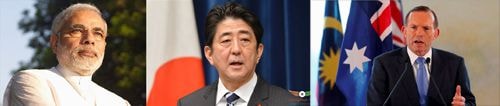 |
| From left to right: Indian Prime Minister Narendra Modi, Japanese Prime Minister Shinzo Abe, and Australian Prime Minister Tony Abbott. (Image from the Internet) |
However, since Prime Minister Narendra Modi's BJP party came to power, the Indian government has taken a more decisive stance and has revived the trilateral India-Japan-Australia dialogue mechanism on security at the Deputy Foreign Minister level. This dialogue will also pave the way for the three countries to conduct multilateral naval exercises in the future.
In reality, the "handshake" between India, Japan, and Australia is based on each side's strategic interests and shared concerns. Despite their geographical distance, Japan shares many similarities with India. They both face a common adversary: China, in their territorial disputes. As for Australia, although it has no territorial disputes with China, the recent actions of the Asian nation deploying its navy to the southernmost point of the South China Sea and claiming sovereignty over James Shoal, claimed by Malaysia, have caused considerable concern. Australian Prime Minister Tony Abbott, upon taking office, implemented several policies to counter China, from maintaining its military bases and allowing the US to increase troop numbers there, to imposing new tariffs on Chinese minerals. However, at this point, Tony Abbott seems to have taken a more cautious and far-reaching approach, not only allying with the US but also forming a bilateral alliance with Japan, cooperating with Japan on defense and weapons development.
In short, the rise of China and the recent tensions in the South China Sea are the reasons why India, Japan, and Australia recognize the need for cooperation, especially in the field of defense and security. Overall, the South China Sea is considered the most dangerous "flashpoint" in the Indian Ocean and Pacific Ocean, threatening not only the security of Southeast Asia and ASEAN but also the security of Asia as a whole. Disputes at sea are no longer just bilateral disputes between China and Japan, or with Vietnam and the Philippines, but also involve the economic and maritime security of a vast region – the busiest shipping lane on the planet.
Particularly recently, China's construction of artificial islands on reefs in the South China Sea has made the regional security situation more tense than ever. Japan, India, Australia, and the international community are all concerned about this action by China, as it is clearly a calculated move that threatens maritime security and safety in the South China Sea. According to analysts, China's artificial island building in the South China Sea is part of Beijing's step-by-step plan to assert sovereignty over this strategic sea region. Therefore, the crucial shipping lanes in this area will inevitably fall under China's control. This is a scenario that any country, whether directly or indirectly involved, cannot help but worry about. Meanwhile, Japan, India, and Australia are all countries that not only have significant interests in the safety and security of the South China Sea, but also have substantial interests in the safety and security of Asia as a whole. Therefore, the three countries share the common understanding that no hegemonic power in the region can threaten them. This is also the reason why the vision of an India-Japan-Australia "arc" alliance is becoming clearer in the not-too-distant future.
Thanh Huyen


