
Are there too many bogus "stepping stones" for the advancement of "children of influential families"?
If everyone had a support system, if the whole society had one, that would be wonderful. We need to view "support systems" fairly, but we have witnessed too many fake ones.
"Rapid promotion" or "unethical favoritism" are phrases used to describe the career paths of some young officials who, thanks to "support" or "patronage," have achieved astonishing "growth." Following the scandals surrounding "rapid career advancement" in the past year, people are understandably concerned about the selection and appointment of young people.
|
| Mr. Luu Binh Nhuong, Standing Member of the National Assembly's Committee on Social Affairs, and Member of the National Assembly representing Ben Tre province. |

Mr. Luu Binh Nhuong, Standing Member of the National Assembly's Committee on Social Affairs and National Assembly Deputy from Ben Tre province, commented on this matter.
The most dangerous thing is the "privatization of power".
PV:Following the controversies surrounding "rapid career advancement" over the past year, the public has the right to be concerned about the selection and appointment of young people, sir?
Mr. Luu Binh NhuongIn fact, selecting talented young people to assume important responsibilities at the central, local, and ministerial levels is a major policy of the Party and the State, clearly expressed in resolutions, directives, and documents from various levels and sectors. This is also the wish of President Ho Chi Minh, as conveyed in his will. Planning and appointing young cadres is considered a strategic issue.
However, when young cadres are appointed or promoted, their youth, dynamism, and innovative spirit should not be the only criteria; they must also meet all the Party's standards: they must possess good character, revolutionary ethics, and a lifestyle and self-cultivation that follows the example of President Ho Chi Minh; these cadres must have high professional qualifications suitable for their work and be able to assume appropriate positions and roles.
Therefore, it can be understood that not all young cadres are appointed. Our ancestors had a saying, "Wisdom doesn't come to the young, strength doesn't come to the old." Wisdom here doesn't mean young people are incompetent, but rather that they lack experience and maturity. People need both theory and practice, so after receiving theoretical and professional training in schools and courses, young cadres need to be put into real life to experience it firsthand. Following the Japanese approach, they should progress gradually, starting with ordinary, arduous tasks before moving to higher positions. Only then can they truly understand and empathize. A young person who lacks understanding, like a talented person without virtue, who is indifferent and cold towards life, is extremely dangerous.
PV:Do you think that young people who rise through their own merit are more admirable than those who are privileged, those who have been given preferential treatment or a "launching pad" to get ahead?
Mr. Luu Binh NhuongI think having support is great; if everyone had support, if the whole society had support, that would be wonderful. We need to look at this issue fairly.
|
| Mr. Luu Binh Nhuong: "It would be wonderful if the whole society had a platform to move forward!" |
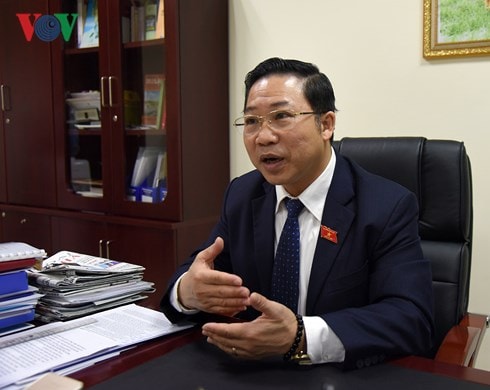
If two candidates receive the same score, I would choose the one who strives for personal achievement because they have succeeded through hard work and self-improvement, setting goals for their lives. However, there are those who, despite having a large family backing them, still create their own launching pad. Two people might both have the advantage of being from a privileged background, but the one who has self-improvement will certainly be chosen. Even without considering the selection process, their self-improvement alone demonstrates their willpower.
If a young official, from an educated family, the child of an official, or even from a family with many generations of officials, strives and sacrifices for the country, is not corrupt, makes significant contributions, and meets all the requirements and standards, then they can still be chosen. This is because they have been educated from a young age to pursue a political career, and they have also been taught that engaging in politics is not about stealing money from the people, but about working for the honor of their family and lineage, and for the honor, integrity, and interests of the country.
If we had officials like that, I would gladly cast many votes. What I fear most is that they only have the outward appearance, a fake support system, clinging to the past, exploiting their ancestors' positions to install their children and relatives – that's not a support system. The real support system I'm talking about must be a "rocket launch pad." Recent events show that we've witnessed far too many fake "support systems."
PV:So, in your opinion, what are the causes of the recent cases of rapid career advancement among some young officials? Is there a flaw in the process?
Mr. Luu Binh NhuongI am a defender of that process, and many people have supported my point of view. Our process is extremely rigorous; it's written for decent people, not for those who engage in shady dealings; but those who use that process are not decent people.
"The most dangerous thing now is the 'privatization' of power entrusted by the State and the people, turning power into one's own private property."
I've said before that the most dangerous thing now is the "privatization" of power entrusted by the State and the people, turning power into personal property. The process is perfectly standard, but unqualified people are still being appointed, so why say the process is wrong? Clearly, those using that process were not impartial.And the result is that we have a whole team of people who specialize in doing wrong. They look at each other, look up, and if this person's child gets in, then their child can get in too. To get their child in, they have to support other people's children. I call this a "witch society." People have disregarded the process, even trampling on the Party's procedures and the law. I can affirm that the process for selecting and appointing an official in Vietnam is extremely rigorous; the standards in that process can be considered the gold standard. Unfortunately, that gold standard is not applied, and people have created their own custom.
"Monasticism, planning in closed rooms"
PV:Many organizations are now using competitive examinations to select leaders. In your opinion, are there any ways for those with dubious connections to circumvent these rules?
Mr. Luu Binh NhuongThe method of selecting leaders through competitive examinations, while classic in nature, is also a very modern way to choose someone for a leadership position. We've had exams since first grade, then in sports, beauty contests... to find qualified people. In the past, generals had to compete against each other through martial arts and literary competitions to select talented individuals, so why shouldn't we choose a competitive examination method?
|
| "We must choose the right questions and exam format so that no cheat sheets can save them." |

In fact, many agencies have already implemented competitive examinations and achieved positive results. The Ministry of Justice held examinations for the positions of Deputy Director of the Judicial Academy and Director of the Department of Legal Document Review; and the Ministry of Transport recruited the Director General of the Road Administration. In my opinion, this competitive examination model should be expanded, and even mandatory for certain positions.
But it must also be acknowledged that no competition is without flaws, regardless of the level. However, the first and most important issue is to choose a topic and method of testing that prevents any kind of "cheat sheet" from saving them.
"No competition is without flaws. But there are still ways to render lifelines ineffective."
It's crucial to let them showcase their abilities in public, rather than sitting around whispering amongst themselves. The selection process must be strategic, appropriate to the caliber of the leadership position, and even involve providing advisory solutions to superiors. They must put themselves in the superior's shoes to offer strategic advice.
Another issue is the selection of evaluators; the recruitment committee must be objective and impartial, and there must be a mechanism to monitor that committee through public opinion. Doing so will narrow the loopholes—not necessarily fill them completely—but avoid closed-door policies, clericalism, and planning within one's own room. We shouldn't be afraid to implement solutions because of loopholes; instead, we should identify those loopholes and find solutions.
PV:Thank you, sir.


