
Pure Land
(Baonghean) - Today, my best friend invited me to the temple to attend the opening ceremony of the Vu Lan week. It's been many years since I last stepped through the temple steps, and a familiar feeling suddenly washed over me. I bowed my head before the triple-arched gate where I used to hide with my friends to play hide-and-seek, silently greeting each brick and each small stone. Only now do I know that Diệc Temple - the simple and affectionate name people often use - truly has a solemn and ancient name: "Tùng lâm diệc cổ" (Ancient Pine Forest of Diệc).
When I was a child, my family lived in the Quang Trung apartment complex. Across the street, I could see a small temple nestled beside a towering triple-arched gate. Curious, I asked my mother:
- What temple is this, Mom? Why is the temple so small, yet its gate is so tall and wide?
- This is Diệc Pagoda, my child. Long ago, there was a very large, ancient pagoda here, with spacious grounds and lush greenery. According to oral traditions passed down by the elders, the pagoda existed even before King Thành Thái issued a decree establishing Vinh as a town. After several renovations, it became one of the largest pagodas in the region. Even now, two stone tablets recording the history of the pagoda's two renovations remain…
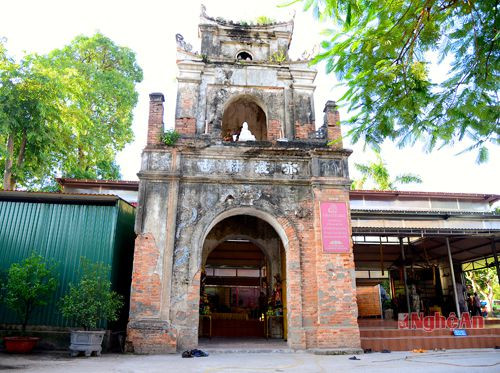 |
| The triple-arched gate of the ancient temple has been preserved to this day. |
Being a curious child, I dragged some neighborhood kids along to "explore" the ancient temple. According to the fairy tales I'd read, temples always had young monks diligently sweeping fallen leaves in the courtyard, carrying water, and copying Buddhist scriptures. But after observing several times, I didn't see any young monks our age, only older women and men regularly coming to clean up the temple to make it less deserted. So I lost interest in learning more about the ancient temple…
A long time passed, and I quickly grew into a university student and went away to study. When I returned, the city had changed dramatically, as if it had donned a new dress, and my family had moved to the suburbs. Without even having time to say goodbye to my roommates, I felt utterly dejected. The old apartment complex was in the city center, across the street from a silent, ancient temple nestled against the wall of time…
But the Diec Pagoda is no longer as quiet and desolate as it was in my childhood memories. Gone is the small hermitage with its makeshift courtyard of only about a hundred square meters. Now, on that land, there is a prayer hall, a spacious main hall with tiled floors and a corrugated iron roof, where monks and Buddhists can offer incense, chant scriptures, and perform Buddhist rituals. Regularly from Monday to Saturday, whenever I pass along Quang Trung Street – the busiest central street in the city – I can't help but pause for a moment before the prayer hall, illuminated by candlelight and filled with the soothing sounds of chanting. The number of Buddhists visiting Diec Pagoda is increasing, especially on the last Sunday of the month when the Venerable Abbot gives sermons, or on the 14th, 15th, 30th, and 1st of each month when the Repentance Sutra and the Medicine Buddha Sutra are chanted to pray for national peace and prosperity.
Today, my best friend invited me to the temple to attend the opening ceremony of the Vu Lan festival. It's been many years since I last stepped through the temple steps, and a familiar feeling suddenly washed over me. I bowed my head before the triple-arched gate where I used to hide with my friends to play hide-and-seek, silently greeting each brick and each small stone. Only now do I know that Diệc Temple – the simple and endearing name people often use – truly has a solemn and ancient name: "Tùng lâm diệc cổ" (Ancient Pine Forest of the Heron). But why the heron? My friend explained: “Legend has it that in the old days, this place was a fertile field with many ponds dug by farmers to irrigate their crops. But one year, a great drought occurred, the ponds dried up, fish and shrimp died and floated all over the fields, leaving the fields desolate. But overnight, herons suddenly flew in from nowhere, crowding the fields, filling the cracked, dry ponds. Suddenly, the sky darkened, the wind and clouds swirled, a storm arose, and rain poured down. But when the ponds filled with water, the flock of herons lay dead. The people said these were birds sent down by Heaven and Buddha to bring rain and save the drought. They gathered the heron carcasses and piled them into a small mound. From then on, every night a flock of herons would fly up from the mound. The elders came up with the idea of building a temple, and the locals called it the Heron Temple, after the legend of the herons bringing rain.”
I was surprised to hear my friend eloquently explain the history of the temple's founding. I wondered how she knew so much, and she explained: "I went to the temple with my mother and grandmother, joined the Golden Lotus Youth Club, helped the monks with their Buddhist duties, and that's how I learned about the history of this ancient temple." Just then, a rather young-looking monk slowly approached, clasped his hands in a respectful bow, and added: “This lady is right, but not entirely. While it's called an ancient temple because of its long history, the Diec Pagoda isn't exactly 'ancient' in the context of city life. In the past, opposite the main gate of the pagoda was the Vinh National School, forming a central cultural complex for the entire city. Throughout various periods, the patriotic intellectual movement has also had significant events marked at this pagoda. Most famously, the patriot Phan Boi Chau chose the Diec Pagoda as a secret meeting place with his comrades. In 1926, a large rally organized by the Phuc Viet Society took place here to demand the pardon of Phan Boi Chau and to commemorate Phan Chu Trinh. Also that spring, Phan Boi Chau, who was under house arrest in Hue, returned to his hometown thanks to the rising people's struggle. The reception in Vinh was incredibly lively.” "With the participation of many students from Nghe An province. During those days, Diec Pagoda opened its doors, lit candles, and day and night the sound of gongs and bells echoed, encouraging the patriotic fighting spirit of the city's people..."
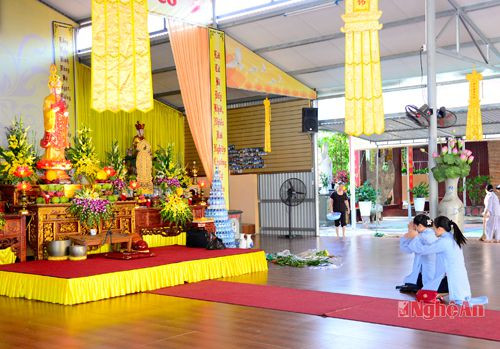 |
| Buddhists light incense in the prayer hall. |
I respectfully bow before the remnants of the ancient temple – though meager in material terms, consisting only of a triple-arched gate, two stone steles, and a few couplets and horizontal inscriptions – its rich history and spirit remain intact, as if untouched by bombs, bullets, and fire. I close my eyes and imagine the figures of students in white robes, their eyes sparkling with youthful enthusiasm and patriotism, or perhaps the shimmering candlelight? A realm of purity, untouched by worldly dust, yet also a place that ignites and fuels the spirit of ethical and patriotic youth. Today, this place is still filled with the sight of students in white robes seeking refuge under the serene Bodhi tree of the Buddhist temple. Over two thousand young Buddhists from the Golden Lotus Club are proof of the widespread influence and transformative power of Buddhism – the oldest religion in Vietnam – which has naturally integrated and become a solid pillar in the values and beliefs of the Vietnamese people.
Strolling leisurely, admiring the tranquil temple, a strangely peaceful place, or rather, a miraculous one, amidst the bustling city. Perhaps at some point, one feels a deep need for a space, a moment of quiet to rediscover oneself, to find the truest and most virtuous qualities that nature has bestowed upon us since birth. Then, suddenly, in the midst of an ordinary morning, in the midst of a life so hectic that the soul yearns, the sound of the temple bell stirs a cool, clear stream within, nourishing the soul with the most fundamental, instinctive, and genuine principles and moral values. A sound awakens one, and looking down at the small lake, one sees only the shimmering golden tail of a playful carp splashing in the water. A sudden memory of my mother yesterday taking my young nephew to release fish into the wild…
Counting on my fingers, only a few days left until the Full Moon of the Seventh Lunar Month – the Festival of Atonement for Deceased Souls, also known as the Vu Lan Festival, a time to show filial piety to parents. I silently vowed to set aside some time amidst my busy work to take my mother to the temple to listen to the sermon. So that the candlelight could illuminate how much more gray her hair had become, so that my steady hand could hold her trembling hand on this night of gratitude. Mother, I offer you this rose to wear on your lapel…
Thuc Anh


