
Rice mills during the Dien Bien Phu Campaign.
To ensure food supplies for the Dien Bien Phu Campaign, in addition to mobilizing and transporting food from the rear to the front lines, the Dien Bien Phu Front Command implemented many solutions to effectively utilize local food sources.
In the 1950s, the people in the mountainous regions of Northwest Vietnam still maintained the habit of "pounding rice on the spot" for each meal. Therefore, they only knew how to pound rice using water-powered mortars or hand pestles. Consequently, although the people had abundant rice reserves, the milling and processing into edible rice was very slow. Faced with this reality, the Front Command requested units to search for officers and soldiers who knew how to build high-efficiency rice mills (similar to those used by people in the lowlands) to quickly process dozens of tons of rice to supply the troops.
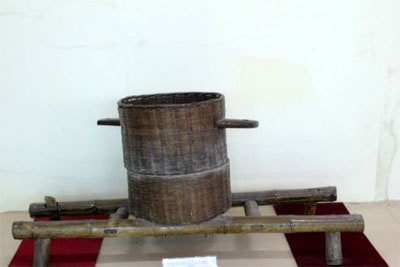 |
| Rice mills used in the Dien Bien Phu Campaign are on display at the Dien Bien Phu Historical Victory Museum. |
Following the directives of the Front Command, units selected officers and soldiers and mobilized hundreds of mill-making craftsmen from Thai Binh and Nam Dinh provinces to Dien Bien, organizing them into numerous mill-making teams. The raw materials for the mills were sourced locally. The mills were made of bamboo and clay. Many teams successfully built large, high-capacity mills. After pilot testing and evaluation of the quality and techniques of building large mills, the Front Command widely disseminated the methods to other units. As a result, within a short time, hundreds of rice mills were supplied to warehouses and construction sites.
During the process of making mills and practicing rice milling, many folk songs were composed by officers, soldiers, and civilian workers to encourage the spirit of labor, combat, and service in the war: "Hurry up, sisters! / One more kilogram of rice will wipe out a lifetime of the Westerners..." Thanks to the large mills, the quantity and quality of rice served to soldiers at the front were improved, contributing to the timely resolution of food shortages during the Dien Bien Phu Campaign.
Many Thai ethnic minority families, upon hearing that the soldiers had successfully built mills capable of grinding large quantities of rice, sought guidance from the officers and soldiers on the technique. The teams also took the opportunity to build more mills to donate to the people and instruct them on how to use them. From then on, the villagers passed on the technique of building mills, enabling them to grind more rice, contributing to improving their lives and supporting the war effort. Thanks to the "contribution" of these mills, the ethnic minorities in the Northwest region were able to supply approximately 27% of the total food needs of the entire campaign.
According to VnMedia


