
The written word journeys along the Pao River.
(Baonghean)In recent years, the teaching of the Lai Pao Thai script has been restored in Tuong Duong and Con Cuong districts. The Lai Pao script is also included as a competition in the annual Cua Rao - Van Temple Festival (Tuong Duong).
To better understand the significance of the flourishing and preservation of this rare heritage of the Thai people in Tuong Duong, please read the research paper "Introduction to the Lai Pao script of the Thai people of Tuong Duong (Nghe An)" by Mr. Tran Tri Doi (University of Social Sciences and Humanities - Vietnam National University, Hanoi) and Mr. M. Ferlus (National Center for Scientific Research, Paris, France), published more than a decade ago.
Accordingly, the Lai Pao script is considered one of the four script systems used by Thai groups in Vietnam, distributed from the Northwest region to Nghe An. “The Thai script called Lai Pao is used by the Thai Muong people (Thai Hang Tong) in the Tuong Duong region (Nghe An), which is the subject of this presentation. Lai Pao, literally meaning 'Pao,' is the Thai name for the Ca River in Vietnam. Only two people still use this script, and only one very short handwritten copy remains [...].”
This script was first mentioned under the name Liếp Nặm during a business trip by the French, Father Théodore Guignard, when he visited this region at the beginning of the 20th century. Two Thai intellectuals who could still use the Lai Pao script at the time of publication of this article were Mr. Lô Văn Thoại (Bản Lạ, Lượng Minh commune, Tương Dương district) and Mr. Lô Văn Mai Liễu, originally from the Xiềng Líp region (now part of Yên Hòa, Yên Na, and Nga Mi communes of Tương Dương district). The document continues: “It is very likely that after these two intellectuals, no one else could read and write the Lai Pao script, and therefore it is necessary to immediately gather together and disseminate this script so that it is not forgotten.”
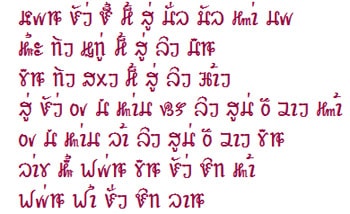
Lai Pao font style.
Fortunately, and very timely, the aforementioned "gathering and dissemination" work was undertaken by Mr. Lo Van Thoai (now deceased) along with Mr. Luong Ba Vin, Mr. Vi Kham Mun, and Mr. Lo Kham Phi, who jointly compiled the Lai Pao script into the book "Teaching the Lai Pao Thai Script," published in February 2009. The book, with 53 pages, presents the alphabet, sentence patterns, and letter forms in a handwritten format. Although the presentation of the rules of the Lai Pao script in this document is quite simple, this initial work successfully prevented the Lai Pao script from falling into oblivion, as has happened to many other heritages.
Currently, the Thai people in Nghe An are using all three Thai script systems: Lai Thanh, Lai Tay, and Lai Pao. The Thai Tay Thanh group uses the Lai Thanh script system, which shares the same rules as the Thanh script system of the Thai people in Thanh Hoa. The Thai Tay Muong group, however, uses both script systems: Lai Tay in the Phu Quy area (Highway 48) and Lai Pao in Tuong Duong (Highway 7). Interestingly, both the Lai Tay and Lai Pao scripts share the same rules for forward syllable formation, a rule different from all other Thai script systems, including those in Laos and Thailand. However, in terms of presentation, the Lai Pao script is written horizontally, while the Lai Tay script is written vertically.
For nearly two years now, the Lai Tay and Lai Thanh Thai scripts have been designed as fonts and integrated into computers for document compilation. The "Preserving Ancient Heritage" section of the NACT Newspaper - MNDT Special Page - regularly publishes nursery rhymes, folk songs, and moral teachings of the Thai people printed in the Lai Tay and Lai Thanh Thai scripts, which has made the people enthusiastic and even more appreciative of their unique ethnic culture.
Recently, after meeting with Mr. Vi Kham Mun, exchanging ideas, and consulting his handwritten Lai Pao script samples (Sam Van Binh), we successfully designed the Lai Pao font to facilitate the rapid and efficient compilation of documents, allowing for the widespread dissemination of the Lai Pao script, including on the internet, transcending spatial boundaries… From centuries ago, the script of the Pao River was known as Liep Nam, meaning “journey along the river.” And now, more than ever, from an extremely small source at the headwaters of the Pao River, through the efforts and dedication of many people, the script of the Pao River, with its journey always faithful to the people, villages, and streams, has now merged with the ocean…
Sam Van Binh (Yen Luom, Chau Quang, Quy Hop)


