
Con Cuong: Drought threatens rice and tea crops.
(Baonghean)Despite only a brief period of mild sunshine, many rice fields in Con Cuong are already suffering from severe water shortages, and hundreds of hectares of newly planted tea plants are showing signs of stunted growth, causing concern among the local population.
Walking along Chi Khe commune (Con Cuong district), many sections of the stream bed are completely dry. Mr. Kha Van Dan in Lam Khe village, while weeding his rice fields, lamented: "It's only been sunny for a few days, but all three acres of rice are already lacking water. The irrigation canals are all dry. If it doesn't rain, we might have to give up everything." It is known that Lam Khe village planted over 60 hectares of spring rice, and currently about 30 hectares are experiencing water shortages, concentrated in the Na Cam, Na No, and Co Huong fields. The village has a reservoir called Khe Cam, but its capacity is small, with only over 40% of its water reserve remaining.
Mr. Loc Van Hoi, Chairman of the Chi Khe Commune People's Committee, said: “The entire commune has planted over 160 hectares of spring rice. Due to the lack of rain for the past three months, most rivers and streams in the area are drying up. Small reservoirs and dams such as Na Hang Dam, Chan Nhan Dam, Phai Lem Dam, and Vuc Ha Dam have low water levels, with water reserves only reaching 30-40%. At this time, over 50 hectares in the commune are experiencing water shortages, mainly concentrated in the villages of Tong Chai, Lien Dinh, and Lam Khe. The commune is focusing its efforts on dredging the Lam Khe, Vuc Ha, and Lien Dinh canals… The commune's irrigation team is regulating the reservoirs and dams appropriately, usually opening the water for 5-7 days each irrigation cycle, and damming streams to provide water for irrigation in the downstream areas. The district has provided one mobile water pump to be placed in Lam Khe.” Mr. Hoi added: If it doesn't rain, the area experiencing water shortages will increase to over 70 hectares.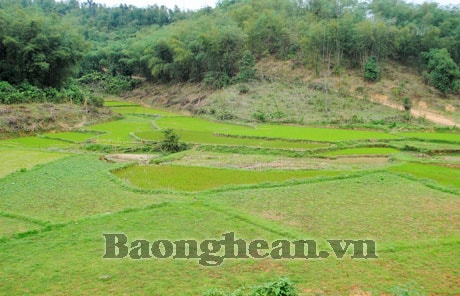
Due to a lack of water, many areas in Don Phuc - Con Cuong cannot yet be used for rice cultivation.
We arrived in Yen Khe commune, where the rice fields were already beginning to crack. Ms. Vi Thi Phong, from Tan Huong village, was scooping water from the stream with a bucket and said: "If it doesn't rain, there's no water in the stream to scoop, and three out of four acres of rice fields have already cracked due to lack of water." Mr. Vi Van Dau, Chairman of Yen Khe commune, shared: “The commune has nearly 120 hectares of spring rice, but about 40 hectares are severely lacking water. The most affected areas are To, Nua, and Trung Huong villages. The difficulty in Yen Khe is that the entire commune lacks reservoirs and dams; the water source mainly comes from rocky outcrops leading to the fields. Currently, most of the water sources at the headwaters have dried up, rendering dozens of irrigation dams built by the commune in the streams ineffective. The commune is currently deploying three mobile water pumps in To, Nua, and Trung Huong villages to support irrigation in the downstream areas. Many households are proactively using buckets or electric pumps. However, if it gets too hot, the pumping method is also not feasible because the water in the streams is depleted. The commune urgently needs government support to install an electric pumping station in the Xieng village fields to irrigate over 50 hectares of rice.”
Not only rice crops are affected by drought, but many newly planted tea areas in Yen Khe are also experiencing water shortages, impacting their growth and development. Mr. Tran Van Quy from Trung Chinh village said: “My family planted 6 sao (approximately 0.6 hectares) of tea and harvested three crops. In 2012, due to the drought, all 6 sao died, causing a loss of 5-6 million VND per month from tea bud harvesting. To date, we have invested in replanting the 6 sao, but since the Lunar New Year, there has been no rain, the streams have dried up, there is no water for irrigation, and the intense heat threatens to kill the tea plants again.” Mr. Vi Van Dau added: “Yen Khe is a key tea-growing commune in Con Cuong district, currently with over 350 hectares of tea plantations. In 2012, drought killed over 100 hectares, and the entire area has been replanted. Newly planted tea is very susceptible to drought, while there is no irrigation system for tea plants in Yen Khe. Therefore, the risk of newly planted tea dying due to lack of water is unavoidable.”
Regarding the drought affecting rice and tea crops, Mr. Vi Van Quynh, Vice Chairman of the People's Committee of Con Cuong district, said: “Recognizing that drought is unavoidable for the spring rice crop, right from the beginning of the season, the district has directed people in the communes to focus on managing and conserving water to prevent water loss; actively utilizing water from streams and rivers to reserve water in reservoirs for the rice flowering and summer-autumn rice stages. At the same time, we have mobilized localities to focus on dredging canals and repairing field embankments; prioritizing the use of irrigation fees subsidized by the State to repair damaged irrigation works… Currently, the district is deploying over 20 mobile diesel pumps in key areas to “save” the rice crop. For tea cultivation areas, the district is developing a project to request State investment in building an irrigation system for tea plants.”
Dinh River


