
Con Cuong: Developing towards an ecological urban area.
(Baonghean) - The Standing Committee of the Provincial Party Committee has just approved the Project "Building Con Cuong District into a Town in the direction of an ecological urban area" to submit to the Government for approval. Baonghean newspaper had an interview with Comrade Hoang Dinh Tuan, Deputy Secretary of the District Party Committee and Chairman of the People's Committee of Con Cuong District, regarding this issue.
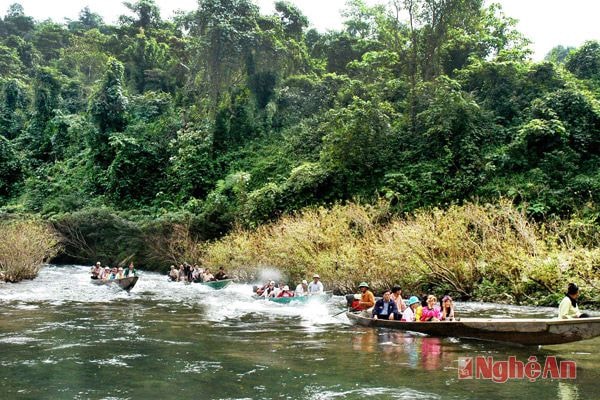 |
| Boat trip on the Giang River. Photo: SM |
Reporter:Could you please explain what an ecological urban area is and what potential advantages Con Cuong has when developing into a town?
Comrade Hoang Dinh Tuan:From a professional perspective, these are low-density, scattered urban areas transformed into a network of limited-scale, high- or medium-density urban residential areas separated by green spaces. In this understanding, Con Cuong possesses all the necessary advantages to be developed into an eco-friendly urban area.
First, geographically, Con Cuong is located in the center of the Southwest region, with National Highway 7 running through it and the Lam River flowing through it, making it very convenient for trade connections with other regions. Con Cuong currently has a very large area of pristine forest (over 130,000 hectares), and notably, it has Pu Mat National Park, recognized by UNESCO as a world biosphere reserve, which is an advantage for building and developing ecotourism.
Culturally, Con Cuong is a multi-ethnic community with diverse and rich customs, traditions, and festivals; it is home to many historical relics and sites such as the first Party cell of Western Nghe An, the national monument of Ma Nhai Stele... and a number of beautiful natural landscapes that need to be exploited for tourism development such as Khe Kem waterfall, Moc stream...
Furthermore, since 2007, Con Cuong has been approved by the Provincial People's Council and a resolution has unanimously classified Con Cuong as a type 4 urban area; on August 31, 2011, in Notice No. 203/TB-VPCP, the Prime Minister directed the research and development of the project "Building Con Cuong district into a town in the direction of an ecological urban area". And very importantly, Con Cuong already has an urban development plan and is currently receiving investment to develop a central area including: a regional hospital; a vocational training school and a series of administrative agencies and units; a transportation system, and urban development infrastructure...
Reporter:So, what are the goals and tasks outlined in the plan for 2020 and the years to come, Comrade?
Comrade Hoang Dinh Tuan:With the goal for the period 2016-2025, Con Cuong district aims to develop into an ecological urban area, a driving force of the Southwest region, with a significant impact on the socio-economic development of the province; this will be a dynamic and comprehensive development area in services, industry, and agriculture; with a favorable investment environment, serving as a hub for trade, goods transshipment, and commercial services, as well as ecotourism in the Southwest region of Nghe An. To achieve this goal, it is necessary to focus investment on implementing four main contents:
Firstly, revise the urban planning for Con Cuong district, focusing on an ecological urban model. Organize the development of urban space and economic zones strategically to promote rapid and sustainable socio-economic development, preserving cultural identity, adapting to natural conditions, maintaining ecological balance, prioritizing social benefits, and blending tradition with modernity, creating a solid foundation for urban architectural development.
Secondly, it is necessary to adjust, supplement, and refine the detailed construction plan for the urban center. Currently, the urban center already has a plan approved by the Provincial People's Committee, so it is necessary to adjust the plan to conform to the trend of building an ecological city, based on respecting what has already been built.
Thirdly, focus investment on building infrastructure to meet the requirements of an eco-urban area. Accordingly, prioritize the construction of landmark buildings with distinctive spatial and architectural features in the central administrative area and along satellite spatial axes to the communes. Accelerate the construction of technical, cultural, and social infrastructure projects, linked to eco-tourism and cultural destinations in the area, following the principle of integrating individual projects with the overall urban architecture, harmoniously combining historical and future structures, and aligning with the requirements of eco-urban development. Gradually build a synchronized infrastructure so that by 2025 the district will essentially meet the criteria of a type 4 urban area.
Fourth, focus on socio-economic development according to the principle and orientation of prioritizing quality, efficiency in socio-economic development, and the ecological environment. Maximize the mobilization of all resources, concentrate on exploiting potential and advantages to achieve high economic growth, and accelerate the shift in economic and labor structure. Strive for an average economic growth rate of 10.82% during the 2016-2025 period; the economic structure will shift with the following proportions: agriculture and forestry accounting for only 24.6%, industry and construction 20.2%, and services and trade increasing to 55.2%. To achieve this goal, it is necessary to promote the development of ecotourism, cultural tourism, services, healthcare, and vocational training services to form urban functions, develop supporting infrastructure services... especially with regard to service development orientation, focusing on developing advantageous service sectors such as trade, tourism, transportation services, postal services, telecommunications, and community service forms. Focus on attracting investment and forming tours and routes such as ecotourism in Pu Mat National Park, Pu Huong Nature Reserve; Lai Ferry - Co Phat village (Mon Son commune), building villages with distinctive community tourism features, developing hotel and restaurant systems, and traditional crafts.
Reporter:Transforming Con Cuong into an eco-city requires tremendous effort and a roadmap that is both specific and strategic... So, what is the district's specific plan, Comrade?
Comrade Hoang Dinh Tuan:Clearly, for the project to be implemented effectively, in addition to the great efforts of the Party committee and the people of all ethnic groups in the area, close guidance from the Provincial Party Committee and the Provincial People's Committee, and smooth coordination among relevant departments and agencies are essential in completing the procedures and processes according to regulations.
Accordingly, the implementation schedule will be as follows: In 2016, a general plan will be drawn up, and the plan for the urban center will be adjusted and supplemented; in the period 2016-2020, basic construction will meet the criteria of a type 4 urban area, and infrastructure in the central region will be built synchronously, gradually synchronizing the infrastructure of the town center and the centers of the communes; in 2025, the town will be established, and in 2030, Con Cuong district will become an ecological town.
To implement the steps outlined in the plan, Con Cuong hopes that the Provincial Party Committee will consider issuing a resolution; the Provincial People's Committee will approve the plan; and the Provincial People's Committee will soon provide guidance on implementing the steps according to the roadmap and timelines, and mobilize resources for priority investment in accordance with the Prime Minister's directives and the Plan for Socio-Economic Development of Western Nghe An until 2020, which has been approved by the Prime Minister.
Reporter:Thank you, comrade!
Huu Nghia(perform)


