
The Bishop's prized horse
(Baonghean)The August Revolution of 1945 in Yen Thanh, which took place on August 25th, had two special events:
Firstly, although the District Party Committee had not yet been established, under the leadership of the Viet Minh in the district, tens of thousands of farmers from the villages rallied under the banner of Viet Minh unity and rose up to seize power from the district to the village level within a single day and night. The village administrative apparatus was disbanded, and the District People's Committee and the village People's Committees took over the management of all affairs in the villages.
Secondly, immediately after seizing power, the people of the villages actively increased production and fought against famine, illiteracy, and foreign invasion. Among them, two Catholic parishioners in Vinh Hoa (Hop Thanh) and Dao Dong (Quang Thanh) donated two valuable assets to the revolutionary government. Mr. Tu An in Vinh Hoa, a predominantly Catholic village, donated a typewriter to the district government. Thanks to this typewriter, all official documents and directives from the district government were printed and sent to the villages. The second person was a priest from Dao Dong church who donated a very large, strong, red-haired male horse. This horse was originally a purebred horse given to the parish by a landowner for the parish priest to use for missionary work. When the Viet Minh movement arose, members of the Viet Minh propaganda team from Van Tu commune went to Dao Dong to persuade the parish priest to donate the horse to the revolution. The parish priest of Dao Dong was very sympathetic to the Viet Minh and sent a group of young Catholic parishioners to participate in demonstrations. To boost the morale of the masses, on the morning of August 25th, the revolutionary self-defense force led this horse at the head of the demonstration from Van Tu commune to the district headquarters. I (Phan Vinh, a veteran revolutionary and former political prisoner of Ban Me Thuot) was assigned to ride the horse with a young Catholic man, carrying a flag at the head of the demonstration.
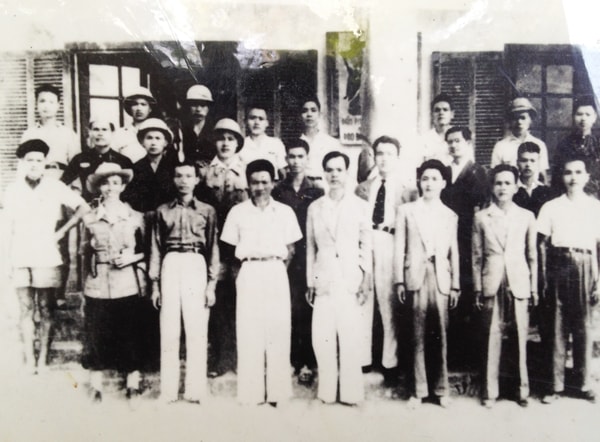 |
| Revolutionary government officials of Yen Thanh district (photo taken in early 1946). |
After gaining control of the district, we assigned Comrade Nguyen Khac Thuong (younger brother of Comrade Nguyen Khac Nhiep, a veteran revolutionary) to work as both a police officer and a liaison, directly managing this horse. Comrade Thuong, from Yen Bang village (Phuc Thanh), had served in the army as a horse groomer, was very skilled at shooting and horseback riding, and his tall, strong physique made him adept at training several of our colleagues in the district People's Committee to ride horses. In a short time, Comrade Ngo Xuan Ham - the Chairman, Comrade Tran Quang Hung - the police commissioner, and I all learned to ride. However, whenever we needed to go to the grassroots level or report urgently to the province, we had to assign Comrade Thuong because he commanded great respect for this horse. As soon as he mounted it, he would gallop. Thanks to this, communication from the grassroots level to the district, and from the district to the province, was much faster because at that time, without a horse, we could only travel on foot or run.
Several incidents occurred immediately after the August Revolution. One was when the self-defense forces of Vinh Tuy village tied up a Confucian scholar simply because the new village chairman questioned the former village headman about official documents. This headman had a habit of asking the scholar about everything. The scholar replied, "Just ask the villagers. If the village elected you, you must beat the drum to invite the villagers to come and ask." The village self-defense forces, hearing this, thought the scholar was rebelling against the government and tied him to a pillar in the village temple. Fortunately, thanks to a horse, Thuong managed to ride back to Vinh Tuy village in time to relay the district chairman's order to untie the scholar. Another incident was in Yen Ma (Ma Thanh) village, where the old and new Viet Minh groups vied for influence, trying to place their own people in the village committee, leading to conflict. Upon hearing this, we immediately sent Thuong there to resolve the situation peacefully...
Mr. Nguyen Khac Thuong was not only skilled at horseback riding whenever the district needed it, but he was also very enthusiastic in training the agency's self-defense force in military drills. In addition, he diligently cut grass and went to the villages to ask for leaves to feed the horse. At that time, the entire district office had only about thirty people. We considered the Committee's horse a precious animal, so whenever anyone returned from somewhere, they would bring back some young grass, corn leaves, or jackfruit leaves for the horse. Despite the scarcity of food, no one touched the horse's daily ration of several bowls of corn. Mr. Thuong, a tall and strong man, was always in good health and had plenty of energy, but sometimes he would even give his meager rice ration to the horse. He cared for the horse meticulously. When it was cold, he would go to the villagers to ask for dried banana leaves to cover the horse.
The district committee's horse and Mr. Thuong were like best friends; whenever Mr. Thuong returned, the horse would neigh and clatter its hooves on the floor. One night, returning from a business trip exhausted, Mr. Thuong didn't tie the horse securely. The next morning, the horse was missing from the stable, causing a panic among the district staff who searched for it, but it was still missing by noon. Mr. Thuong was very worried because the loss of the horse meant the district had lost an important means of transportation, a valuable asset. While the entire district staff was anxiously waiting, two young men from the Dao Dong parish arrived with the horse in the evening. They said, "This horse remembers its old owner and is trying to find its way back to the church. The Bishop told us to bring it to the committee because the district needs a horse more than anything right now." With the horse back, the whole office cheered up, and everyone enthusiastically threw themselves back into revolutionary work.
Christmas 1945 arrived quickly, the first Christmas after the seizure of power. The District Party Committee assigned its staff to visit churches throughout the district to greet the clergy and parishioners. Ngo Xuan Ham went to Vinh Hoa and Bao Nham, while Thuong and I went to Lam Xuyen and Dao Dong, also taking the opportunity to thank the parish priest. The road to Dao Dong was narrow and winding at that time, crossing the steep Hung Tran slope, but thanks to our prized horse, we arrived in time to attend Christmas Mass with the parish priest and the parishioners. After Christmas, the parish priest invited us to stay for bitter tea, boiled sweet potatoes, and conversation until nearly dawn before returning to the district. This noble gesture and the warm affection of the parish priest and the parishioners of Dao Dong left a deep impression on my revolutionary activities.
After the first Christmas in 1945, I worked in the district for a while before leaving to join the main army. I never had the chance to return to Dao Dong until after the peace treaty in 1954. There, I visited home and met Mr. Nguyen Khac Nhiep, who was then working at the District Committee. I learned that Mr. Nguyen Khac Thuong and his prized horse had been seriously wounded by enemy aircraft during a mission to the southern part of the district. Mr. Thuong was taken to Phuc Tang Hospital for treatment but passed away some time later. The prized horse, also seriously wounded, died and was buried along Highway 7, near the Bao Nham stone church.
Tell me a few stories from after the Revolution's success, the story of the typewriter, the story of the precious horse and its keeper, to see the people's devotion to the cause of national unity and salvation led by the Party and President Ho Chi Minh.
Ngo Duc Tien
(Recorded based on the account of Mr. Phan Duc Vinh, Secretary of the Yen Thanh District Party Committee, 1936 - 1941)


