
There are still many shortcomings.
(Baonghean)Despite strict legal regulations on the collection and treatment of wastewater and medical solid waste, in reality, this work has not been fully ensured for many years...
On May 4th, a task force from the Environmental Crime Prevention Police Department of the Provincial Police discovered Le Thi Tam (1971), residing in Nghi Thai commune, Nghi Loc district, collecting and transporting 11.5 kg of used plastic syringes and bottles containing intravenous fluids at the Provincial Traditional Medicine Hospital. Of the 11.5 kg of syringes and bottles, Le Thi Tam claimed to have purchased 4 kg from Nguyen Thi Thu Hoai, a hospital orderly, while the remainder was purchased from two other nurses, but because they were wearing masks, Le Thi Tam did not know who they were. The case is still under investigation.
Speaking with Mr. Nguyen Van Hai, Director of the Provincial Traditional Medicine Hospital, he stated: "I was very surprised by this incident because the hospital has always strictly managed the handling of all types of waste, especially medical waste. Specifically, every year the hospital signs a contract with the Nghe An Urban Environment Company to handle household waste. As for medical waste, the hospital contracts with Green Environment Production, Service and Trading Company Limited in Hai Duong. Every day, after sorting, the medical waste is placed in separate bags and transferred to the warehouse, and this company comes to collect it once a week."
Observing the waste collection process at the Traditional Medicine Hospital, it's clear that the nurses and hospital staff are quite diligent in carrying it out. However, the daily collection of medical waste in the departments lacks proper record-keeping, and the hospital's waste storage area is not closed and is located near the general waste disposal area. Therefore, it's easy to understand why, despite being collected and sorted, plastic syringes and bottles are still being disposed of outside the designated area.
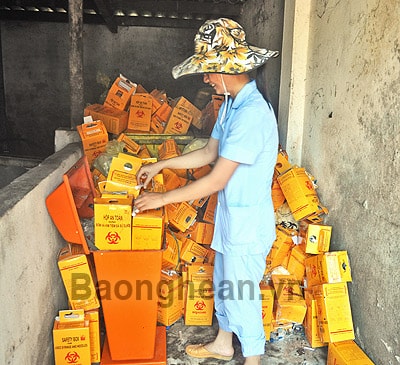
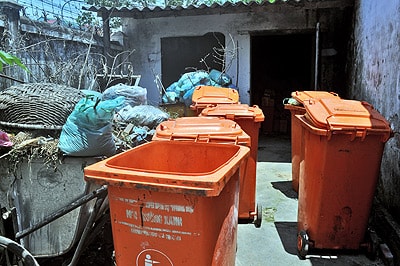
Waste from the Traditional Medicine Hospital after being collected and stored in the warehouse.
The issue of medical waste pollution is also a pressing concern in many residential areas near hospitals and has remained unresolved for many years in our province. With 41 hospitals, 22 regional polyclinics, 480 commune/ward/town health centers, and 359 private medical practices, according to a survey by the Department of Health, hospitals in the province generate 12 tons of medical waste daily, of which 1.7 tons are hazardous waste (accounting for 14.1%). The hospitals with the highest levels of hazardous waste discharge are the Provincial General Hospital (0.3 kg/bed/day), the Oncology Hospital (0.4 kg/bed/day), and the Obstetrics and Pediatrics Hospital (0.25 kg/bed/day).
With such a large amount of waste, most hospitals currently process it on-site in their own incinerators. However, of the 17 operating incinerators, only 8 are functioning relatively stably. The remaining 9 incinerators at the general hospitals of Ky Son, Thanh Chuong, Quy Chau, Tan Ky, Quynh Luu, Dien Chau, Yen Thanh, Do Luong, and Nam Dan are experiencing problems such as high fuel consumption, low temperatures, and failure to meet environmental emission standards. The incinerator at the Tuberculosis and Lung Disease Hospital has deteriorated and is now broken after 5 years of operation. Hospitals in Vinh City have long shared their incinerator with the Nghe An General Hospital, but this incinerator is also deteriorating due to frequent overloading and equipment malfunctions.
During the incineration process, the furnace emits black smoke, polluting the environment around the hospital and surrounding residential areas. At other medical facilities, the frequently used solutions are burial, burning in brick kilns, or burning outdoors. However, these are all unsafe solutions. In addition, recyclable waste such as non-infectious plastics or plastics that have been decontaminated are often sold by medical facilities to recycling centers. However, currently, there are no legally registered recycling centers in the province as required by regulations. Hospitals have to collect waste and transport it to a centralized disposal site for disposal, but there are no specialized vehicles, and the transportation cannot be monitored or controlled.
Mr. Bui Dinh Long, Director of the Department of Health, stated: From a management perspective, medical waste management involves many departments, but currently there is no mechanism for coordination between departments and agencies in the province; no inter-agency council or working group has been established to address difficulties in medical waste management...
In my opinion, to address these issues, the primary responsibility lies with the governing body. Besides advising the State on investment and support policies, it is necessary to assign responsibility to each hospital director, holding them accountable for managing medical waste from its generation to its final disposal. Any violations must be dealt with severely. Furthermore, it is essential to improve the management capacity of healthcare facilities, combined with public awareness campaigns and education to help healthcare workers understand the harmful effects of medical waste and to improve the collection, prevention, and scientific disposal of waste.
Text and photos: My Ha


