
Five new laws and three new resolutions have been announced.
On the morning of December 11th, the Office of the President held a press conference to announce the President's Order promulgating 5 new Laws and 3 Resolutions that were passed at the 8th session of the 13th National Assembly.
 |
| Overview of the press conference announcing new laws and resolutions. Photo: PLO |
Among the 5 laws and 3 resolutions, these include: the Law on the Organization of the National Assembly; the Law amending and supplementing a number of articles of the Law on Officers of the Vietnam People's Army; the Law on the People's Police; the Law on Citizen Identification; the Law amending and supplementing a number of articles of the Law on Civil Aviation of Vietnam; the Resolution on taking votes of confidence and no-confidence votes for those holding positions elected or approved by the National Assembly and People's Councils; the Resolution on ratifying the United Nations Convention on the Rights of Persons with Disabilities and the Resolution on ratifying the United Nations Convention against Torture and Other Cruel, Inhuman or Degrading Treatment or Punishment.
The Directors of Public Security in provinces and cities who have been promoted to the rank of general shall not be demoted.
Introducing the basic contents of the Law on the People's Public Security Force, Lieutenant General Dang Van Hieu, Deputy Minister of Public Security, stated: To ensure compliance with the 2013 Constitution, to ensure the balance between the People's Public Security Force and the People's Army, and to meet the requirements of the situation and tasks of protecting national security and ensuring social order and safety, and combating crime in the new period, the Law strictly and specifically stipulates the positions and ranks of People's Public Security officers with the highest rank being General. At the local level, the Law stipulates that the Director of Public Security of Hanoi and Ho Chi Minh City has the highest rank of Lieutenant General; the Directors of Public Security of other provinces and centrally-administered cities have the highest rank of Colonel.
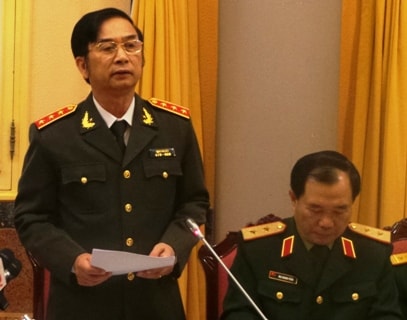 |
| Lieutenant General, Deputy Minister of Public Security Dang Van Hieu. |
At the same time, the Law adds regulations stipulating a minimum promotion period of 4 years from Colonel to Major General, and within each general rank.
Responding to media concerns about the current situation where many local police chiefs hold the rank of general, and how this issue will be addressed once the law takes effect, Deputy Minister Dang Van Hieu stated: “In the coming time, we will reassign and rotate police chiefs in localities. Those who have already been promoted to the rank of general must retain that rank until retirement. There is no reason or law to strip them of their general rank. If they are worthy of being a police chief, they must still be appointed to that position. The Central Party Committee of the Public Security Ministry's stance is to strictly implement the law passed by the National Assembly.”
The Law on the People's Public Security Force (PPSF) consists of 7 Chapters and 45 Articles, stipulating the principles of organization and operation; functions, tasks, powers, and policies for the PPSF, effective from July 1, 2015. The regulations on conferring, promoting, demoting, and revoking the rank of general; appointing, dismissing, removing from office, and demoting positions with the highest rank of general, effective from the date this Law is promulgated.
Vietnamese citizens aged 14 and above are issued a Citizen Identity Card.
The Law on Citizen Identity Cards comprises 6 chapters and 39 articles, regulating citizen identity cards, the Citizen Identity Card Database and the National Population Database; the management and use of Citizen Identity Cards; and the rights, obligations, and responsibilities of relevant agencies, organizations, and individuals. It came into effect on January 1, 2016.
Lieutenant General Dang Van Hieu, Deputy Minister of Public Security, stated: Regarding age, the Law stipulates that Vietnamese citizens aged 14 and above are eligible to be issued a Citizen Identity Card to ensure the stability of citizens' personal information as prescribed in the Law.
Article 20 of the Law clearly affirms the validity of the Citizen Identity Card. Accordingly, the card serves as proof of the cardholder's identity for conducting transactions within Vietnam. When a citizen presents their Citizen Identity Card, competent agencies, organizations, and individuals are not allowed to request the citizen to present any other documents certifying the information already contained on the card.
A notable new point is that the Law stipulates that citizens are not required to pay a fee when receiving their first Citizen Identity Card; and when renewing their card upon reaching the age for card renewal as prescribed by the Law.
The rank of the Commander of Ho Chi Minh City is Lieutenant General.
Referring to the new provisions of the Law amending some articles of the Law on Officers of the Vietnam People's Army, Lieutenant General Mai Quang Phan, Deputy Head of the General Political Department, Ministry of National Defense, said: Compared to the provisions of current law, the amended and supplemented Law adjusts the regulations on the highest military rank to general for some officer positions, and also specifies the number of deputy positions with the rank of general.
 |
| Lieutenant General Mai Quang Phan, Deputy Head of the General Political Department, Ministry of National Defence. |
According to the amended Law, the rank ceiling for the Commander of Ho Chi Minh City is Lieutenant General, higher than the rank ceiling for the Deputy Commander of Military Region 7, which is Major General. Some opinions suggest that this new regulation leads to difficulties in work because the rank of subordinates is higher than that of their superiors. Regarding this issue, Lieutenant General Mai Quang Phan, Deputy Head of the General Political Department, Ministry of National Defense, said: "This is quite normal in practice; whoever has a higher rank is the leader and commander. The law stipulates it, so it must be strictly followed."
The law takes effect from July 1, 2015. The regulations concerning the conferment, promotion, demotion, and revocation of general ranks; the appointment, dismissal, removal from office, and demotion of positions with the highest rank of general, take effect from the date this law is promulgated.
A person who receives more than half of the "no confidence" votes in a confidence vote may resign.
On November 28, 2014, the 13th National Assembly passed Resolution No. 85/2014/QH13 on conducting votes of confidence and no-confidence votes for officials elected or approved by the National Assembly and People's Councils. The Resolution came into effect on July 1, 2015.
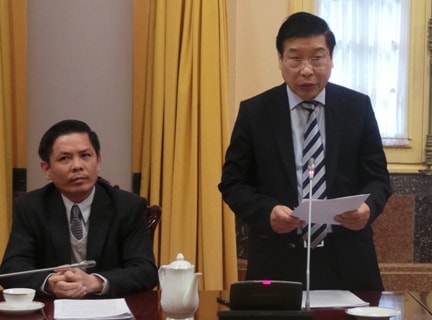 |
| Deputy Chairman of the National Assembly's Law Committee, Le Minh Thong. |
According to Deputy Chairman of the National Assembly's Law Committee Le Minh Thong, the Resolution has amended and supplemented regulations on the timeframe and timing of confidence votes in the National Assembly and People's Councils. Accordingly, "The National Assembly and People's Councils shall organize confidence votes once in each term at the regular session at the end of the third year of the term."
Regarding the level of confidence expressed on the confidence vote ballot, the resolution continues to stipulate a secret ballot with the following levels: "high confidence," "confidence," and "low confidence."
Notably, Article 10 of the Resolution stipulates that if more than half of the total number of National Assembly deputies or People's Council deputies rate a person subject to a confidence vote as having "low confidence," that person may resign. If two-thirds or more of the total number of National Assembly deputies or People's Council deputies rate a person subject to a confidence vote as having "low confidence," the Standing Committee of the National Assembly shall submit the matter to the National Assembly, and the Standing Committee of the People's Council shall submit the matter to the People's Council for a confidence vote.
The Law on the Organization of the National Assembly consists of 7 chapters and 102 articles, stipulating the position, functions, tasks, and powers of the National Assembly, the Standing Committee of the National Assembly, the Council of Ethnic Minorities, and the Committees of the National Assembly… The Law came into effect on January 1, 2016. The Law has concretized the tasks and powers of the National Assembly in 16 articles corresponding to the three functions of legislation, supervision, and decision-making on important national issues, as enshrined in Articles 69 and 70 of the Constitution. The Law amending and supplementing several articles of the Law on Civil Aviation of Vietnam came into effect on July 1, 2015. To address flight delays and cancellations in civil aviation and improve passenger service quality, the Law adds regulations on the obligations of air transport businesses, the obligation to maintain minimum service conditions and quality; and adds the responsibility of the carrier in cases of prolonged flight delays without prior notice. On November 28, 2014, the National Assembly passed Resolution No. 84/2014/QH13 ratifying the United Nations Convention on the Rights of Persons with Disabilities, comprising 50 articles. The ratification of the Convention at this time is very important, demonstrating respect for commitments, creating a basis for strengthening dialogue on human rights and exchanges with other countries and international organizations on human rights, enhancing Vietnam's political standing and prestige in the international arena. According to Lieutenant General Dang Van Hieu, Deputy Minister of Public Security: The ratification of the Convention Against Torture is a very important political and legal event in protecting human rights and implementing the humanitarian policy of the Vietnamese Party and State, making a practical contribution to the implementation of the 2013 Constitution of the Socialist Republic of Vietnam. At the same time, it affirms the consistent policy of the Socialist Republic of Vietnam in protecting human rights, creating a basis for strengthening dialogue and exchange with countries and international organizations on human rights. |
According toCommunist Party of Vietnam


