
New DNA technology unravels mysterious deaths.
Polish scientists announced on January 14th that new DNA testing technology could help recover at least some of the identities of people who leave no photographic record after death.
This new technology, called HirisPlex, has helped scientists identify the eye and hair color of unidentified victims murdered during the Nazi era. Furthermore, it has also helped identify a mysterious woman buried alongside priests in a medieval catacomb.
(Source: AFP)
"This system could be used to resolve historical disputes when color photographs and other documents are unavailable," said Wojciech Branicki of the Forensic Research Institute in Krakow, Poland.
The new system is a revamped version of the tools already used to assess DNA codes that indicate eye and hair color. The new system can also be used because teeth and bone have a longer DNA storage time compared to soft tissue.
In the scientific journal Investigative Genetics, researchers said they initially tested the method on a tooth removed from the body of General Wladyslaw Sikorski, who led the Polish government-in-exile in Britain during World War II before dying in a plane crash in 1943.
Sikorski's body was initially buried in a cemetery in Newark, England, and was reinterred in Krakow in 1993. In 2008, his grave was exhumed again to examine a hypothesis that Sikorski had been poisoned, shot, or suffocated.
Genetic analysis of the teeth suggests a 99% probability that Sikorski had blue eyes and an 85% probability that he had blond hair. Both are consistent with contemporary depictions of Sikorski and paintings of him from years after his death (no color photographs of him survive).
HirisPlex also helped partially confirm the identities of 12 people who died in a prison in Nazi-occupied Poland in 1942, whose identities were never known. Their skulls were sent to Vienna, for an exhibition at the city's Natural History Museum.
DNA results from the skulls suggest these individuals most likely had brown eyes and hair ranging from brown to blonde, a finding consistent with typical Poles.
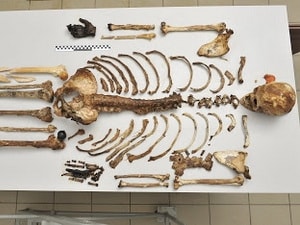
A third test shed light on the mystery at a Benedictine monastery in Tyniec, near Krakow, where archaeologists discovered the bones of two women alongside 17 other skeletons believed to be those of male monks. Tests on one of the samples revealed the woman had brown eyes and blonde or brown hair.
According to (Vietnam+) - VT


