
Agricultural extension work in the construction of new rural areas.
(Baonghean) - To enhance the bridging role of agricultural extension work and bring effective, advanced, and safe production models to the fields, localities are focusing on many solutions to integrate resources and techniques with farmers.
In 2014, Quynh Luu district had 5 communes that achieved the New Rural Development (NRD) status. A common feature is that these communes all showed significant economic growth and structural transformation. Along with effectively exploiting their economic strengths, the communes also developed production models, creating jobs, increasing income, and stabilizing the lives of the people. To achieve this goal, local Party committees and authorities made efforts to introduce agricultural extension models to the fields. Before the introduction of high-value crop and livestock models, communes like Quynh Giang, Quynh Hong, Quynh Hau, Ngoc Son, and Quynh Luong... all faced problems such as peak rice yields and unsold vegetables during harvest season. Thanks to agricultural extension models such as clean vegetable production according to VietGAP standards or models for planting new crops on fertile land and upland areas, people's mindsets have gradually changed, and they have boldly switched to higher-value crop and seasonal structures.
 |
| Inspection before acceptance of the shrimp farming model of Mr. Ho Duc Toan's household, Hoc Van hamlet, Quynh Bang commune (Quynh Luu district). |
We visited Quynh Bang during the commune's acceptance of an agricultural extension model for the development of aquaculture. With 186 hectares of intensive shrimp farming, Quynh Bang is a key shrimp farming area in the province. However, in recent years, due to environmental pollution, farmed shrimp have often suffered from diseases. In the 2015 farming season, with support from the Agricultural Extension Center, the commune built a "biosecure shrimp farming" model, with Mr. Ho Duc Toan's family in Hoc Van hamlet and Mr. Nguyen Van Tai's family in Dong Van hamlet selected as pilot projects. After 2 months of farming, with 5,000 m2 of ponds in each model, the yield reached 10 tons/ha, with a harvest rate of 70-80 shrimp per kilogram. With a selling price of over 100,000 VND/kg, each model yielded a profit of 300 million VND, exceeding expectations. Mr. Vu Van Duong, Vice Chairman of the Commune People's Committee, assessed: "This year's shrimp farming season was not favorable. Out of over 100 households raising shrimp, only 10% made a profit. Among them, two successful models supported by agricultural extension services are a significant encouragement for the movement. Shrimp farming is a key economic sector and a strength of the commune. If shrimp farming is successful, it will bring in hundreds of billions of dong annually, accounting for nearly half of the commune's annual production value, providing a basis for raising the average income of the people..."
Through field research in Yen Thanh and Dien Chau districts, many production models have emerged that yield high economic efficiency. From the initial pilot models supporting high-quality rice production in a few communes, these models have now been replicated in many communes, creating model fields that generate high incomes. In these communes, not only rice cultivation but also other industries are thriving, such as shiitake mushroom and wood ear mushroom farming, and clean vegetable production. New crop and livestock models like watermelon and cantaloupe have been successfully transferred and become the main annual crops; creating conditions for farmers to diversify their crops, increase the number of harvests, and raise the income per unit area by 1.5 to 3 times.
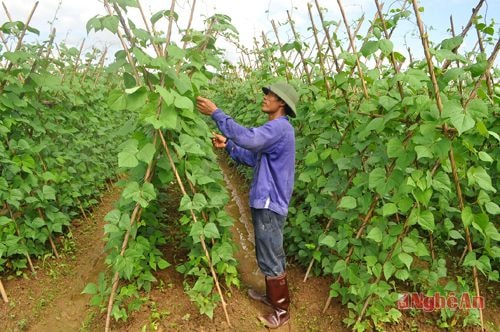 |
| The off-season vegetable farming model of Mr. Hoang Van Hien, Nam Thanh commune (Yen Thanh district). |
However, in many places, agricultural extension work has not been fully effective due to the scattered management mechanisms and investment resources. The role of agricultural extension in building new rural production models is increasingly important. In addition to participating in planning and evaluating production projects, agricultural extension is also responsible for participating in the acceptance and final settlement of models. However, in many agricultural production models, localities do not invite agricultural extension workers to participate or participate very limitedly, and are even less invited to participate in the acceptance and final settlement when the model ends. Therefore, although these are labeled as grassroots agricultural extension models, the agricultural extension apparatus at the local level does not participate...
Furthermore, despite efforts, funding for agricultural extension is quite limited, averaging only 2-3 billion VND per year across the province, distributed evenly among 21 districts, cities, and towns. Due to limited funding, except for model communes registered to achieve New Rural Area status, which receive priority investment with higher funding from the national target program (commonly 150-170 million VND/model), the remaining support from the province is only 50-80 million VND/model. In the four years of building New Rural Areas, with approximately 10 billion VND, the province has built 460 models in various fields. However, with 467 communes, averaging only one model per commune, the impact of agricultural extension models on production remains very modest.
One of the reasons why the effectiveness of agricultural extension in building new rural areas is not high is due to the unclear regulations on the participation of agricultural extension; agricultural extension has mostly stopped at providing advice and technical training, and has not truly been a partner, working alongside farmers and sharing responsibility for the results of model implementation. To date, only 2 district-level agricultural extension stations in the province are members of the district-level New Rural Area Coordination Board, while other agricultural extension stations remain uninvolved, and localities developing production models are not invited to participate.
Through our research, we learned that although there are successful agricultural extension models in the province, their replication has only been within individual communes of each district, and there has been no linkage to expand them to inter-commune or inter-regional levels. Mr. Nguyen Quy Linh, Director of the Provincial Agricultural Extension Center, said: “Based on the above situation, the Center is currently tasked by the Department of Agriculture and Rural Development and the Provincial People's Committee to hold a specialized workshop to assess the role and position of agricultural extension in building new rural areas. From there, we will advise the province on developing mechanisms and solutions for guidance. In reality, localities that truly care about agricultural extension, after evaluation, if they find a model suitable for their locality, will decisively direct its application to production; applying and integrating certain mechanisms and policies to invest in expanding the model will lead to a thriving production movement. If we can do that, the effectiveness of the models and the role of agricultural extension will certainly become increasingly positive in the construction of new rural areas.”
Nguyen Hai


