
Poverty eradication efforts: Many efforts towards sustainable goals.
(Baonghean) - During the 2010-2015 term, Party committees and authorities from the provincial to the grassroots level implemented many innovative approaches, mobilizing social resources to create a shift in poverty eradication and reduction, contributing to socio-economic development. The results achieved show that, in addition to the efforts of poor households, there was also the active participation and cooperation of all levels and sectors in the province, as well as the active support of businesses.
Poverty eradication aims to achieve social justice while simultaneously improving the material and spiritual lives of the people, creating a solid foundation for socio-economic development, and ensuring national defense, security, and social order. Deeply aware of this issue, during the 2010-2015 term, all levels of government, sectors, people from all walks of life, and the business community in the province focused on implementing numerous solutions for poverty reduction.
The Provincial Party Committee issued Resolution No. 02/NQ-TU, dated February 22, 2011, on the action program to implement the Resolution of the 17th Provincial Party Congress; and Conclusion No. 05/KL-TU, dated October 3, 2011, on the target program for poverty reduction in Nghe An province, 2011-2015. Accordingly, the targets set were to reduce the poverty rate by 10% by the end of the term, with an average annual reduction of 2.5-3% of poor households.
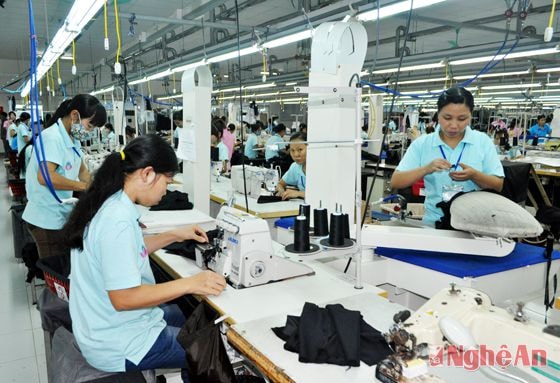 |
| Workers at the Samsung Vina factory in Thap-Hong-Ky Industrial Park (Dien Chau). |
In that spirit, poverty eradication has become a key political task for Party committees, government agencies, and the entire political system from the provincial to the grassroots level. For Tuong Duong district – one of the province's "key" poor districts – and in conjunction with the effective use of investment resources from Government Programs 30a, 134, 135, and 167, the District Party Committee issued Directive No. 19/CT-HU on "Strengthening the leadership of Party committees in building and replicating economic models." Through this, the intelligence and responsibility of each member of the District Party Committee, and the heads and deputy heads of district-level departments and agencies, were mobilized to guide each grassroots unit and each specific economic model. As a result of this guidance, the entire district has now replicated 249 economic models, such as the large-fruit tomato model, the clean vegetable model, the black pig farming model, and the Muscovy duck farming model.
The family of Mr. Vi Duc Tuan, in Mon village, Thach Giam commune, is one of the poor households that received direct guidance and initial support in the form of two breeding pigs. To date, from those two breeding pigs, he has accumulated capital and knowledge to buy and raise more goats and pigeons. Mr. Tuan said that his family has now established a comprehensive livestock farm with 30 goats, 5 pigs, and dozens of pairs of pigeons, generating an income of approximately 100 million VND per year. Even more encouraging is that many households in Mon village have followed his model.
Comrade La Thi Nhung, Permanent Deputy Secretary of the Tuong Duong District Party Committee, said: In addition to the Party Committee's policy, the Tuong Duong District People's Committee also issued a plan assigning district-level departments, agencies, and units to help and support poor households escape poverty. Based on the plan of the District People's Committee, 281 poor households have received assistance and support from agencies and units, of which 180 households have escaped poverty.
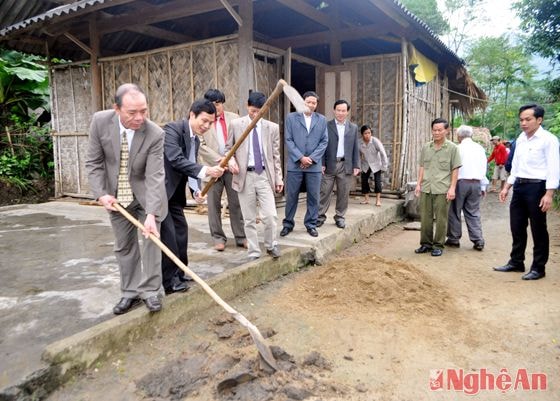 |
| Leaders of the Provincial and Con Cuong District Fatherland Front Committees commenced the construction of a Solidarity House for the family of Mr. Lo Van Hung, in Nua village, Yen Khe commune, Con Cuong district. |
As one of the poorest districts in the province, poverty alleviation efforts in Que Phong focus on economic development through various models and the assignment of departments to assist poor households. This is coupled with promoting the transformation of crop and livestock structures; selecting some plant and animal varieties with local characteristics, such as passion fruit in Tri Le, beekeeping in Chau Thon, high-yield rice in Chau Kim and Cam Muon, and Muscovy duck farming in Tien Phong... As a result, the poverty rate in the entire district has decreased from 59% in 2010 to 36.38%. Que Son commune is one of the communes that has undergone rapid change through the district's economic development programs and projects.
Comrade Lo Thai Huyet, Secretary of the Party Committee of the commune, shared: "In previous years, the lives of the people depended solely on rice cultivation, so life was very difficult. Now, Que Son has created its own strength in sugarcane cultivation with 241 hectares sold to the Tate & Lyle Sugar Factory, bringing significant income to the people to escape poverty sustainably. The poverty rate in Que Son has decreased from 34% (in 2010) to 22.7% (in 2014)."
One of the poor households in the commune, Mr. Ho Quang Hien's family in Phong Quang hamlet, earns 80-100 million VND per year thanks to sugarcane cultivation. Que Son also has the largest area of clean vegetable production in Que Phong district with 45 hectares, averaging 4-5 harvests per year, and the commune is currently piloting the conversion of some areas to growing gac fruit and oranges.
In Nam Dan district, the District Party Committee issued Resolution No. 07/NQ-HU on promoting poverty eradication and reduction, giai đoạn 2011 - 2015. Based on this, organizations, units, and localities have concretized the contents and tasks to put the resolution into practice. This includes focusing on disseminating successful models and practices in poverty eradication and family economic development for poor households to learn from and emulate. They have also conducted a thorough and accurate review, assessment, and classification of poor households, clearly identifying the causes of poverty. Furthermore, they have strengthened vocational training, created job opportunities for the poor, and promoted social mobilization to ensure more resources are available for the poor and impoverished households.
This is linked to accelerating economic growth and restructuring the economy, crop and livestock production, in order to create more job opportunities and improve income for the people in general and the poor in particular. The income of poor households generally increased, averaging 1.29 times, contributing to reducing the poverty rate in the entire district from 18% (in 2010) to 4.77% (at the end of 2014).
Mr. Nguyen Bang Toan, Director of the Department of Labor, War Invalids and Social Affairs, stated that by concretizing and integrating the central government's poverty reduction support programs and policies, the province has issued many of its own mechanisms and policies to create all conditions for rapid and sustainable poverty reduction. Specifically, the Provincial People's Council and People's Committee have issued poverty reduction support policies for 42 poor communes with a poverty rate of 30% or more, excluding the 30a districts; policies to reduce poverty and improve living standards for people in the western and coastal areas of Nghe An province by 2020; campaigns to support Tet for the poor;... By the end of 2014, the poverty rate in the entire province was 10.28%, and it is expected to decrease to 7.5-8% by the end of 2015 (the congress's target was to reduce it to 10% by the end of 2015). On average, the number of poor households decreased by over 3% annually, exceeding the target set by the 17th Provincial Party Congress of an average reduction of 2.5-3% per year and higher than the national average reduction of only 2% per year.
The whole society participates in eradicating hunger and reducing poverty.
In addition to mobilizing the political responsibility of Party committees, government agencies, and the entire political system from the provincial to the grassroots level, the province has done a good job of socializing poverty alleviation efforts during the 2010-2015 term.
Chairman of the Provincial Fatherland Front Committee, Nguyen Van Huy, shared: To have more resources to support the poor, the fundraising campaign for the "For the Poor" Fund and the "Tet for the Poor" campaign has been expanded to include a wider range of participants. For the "For the Poor" Fund, instead of only mobilizing contributions from cadres, workers, and civil servants with an average of at least one day's salary and from the general public with an average of 10,000 VND per household, the Provincial Fatherland Front Committee has brought the fundraising efforts down to the grassroots level, from agencies to residential areas, to find suitable methods. These grassroots units focus on mobilizing contributions from individuals, households with the means, and production and business establishments in each locality. In various sectors, agencies, and organizations, in addition to mobilizing their own staff and members, they also actively encourage organizations, units, and businesses with whom they cooperate to care for the poor. Along with mobilization, the Provincial Fatherland Front Committee has also innovated its support methods.
From focusing on supporting the construction of "Great Solidarity Houses," the Fatherland Front at all levels has shifted its support to purchasing breeding cows, goats, pigs, and poultry for the poor in the form of providing livestock worth 10 million VND per household over 4 years, with the funds then transferred to other poor households. Since 2011, the "For the Poor" Fund has mobilized over 125 billion VND by the Fatherland Front at all levels. In 2014 alone, the province mobilized 31 billion VND, including the repair and construction of 1,608 houses for poor households; support for medical examinations and treatment for 2,298 poor people; support for the education of 9,939 poor students; and support for 2,956 poor households to purchase seedlings and livestock for production and animal husbandry.
Responding to the call from the Secretary of the Nghe An Provincial Party Committee, the "Tet for the Poor in the Year of the Goat 2015" program was launched, creating a strong ripple effect and mobilizing social resources to care for the poor. Throughout the province, 264 agencies, units, organizations, businesses, and individuals donated to the poor during the Tet holiday, totaling over 32 billion VND.
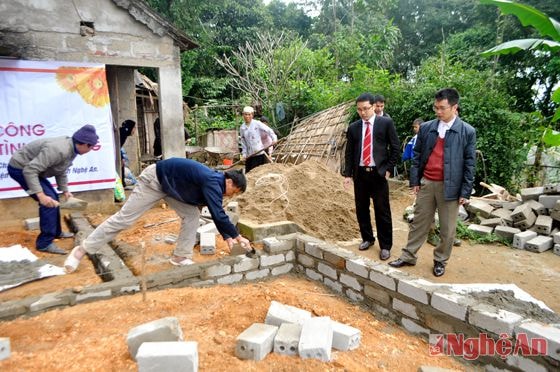 |
| HDBank Nghe An branch provided support for the Solidarity House in Thanh Mai commune, Thanh Chuong district. |
In particular, following the Provincial Party Committee's directive and the Provincial People's Committee's decision on assigning agencies and units to assist poor communes, 110 agencies have now provided practical assistance to 110 poor communes through actions such as building and strengthening the political system, improving the capacity and creating favorable working conditions for commune-level officials and civil servants; building roads, improving students' learning conditions; providing guidance on farming methods and supporting people with livestock and seedlings to alleviate poverty. The total value of assistance mobilized for the 110 poor communes from 2012 to 2014 by agencies and units was 137.36 billion VND, of which 69.156 billion VND was in 2014.
One of the units that performed well was the Provincial Military Command. Specifically, the unit supported the Nậm Giải Commune Health Station (Quế Phong District) to achieve national standards in healthcare; and provided free medical examinations and medication to the local people. Many poor households in Nậm Giải, such as the families of Mr. Lô Văn Tình, Mr. Lữ Văn Hiếu (Piêng Lâng village), Mr. Lô Văn Hùng (Pục village), Mr. Quang Văn Trường (Tống village), and Mr. Lô Văn Hoàng (Chà Lấu village), received breeding cows from the unit to help them escape poverty. “The soldiers have given us the cows; all that's left for the family is to raise them so they produce many calves and we can escape poverty,” Mr. Lữ Văn Hiếu shared.
In Nam Giai commune, many tasks performed by officers and soldiers of the Provincial Military Command have been praised by the Party Committee and the people, such as mobilizing and working with the local people to build roads in Cang and Puc villages according to the new rural standards; and other activities linked to the local political tasks.
With the support of Nghe An Newspaper for Xieng My commune (Tuong Duong district), the agency annually sends staff to the locality to encourage people to develop production, survey areas in need of assistance, and mobilize staff, reporters, and technicians to donate to help the poor commune... In 2014 alone, from voluntary contributions of staff, reporters, and employees, the lowest donation was 200,000 VND, and the highest was 10,000,000 VND, with a total collection of over 120 million VND.
From this fund, Nghe An Newspaper directly purchased tables, chairs, clothes, blackboards, and some school supplies to donate to the remote school in Dinh Tai village, Xieng My commune, worth 45 million VND; purchased 3 cows and 6 pairs of breeding pigs and provided financial support for building barns for poor households. Nghe An Newspaper also continued to separate 4 calves after investing in raising them for 2 years in poor households, transferring them to other poor households, worth 40 million VND. In addition, during the recent Lunar New Year of the Goat, the Newspaper donated Tet gifts worth 10 million VND to poor households and mobilized units, agencies, and businesses to donate 150 million VND... Along with that, the Newspaper also propagated and guided the people on how to raise livestock effectively, not letting buffalo and cattle roam freely, knowing how to grow grass for livestock, and knowing how to keep cows warm in winter, so the cattle herd thrived.
Not only state agencies, but also many organizations and businesses, through the call of provincial leaders, have integrated various programs and projects related to poverty reduction. For example, Viettel Group's Nghe An branch has implemented the "Joining Hands for the Community" program by purchasing cows to donate to poor households with the goal of supporting 1,000 cows; a program to provide broadband internet to schools in mountainous and remote areas; and the "For Studious Children" program... Units such as the General Construction Corporation of Transport Works 4, the Investment and Development Commercial Bank of Nghe An, and Bac A Commercial Bank... are also units with many practical activities such as investing in infrastructure construction, donating cows, providing scholarships for students, and savings accounts for the poor. The total amount of money mobilized from integrated programs by businesses from the beginning of the term to date is 323.96 billion VND, with 116.5 billion VND in 2014 alone...
Efforts to reduce poverty sustainably
Clearly, the province's poverty reduction efforts during the 2010-2015 term achieved many outstanding results. However, the current poverty rate in the province is still 10.28%, higher than the national average (6%), and the number of near-poor households accounts for a significant proportion at 11.4%. Furthermore, the results of poverty reduction in recent years have not been truly sustainable, and the risk of re-poverty remains high. Given this reality, and the requirement for Nghe An province to successfully implement Resolution 26 of the Politburo in the next term, striving to make Nghe An a relatively prosperous province in the North, poverty reduction efforts need to be more decisive with more effective solutions and measures.
According to the Chairman of the Provincial Fatherland Front Committee, Nguyen Van Huy, it is necessary to innovate the methods of supporting and assisting the poor in a sustainable way, such as providing interest-free loans to buy livestock and seedlings to create income sources for poor households. In addition, socializing the mobilization of resources to support the poor by promoting the role of grassroots organizations in guiding and helping the poor to improve their lives is crucial.
According to Comrade Kha Van Tam, Permanent Deputy Secretary of the Que Phong District Party Committee, many families still lack awareness and initiative in production and economic development. This affects the district's poverty alleviation efforts. Therefore, it is crucial to change the mindset of the people, combat the mentality of waiting and relying on state support, and encourage the poor themselves to strive to escape poverty. Along with that, it is necessary to focus on developing and expanding economic models, linking them with finding stable markets for agricultural products, creating income for people to escape poverty more quickly and sustainably.
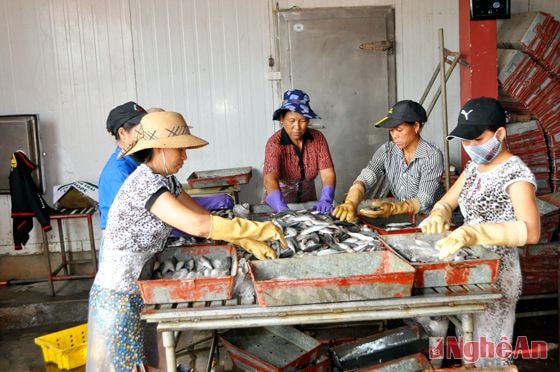 |
| Expanding and developing cold storage facilities - a sustainable poverty alleviation model in Nghi Tan ward, Cua Lo town. |
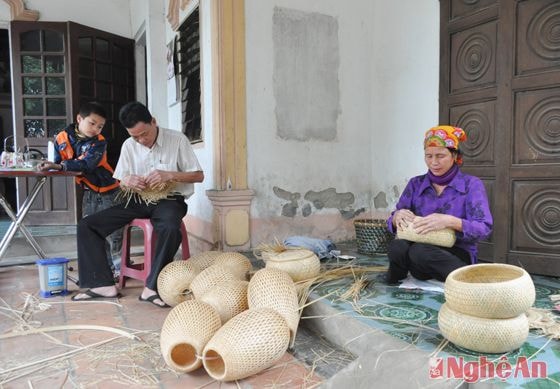 |
| Developing the rattan and bamboo weaving craft - a poverty alleviation model in Nghi Thai commune, Nghi Loc district. |
According to Mr. Nguyen Bang Toan, Director of the Department of Labor, War Invalids and Social Affairs, a comprehensive solution in the fight against poverty requires continued attention from all levels, sectors, and the political system. This should be identified as a key political task to focus leadership and guidance on. Greater attention should be paid to propaganda and raising awareness, thereby mobilizing social resources for this work; especially, empowering the poor themselves to strive to escape poverty is a decisive factor. At the same time, the process of accurately assessing poor and near-poor households should be strictly implemented. Based on this, the poor should be classified, the causes of poverty clearly identified, and appropriate interventions tailored to each group to create truly sustainable results.
Along with that, it is necessary to strengthen vocational training and job creation for workers, especially those in remote areas and ethnic minority regions, in order to create local jobs, supply labor to industrial zones inside and outside the province, and continue to promote labor export... Besides the resources invested in building infrastructure in poor communes and districts, which are gradually being integrated by the State and all levels through specific projects, an important factor is that localities and people need to make efforts in production and livestock farming, seize opportunities for vocational training, seek jobs, increase income, and build aspirations to become prosperous and wealthy...
Mai Hoa - Thanh Le


