
Nghe An Rubber Investment and Development Joint Stock Company: Steadfast in its development
(Baonghean) - After more than 8 years since officially planting the first rubber trees in Nghe An province, Nghe An Rubber Investment and Development Joint Stock Company has proven the project's success, with the rubber trees developing sustainably and becoming one of the top units with beautiful plantations within the Vietnam Rubber Industry Group.
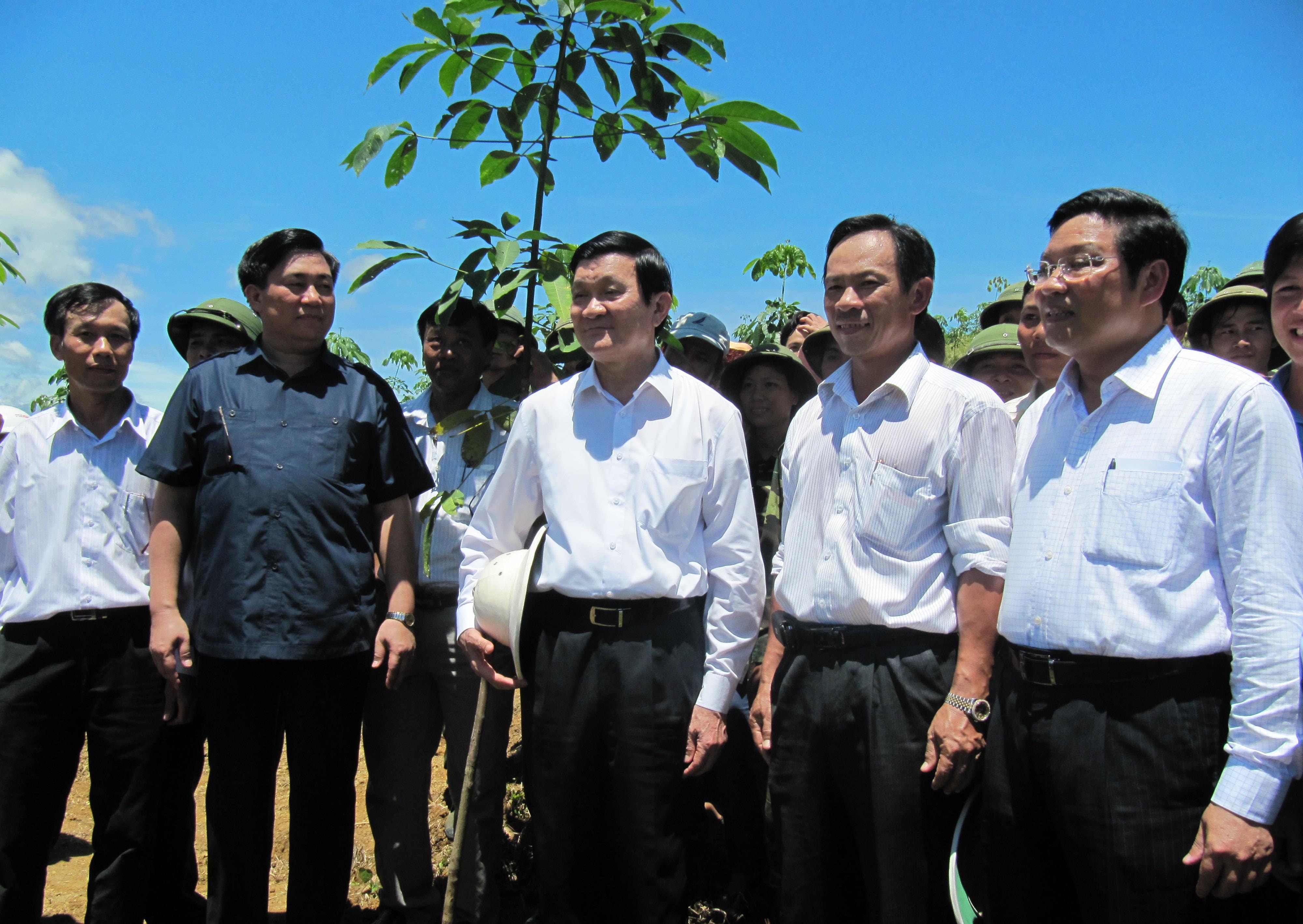 |
| President Truong Tan Sang and other leaders visited the company's orchard in 2011. |
Addressing employment issues effectively and ensuring social security.
Since September 12, 2010, when the first rubber tree was planted at the launching ceremony in Thanh Duc commune, Thanh Chuong district, until now, not only in Thanh Chuong and Anh Son districts, but also on the vast hills of Que Phong district, rubber trees have taken root and are thriving.
Overcoming numerous difficulties and facing harsh weather conditions, strong winds, scorching heat, and storms, the rubber plantations of Nghe An Rubber Investment and Development Joint Stock Company have resiliently grown lush and green, with high growth density. The latex yield from pilot harvesting at the end of 2018 reached 650 kg/ha, proving that rubber trees are well-suited for development in this western region.
To date, after more than 8 years, the company has developed rubber plantations covering over 4,363.52 hectares, including 4,238.84 hectares of mature rubber trees and 27.52 hectares of rubber trees grown for extended periods.
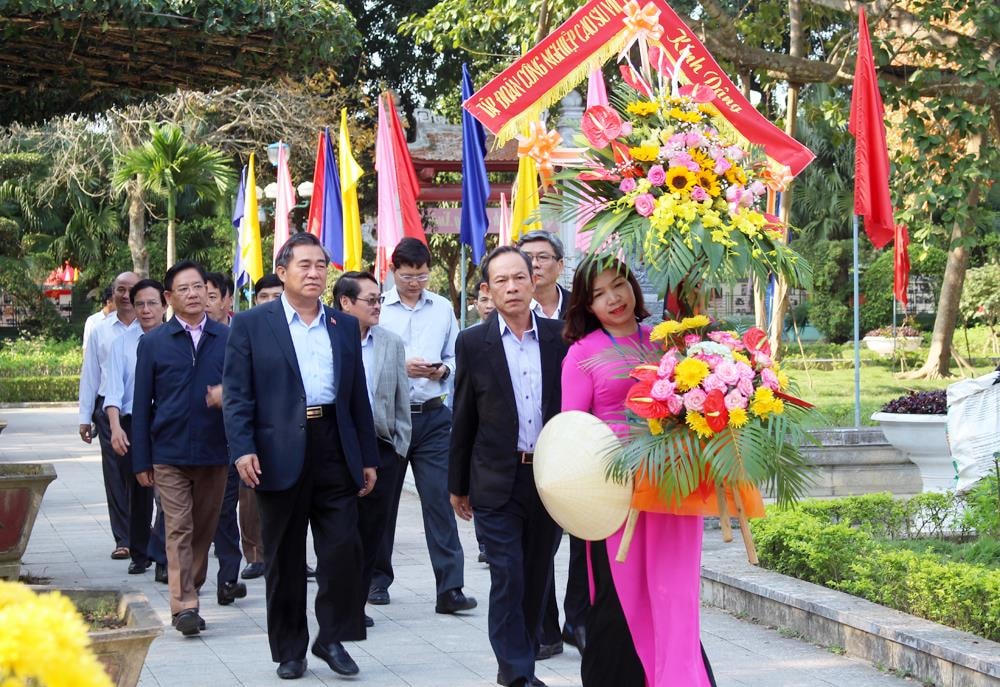 |
| Leaders of the Vietnam Rubber Industry Group and Nghe An Rubber Investment and Development Joint Stock Company offered incense at President Ho Chi Minh's birthplace. |
Que Phong is a high-altitude mountainous district, one of the 62 poorest districts in the country. Its steep terrain makes rubber tree cultivation very difficult. However, through concerted efforts and sound solutions, at the Que Phong Rubber Plantation, 10 hectares of rubber trees began production in early 2019 (two years earlier than planned); by early 2020, production will be further expanded to approximately 100-120 hectares.
Mr. Nguyen Van Linh, Director of the plantation, said: To date, the total area of 891.74 hectares of rubber plantations located in the four communes of Tien Phong, Hanh Dich, Que Son, and Muong Ngoc is developing very well. The plantation has 70 workers, of whom 62 are ethnic minorities in the area, with stable incomes. Many households that take care of rubber trees also intercrop with lemongrass and turmeric, and raise livestock to increase their income. For example, Mr. Vi Van Hai's household (Team 5) takes care of 30 hectares of rubber trees, raises nearly 30 cows, and intercrops other crops; or Mr. Sam Van Sau's household (Team 3), takes care of 10 hectares of rubber trees, raises dozens of buffaloes and cows, and intercrops lemongrass to increase his income...
The three districts are located in mountainous, remote, and ethnic minority areas with virtually no infrastructure investment. Meanwhile, due to fluctuations in the global rubber market, rubber prices have fallen sharply in recent years, leading to a corresponding decrease in investment costs, while the prices of materials and consumer goods remain high. Facilities and equipment are lacking; and the weather and climate are complex and extreme, significantly impacting production progress and increasing investment costs in several stages.
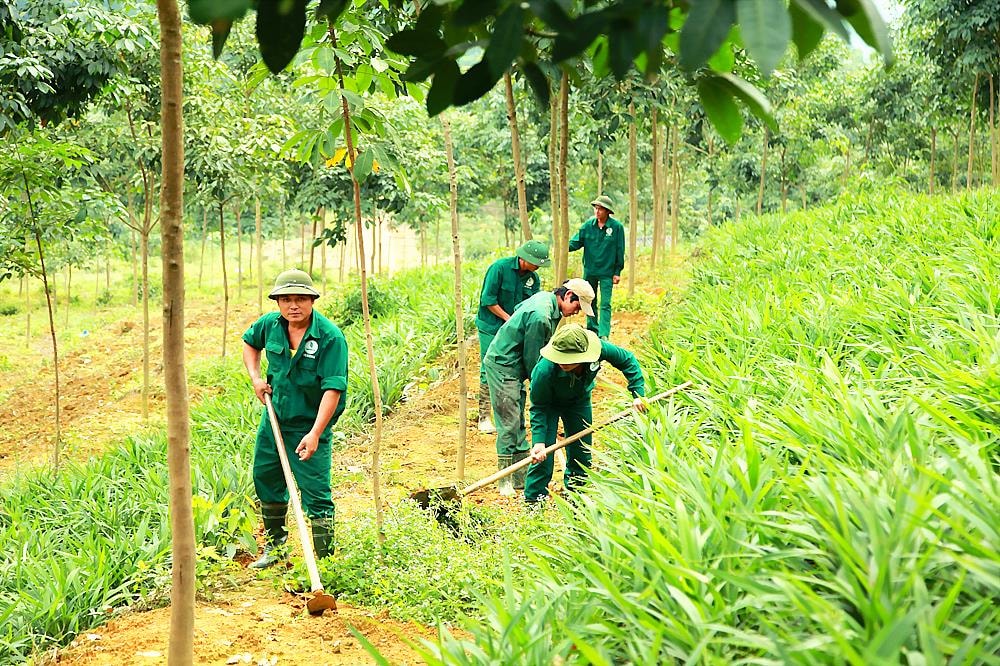 |
| Workers of Nghe An Rubber Investment and Development Joint Stock Company are tending to the rubber plantation. |
However, the company has implemented many practical and effective policies and strategies, applying them flexibly in its management and operations. Public relations work has always been given thorough attention, and the company has proactively organized land clearance to secure land for production, fulfilling its annual rubber planting plan. Simultaneously, it has ensured the stable living conditions of its employees, meeting its targets for state taxes, and ensuring that social insurance, health insurance, and unemployment insurance contributions for its workers are paid in full.
“As the project progresses, local people are hired as workers. To date, the total number of official employees of the company is 327, ensuring an average of 11.44 hectares per worker for the basic construction and maintenance of rubber plantations, providing workers with regular employment of 270-280 working days per year. In addition, thousands of seasonal workers participate in planting and caring for rubber trees. 100% of employees are covered by social insurance, health insurance, unemployment insurance, occupational safety insurance, and other full benefits. The average income reaches 3 million VND/person/month for workers caring for rubber trees in basic construction and 4.5 million VND/person/month for workers in rubber tapping.”
During the development process, the company restructured the varieties to suit the climate and soil conditions of each locality; organized the planting and care of new rubber plantations in accordance with technical procedures, thereby ensuring the quality of the plantations and their growth and development.
During a working visit and inspection in February this year, Mr. Tran Ngoc Thuan, Chairman of the Board of Directors of the Vietnam Rubber Industry Group, highly appreciated and affirmed that the rubber project in Nghe An has a rapid development rate. The plantations are invested in and cared for according to procedures, ensuring growth and development, ranking among the "top" plantations of companies in the Central coastal region and the northern mountainous provinces. In 2018, the company was assigned by the Group to exploit 97.16 hectares, with an average latex yield of 600 kg to 700 kg/ha/year in the first year, and striving to achieve 900 kg/ha/year in the second year of rubber exploitation.
To date, the company has constructed over 312 km of internal roads serving production and 11.5 km of main roads meeting the standards of mountainous region level VI in the project districts. The company's production road system is connected to the rural transportation infrastructure of the communes, facilitating the lives and activities of the local people; supporting the digging of clean water wells for the communities in the rubber plantation areas and supporting the construction of rural roads in Tien Phong commune, Que Phong district…
Moving towards building a modern processing line.
Currently, Nghe An Rubber Investment and Development Joint Stock Company is focusing on implementing various solutions, striving to increase the average income of its employees by 5-10% annually. At the same time, it is actively directing efforts to properly care for and protect the existing 4,363.52 hectares of rubber trees, gradually improving the quality of the plantations; and making rational investments in rubber plantations to ensure technical procedures are followed and to bring them into production as soon as possible.
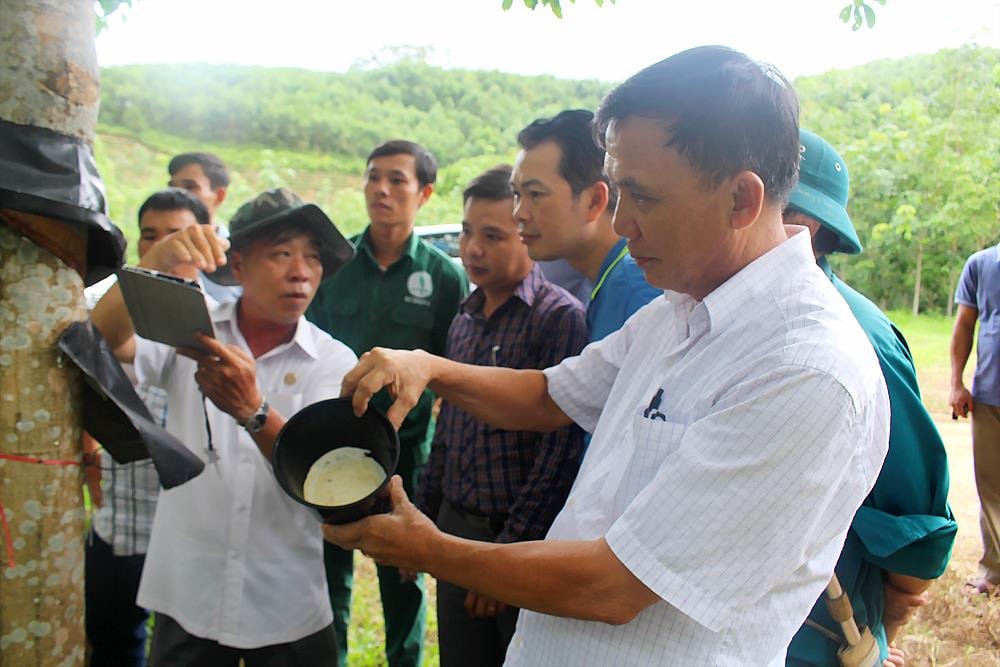 |
| In 2018, the company's first rubber plantations began producing latex. |
Mr. Pham Trung Thai, Chairman of the Board of Directors of the company, who has been involved since the early days of introducing rubber trees to Nghe An province, shared: "In 2019, we continued to strive to build the company towards sustainable and stable development, providing better income for employees, ensuring our obligations to the State, and contributing to maintaining security and order in the area."
The specific goal is to better care for 4,119 hectares of rubber plantations; in 2019, the harvested area was 245 hectares, with a yield of 7-8 quintals/hectare; in 2020, the harvested area will be 800-900 hectares. “Currently, we are continuing to sign contracts with a qualified unit to process the products while the company has not yet built a factory. At the same time, we are urgently developing a plan for the proposed location of the processing plant with advanced and modern technology to produce products that meet market demands; and training a team of technical staff and workers to serve the processing, business, and import/export activities,” said Mr. Pham Trung Thai.


