
"Let's all consume responsibly"...
(Baonghean) - The theme of World Environment Day 2015, "Together for Responsible Consumption - For a Sustainable Earth," is a message to every citizen to think and change their actions in consumption...
All kinds of waste
A friend who had lived abroad for many years returned home and confided: "I've noticed something strange: our homeland isn't rich, yet the spending is incredibly wasteful." He cited examples like lavish parties and banquets where leftover food piled high on the tables, and beer and soft drinks were poured into large glasses and left untouched. His words reminded me of a story another friend told me about his uncle's family in his hometown, who had worked hard their whole lives, and who, nearing 50, decided to move to the capital for a visit.
And to afford that trip, my uncle's family had to sell an extra pig from their sty and two taels of gold they had saved up. Their "motto" was: "No one knows how hard things are at home, but when you go out, you have to be 'respectable,' and everyone must order their own portion of food; no sharing." With this "motto" instilled from the start, whenever they went to any restaurant, my uncle's family would order a lot of food and even leave leftovers, as a kind of "courtesy"...
From the two stories above, it's clear that most consumers around us today suffer from a "vanity syndrome," leading to wastefulness. From an environmental protection perspective, this indirectly causes environmental pollution. Producing food begins with raising livestock and poultry, requiring large areas of land, water, food, and fuel; and for industrially produced food, the processing requires natural resources, electricity, coal, gasoline, and oil... These fuels all pollute the environment. Furthermore, leftover food releases waste into the environment, also causing pollution. If we limit consumption, we will certainly reduce the emission of pollutants from farming, animal husbandry, and production.
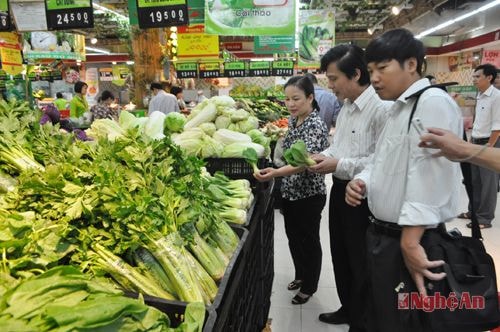 |
| Even vegetable production has consequences for land and water resources, and chemical residues negatively impact the environment. |
Another fairly common type of waste today is electricity. Many households don't fully understand how to use electrical appliances more efficiently. For example, turning the TV on and off with a remote control, or plugging in the water heater or washing machine when not in use, still consumes electricity. Another common problem is purchasing appliances that aren't suitable for their needs. According to one calculation, if 1 million families in Vietnam replaced their 75W light bulbs with energy-saving bulbs, the total annual electricity savings would be equivalent to 280 billion VND.
On the other hand, some well-off households think that monthly electricity bills are very small compared to their total living expenses, so they don't pay attention to or have no awareness of saving electricity. For organizations and agencies, despite limited budgets, the wasteful use of electricity, with no one taking responsibility for shared costs, still occurs. The wastefulness of electricity in the province is also evident in alleyways, streets, and on advertising billboards and posters, where the electricity company provides lighting even when it's not needed.
Even greater waste comes from numerous public investment projects that are wasteful, such as those built but never used; projects with excessively short lifespans; and cases where projects are fabricated to legitimize spending. This waste stems from a narrow vision and a lack of responsible consumption habits.
According to experts, the concepts of responsible consumption and sustainable consumption are not yet fully understood, and implementation remains limited. Meanwhile, many consumption habits, influenced by customs and traditions, have become direct or indirect causes of resource exploitation and environmental damage, leading to ecological imbalance and unsustainable development. Similarly, excessive use of industrial products and insufficient use of eco-friendly products contribute to the release of non-biodegradable waste into the environment.
We need to consume responsibly.
World Environment Day 2015, with the theme "Together for Responsible Consumption - For a Sustainable Earth," aimed to call on people to protect the planet now through practical actions in their consumption. In reality, while technological advancements have made human life more convenient and efficient, nature has been increasingly devastated and polluted. With the depletion of natural resources, a large amount of plastic bags and non-biodegradable plastic consumer goods are being discarded into the environment. Similarly, the excessive use of industrial products, the wasteful use of agricultural products, and the wasteful use of resources... These seemingly "normal" actions are leading to unforeseen consequences such as climate change and environmental pollution, which we are now suffering from, including rising sea levels causing erosion, land loss, resource depletion, floods, and droughts.
To mitigate the aforementioned situation, according to Ms. Nguyen Thi Tien, Deputy Head of the Provincial Environmental Protection Department, the most important thing is for people to change their purchasing and consumption behavior. Because consumption – purchasing power – is the essence and root of development. Demand is essential for supply and the development of supply sources. If consumers change their consumption habits, producers will also change, and society will change accordingly. For example, consumers abandoning the habit of using products derived from rare and endangered animals or forest products will contribute to increasing biodiversity, combating the risk of extinction in certain animal groups and species, preventing the depletion of forest resources, and contributing to environmental protection. It also requires saving in consumption; saving here doesn't mean not using, but using most efficiently, satisfying needs at the lowest cost. Simultaneously, businesses, organizations, and individuals need to enhance their responsibility in collecting used products to protect the environment. Recently, the Prime Minister also issued Decision No. 16/2015/QD-TTg, dated May 22, 2015, on regulations for the recovery and processing of discarded products nationwide, including batteries, washing machines, air conditioners, refrigerators, computers, mobile phones, lubricants, inner tubes, tires, and vehicles that have reached the end of their service life.
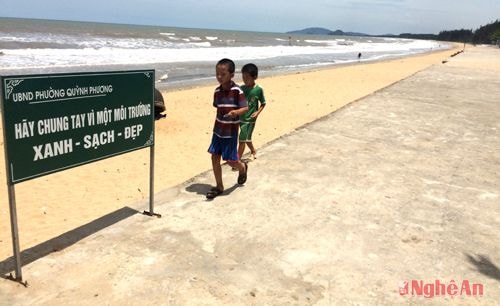 |
| Quynh Phuong beach in Hoang Mai town is kept clean and beautiful. |
World Environment Day 2015 coincided with Vietnam's Sea and Islands Week 2015, themed "Blue Ocean, Green Planet." In response to these two events, the Provincial People's Committee issued Plan No. 285/KH-UBND, dated May 20, 2015, on organizing practical activities to raise awareness, understanding, and action regarding environmental protection, sustainable development, and climate change adaptation; to use natural resources efficiently and effectively; and to encourage and mobilize each individual, agency, organization, and enterprise to consume responsibly and sustainably.
The Provincial People's Committee assigned the Department of Natural Resources and Environment to coordinate with relevant departments, agencies, and localities to organize a rally in response to World Environment Day and the Week of the Sea and Islands in 2015 on June 2nd in Quynh Phuong commune (Hoang Mai town) with over 500 participants. The event aimed to raise awareness and promote environmental protection and the preservation of maritime sovereignty; and to encourage all citizens, organizations, units, and businesses to conserve energy by using energy-saving household appliances such as compact fluorescent lamps and rechargeable batteries, while also fostering the habit of turning off lights and computers when not in use.
Protecting the environment by practicing a frugal lifestyle and reducing living expenses is not only true in daily life but also helps reduce greenhouse gas emissions. For example, reducing the use of plastic packaging and bags significantly reduces production and recycling costs, decreases fuel consumption, and limits environmental impact. Actively growing safe fruits and vegetables at home for consumption reduces the use of chemical fertilizers and pesticides in production, which increases methane emissions in the air. Eating plenty of fruits and vegetables improves health, because the habit of eating fewer vegetables and more meat is not only bad for the body but also increases the scale of livestock farming – the largest producer of greenhouse gases. Let each person act with awareness and ability to celebrate World Environment Day, not just on this one day but daily throughout the year, to contribute to changing the living environment, "for a sustainable planet."
Minh Chi


