
How to properly perform the Mid-Autumn Festival (Rằm tháng Bảy) ritual?
(Baonghean.vn) - July, the month of wandering spirits, is a time when free spirits return to the mortal world, seeking ways to re-enter by seizing and binding the souls of the living. Therefore, Vietnamese people have the custom of offering sacrifices during the month of wandering spirits to ward off evil, pray for peace, and dispel bad luck.
According to folklore, the period from the 2nd of July is when the King of Hell orders the opening of the Gate of Hell, allowing ghosts and demons to enter, and after midnight on the 15th of July, these ghosts and demons must return to hell.
 |
| Image of the King of Hell ruling the Gate of Hell. (Image from the internet) |
Should the offering ceremony for the 15th day of the 7th lunar month be held on the 14th or 15th?
Because it is believed that the gates of hell are opened on this day to grant amnesty to the souls of the deceased, people prepare offerings to appease homeless and destitute spirits, hoping they will find peace and not be disturbed by evil spirits. In Northern Vietnam, people usually make offerings to the earth god, ancestors, and grandparents before the 15th day of the seventh lunar month.
On the 15th day of the seventh lunar month, the Buddha grants amnesty to the deceased for one day. All souls, including sinners and evil spirits, are set free. Therefore, folk belief holds that offering sacrifices on this day might invite trouble from these spirits, bringing more malevolent forces and wandering souls into one's home. Also, because so many spirits wander, burning paper offerings on this day is believed to easily lead to theft, making it difficult for relatives to receive them.
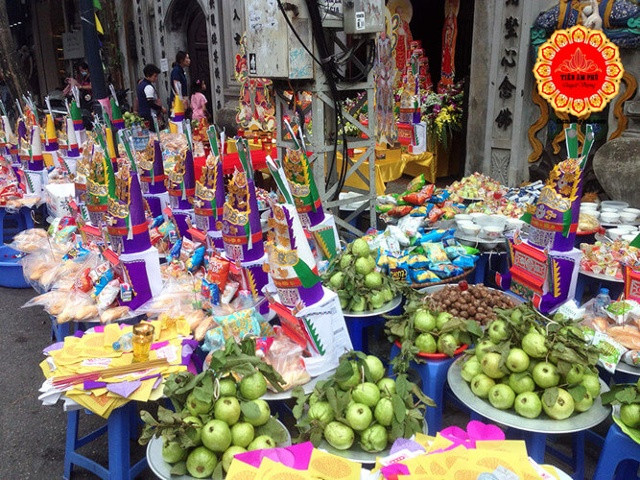 |
| The image shows offerings to wandering souls made right in front of a temple gate in Hanoi. |
Therefore, the names of the recipients are usually clearly written on the paper clothes and other items used in the ritual. When offering sacrifices, the names are also clearly stated, and permission is asked of the local deities to allow the deceased to receive the items. The offerings are made and burned beforehand so that the deceased can easily receive them.
What is the correct time to offer prayers on the 15th day of the 7th lunar month?
The Vu Lan Festival, a time for praying for the souls of ancestors and showing filial piety, should be performed during the day. However, the ritual of offering alms to wandering souls who were unfortunate, homeless, and suffered injustice in society should be performed in the late afternoon or evening.
According to folk beliefs, during the day there is strong sunlight, while the wandering souls, released from their "prison gates," are very weak. Therefore, if offerings are made during the day, the wandering souls, fearing the light and sunlight, will not dare to come and receive the offerings from the families. However, regardless of the time chosen, the offering to wandering souls must take place before midnight on the 15th of July.
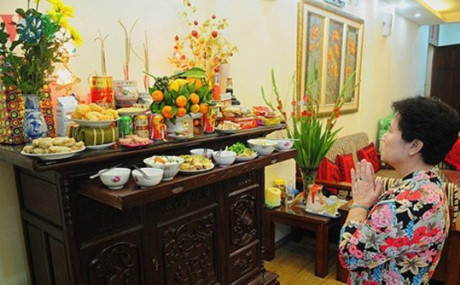 |
| The ritual of offering sacrifices to wandering spirits should be performed in the late afternoon or evening before midnight on the 15th day of the 7th lunar month to avoid inviting spirits into the house. (Illustrative image.) |
Should we offer prayers for the 15th day of the 7th lunar month at home or at the temple first?
On this day, families should go to the temple to perform the Vu Lan ceremony, praying for the souls of their parents, grandparents, and ancestors to show filial piety during the day. Afterwards, they should return home to prepare a vegetarian meal and offer incense at the Buddha altar and the altar of their deceased relatives.
Specifically, the offering tray for wandering souls who have not yet found peace should be prepared in the late afternoon or evening. The offering tray should be placed in the yard, not on the doorstep.
If you don't want to offer sacrifices to wandering souls at home, you can do so at a temple. The Vu Lan filial piety ceremony at home should follow these rituals: offering to Buddha, offering to deities, offering to ancestors, offering food to wandering souls, and releasing animals.
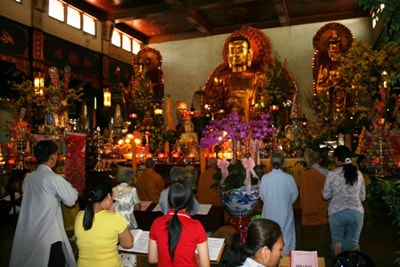 |
| During the full moon of the seventh lunar month, the Vu Lan filial piety ceremony is an indispensable part of Buddhist rituals. This is one of the main holidays of Buddhism. |
What preparations are needed for the Hungry Ghost Festival?
Salt and rice (1 plate), thin white rice porridge (12 small bowls) or rice balls (3 balls), 12 pieces of brown sugar, paper clothing, paper money, popcorn, sugarcane (with the peel on and cut into small pieces about 15 cm long), cakes, candies, water (3 small glasses), 3 incense sticks, 2 small candles.
Preparing for the Buddhist ceremony.
On the 15th day of the seventh lunar month, prepare a vegetarian meal or, more simply, a plate of five kinds of fruit to offer to Buddha at home. When making the offering, it is best to recite a sutra – the Ullambana Sutra – to understand the meaning of the Day of Filial Piety and dedicate the merits to deceased relatives so that they may be reborn in a higher realm.
Offering sacrifices to deities and ancestors.
Some Vietnamese people believe that the harvest season begins each year around the 6th and 7th lunar months. To ensure good fortune and smooth progress, people often pray to deities and spirits of the land to imprison evil spirits and vengeful ghosts so they won't cause trouble.
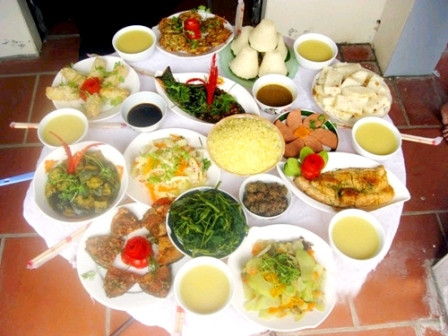 |
| Offering tray for the full moon ceremony in the seventh lunar month. |
By the 15th of July, everything must be completed; this is also the time when "the gods forgive the spirits, the landowner forgives the rice planters," and "the gates of hell open to pardon the deceased." On this day, people usually hold a thanksgiving ceremony to the gods and prepare a feast to commemorate their ancestors, praying for the souls of the deceased to find peace and for the family to be blessed. Therefore, most families offer meat dishes, but according to Buddhist teachings, vegetarian offerings are better.
Religious rituals and taboos exist in almost every country, even the most advanced and modern ones. In a way, these taboos help people maintain peace of mind.
Throughout history, the spiritual cultures of most nations around the world have included customs and taboos aimed at bringing good fortune and avoiding bad luck. However, these taboos are only relative and should not lead to excessive superstition.
Kim Ngoc
(Synthetic)


