
"The low pitch" of drumming
(Baonghean) - Through the ups and downs of time, the drum-making craft in Nghe An has been preserved, with renowned master craftsmen in every era. The drum-making craft has contributed to improving the lives of local people and creating jobs for local laborers. However, in recent years, the craft has faced difficulties due to a shortage of raw materials and weak market demand.
Visiting the traditional drum-making village of Hoang Ha in Dien Hoang commune (Dien Chau district), and chatting leisurely with the elders, I learned that the craft of making drums in Hoang Ha has existed for several hundred years. The founders of this drum-making village were Nguyen Phuc Giang and Nguyen Phuc Dat, descendants of the Nguyen Dinh family, descendants of Cuong Quoc Cong Nguyen Xi. Mr. Hoang Thanh Tan, head of Hamlet 18 (Hoang Ha drum-making village), recounted: During the war against the US, the drum-making craft in the village declined. However, the drum makers were conscious of preserving the craft, and the elders tirelessly passed on their "master techniques" to the younger generation. With perseverance and dedication to the craft, Hoang Ha drum-making village was recognized as a traditional craft village by the province in 2009. Hoang Ha drums, with their diverse range of products such as medium, large, and small drums, are well-known in markets both within and outside the province. For a long time, the drum-making craft has contributed to improving the lives of the people, but it is currently facing many difficulties, especially in finding markets for its products.
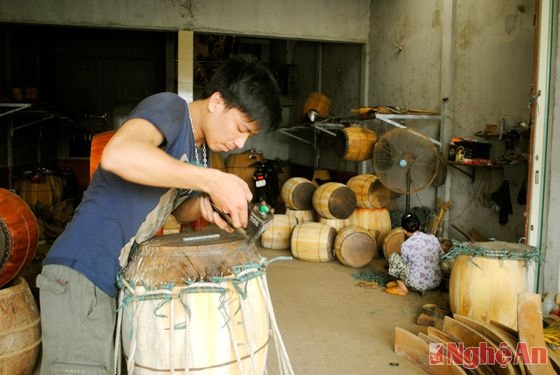 |
| Drum makers in Nam Son (Do Luong) use nail guns to make drum frames. |
Visiting the drum-making workshop of 45-year-old Nguyen Van Tam, we saw a space filled with the clatter of chisels and carvings; drums of all sizes were piled up. Mr. Tam explained: "I started making drums when I was 15, got married at 26, and passed the trade on to my wife. Before, it took us two or three days to make a drum by hand. Now, we've bought additional equipment like circular saws, rim saws, boring machines, and planers... and we can make two or three drums a day. However, sales aren't always brisk. Slow sales are partly due to the fact that a medium-sized drum costs between 1 and 1.5 million VND, but lasts for over 10 years before needing replacement... Sometimes we have to sell the drums we make as far away as Ha Tinh and Quang Binh provinces." According to Mr. Tam, while the machinery allows for faster production, the difficulty in finding buyers means they only dare to produce on a limited scale, mainly making drums only when orders come in. His workshop produces about 70-90 drums of various types per year, generating revenue of over 110 million VND. After deducting expenses, the profit is only 50 million VND for two workers, which is far too low.
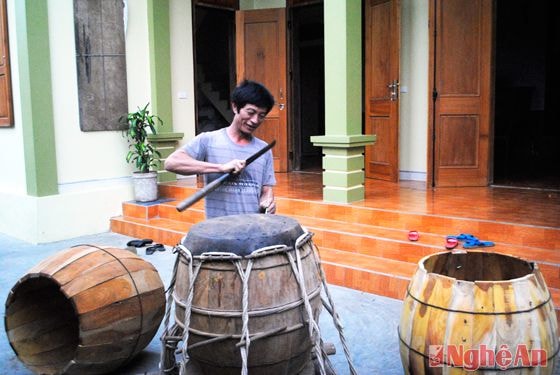 |
| Mr. Nguyen Van Tam, a drum maker in Hoang Ha village, Dien Chau district, is nailing a drum. |
At Mr. Nguyen Xuan Ky's family drum-making facility, there are currently over 10 drums in stock, priced from 1 to 8 million VND per drum depending on the type. Mr. Ky shared: "Each year, our family produces about 150 drums. To find a market for our products, we have to find ways to sell them. For example, we regularly send people to clans, ancestral temples, and schools to 'market' them. When a drum is sold, we immediately write our phone number on the drum so others know. During Tet (Lunar New Year), customers who buy drums are given a wall calendar with our phone number printed on it for easy contact. Not to mention, we even travel to Laos to sell drums to Vietnamese expats and Laotians. Even so, sales are still very difficult. Each year, the drum makers of Hoang Ha village only leisurely produce drums during Tet, Thanh Minh (Qingming Festival), and from summer to Mid-Autumn Festival. The products we make are mainly medium-sized drums; very few large drums are used for festivals."
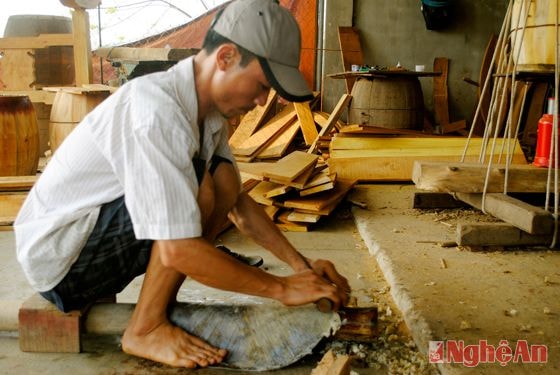 |
| Drum makers in Nam Son - Do Luong use a nail gun to assemble drum frames. |
The lack of a guaranteed market for drum-making is also a reason why young people are not enthusiastic about the craft. For example, Mr. Nguyen Van Tam's family has been making drums for a long time, with both husband and wife working in the drum-making trade, while their two children have pursued other professions. Mr. Nguyen Xuan Ky's family has five children, but only one has followed the trade, while the other four work in other professions. It is known that Hoang Ha drum-making village currently has over 200 households, but only 18 households practice drum-making, with nearly 10 of them producing on a large scale. Due to limited promotion and branding, sales contracts for drums have been scarce in recent years, and the income of drum-making workers is steadily declining, reaching only about 2.5 - 3 million VND per person per month.
In Luu Son commune (Do Luong district), Mr. Tran Cong, a drum maker, told us: "Previously, we produced drums in Thanh Van (Thanh Chuong district). Due to difficulties in selling them, we had to move to land along National Highway 7 in Luu Son commune for easier sales. We've been in the new location for two years, but the market for drums remains unstable. Sometimes, we only sell 7-10 small drums a whole month, mainly to local people and schools." According to Mr. Cong, there used to be 5-6 households producing drums in Thanh Van commune (Thanh Chuong district), but now only a few remain. Mr. Cong's own workshop is run by him and his wife on a small scale, and he doesn't dare let his children continue the trade.
In Nam Son commune (Do Luong district), there are also a few families who originally came from Doi Tam drum-making village in Duy Tien district (Ha Nam province) to make drums. Mr. Truong, a drum maker, confided: “Doi Tam drum-making village is famous nationwide, but due to difficulties in selling the drums, many families have switched to making wine 'bombs' (wood sawn and assembled into containers for wine bottles). My family has been involved in drum-making for generations. To preserve the craft and make a living from it, I had to move to Nghe An to make drums…”
When asked if the drum makers in Hoang Ha village receive any social assistance from the organization regarding capital and market access, they replied that although the province recognized the village as a drum-making craft village in 2009, drum makers have long had to do everything themselves, find their own markets, and borrow capital. If loans are available, priority is given to poor households and those eligible for social welfare programs.
Drum makers in Hoang Ha village say that to make drums, families have to invest over 50 million VND in equipment and machinery, not to mention the annual investment of over 150 million VND in jackfruit wood and buffalo hide for reserves. Most of this money is borrowed from outside sources, without any preferential loans under any policy, making it very difficult to develop the drum-making craft. In Hamlet 5, Nam Son commune (Do Luong district), Mr. Tran Son's drum production facility is the most extensively invested. Mr. Son said: "Our facility invested over 500 million VND in a jackfruit wood bending machine (Korean technology) (mainly used for bending jackfruit wood for other drum-making villages in the province)."
Previously, people had to saw the wood into round shapes, which was very wasteful. Now, they just need to put straight pieces of wood into a machine to bend them. Each batch bends 400-500 pieces of wood in various sizes for different types of drums. If we can get a preferential loan, we will buy more machines to process the "raw" wood for drum making." According to Mr. Son, processing the jackfruit wood using machinery ensures the quality of the wood in terms of dryness and bending, reducing labor and costs for drum makers, and making the drums sell at a lower price.
However, the biggest challenge for drum-making today is the increasing difficulty and high cost of raw materials. Jackfruit trees are grown by farmers in their gardens, mainly for their fruit, but because people recognize the advantages of jackfruit wood such as durability, resistance to termites, and lightness, many are "hunting" for it to make furniture and house frames. When they cut them down, they do so in large quantities, but they are not allowed to replant. Not to mention that many people are even cutting down jackfruit trees to plant other crops with higher economic efficiency. Mr. Dinh Chieu from Hoang Ha drum-making village affirms: The main materials for making drums can only be jackfruit wood and buffalo hide. The price of jackfruit wood is quite expensive, ranging from 16 to 18 million VND/m3. If drums are produced year-round, 5 to 8 m3 of jackfruit wood needs to be stockpiled. There are times when jackfruit wood is in short supply, sometimes forcing people to take a month off work to "hunt" for jackfruit wood in Nghia Dan, Tan Ky, and Yen Thanh districts...
Buffalo and cow hides are not rare; however, most slaughterhouses prefer to sell them to factories and businesses that produce leather shoes and sandals, making hides for drums difficult to obtain. To make a medium or large drum, drum makers often have to go to great lengths to buy intact buffalo hides from buffalo and cow slaughterhouses. Unlike other crafts, drum making is a family tradition, as only descendants within the family are taught the secrets of the trade. However, along with the difficulties caused by the market economy, young people are not interested in drum making. And, not everyone who pursues the profession becomes a skilled craftsman; drum makers must have a good ear and a keen sense of sound to understand the resonance and bounce of each type of drum.
With numerous difficulties piling up, the risk of the craft disappearing is a major concern for drum-making villages today. Mr. Tran Van Huy, Head of the Policy Consulting Department of the Provincial Cooperative Alliance, stated: To date, only Hoang Ha village has been recognized as a traditional craft village by the province (with nearly 20 participating households). The remaining villages have scattered, smaller-scale drum-making activities with 3-7 households each, such as Nghi Duc drum-making village (Vinh City), Thanh Van drum-making village (Thanh Chuong), and Nam Son and Luu Son drum-making villages (Do Luong).
Besides improving designs, enhancing quality, and lowering production costs, the Hoang Ha drum-making village, for example, needs to obtain a collective trademark registration certificate to further enhance the value and reputation of its products, making drums more competitive in the market. Regarding capital, the province currently lacks specific policies and mechanisms for the drum-making craft; therefore, those involved in the craft can form joint ventures or partnerships to establish businesses in order to access loans. Local authorities act as guarantors for household groups to borrow capital from the Policy Bank through channels such as the Farmers' Association, Women's Association, and Youth Union... Regarding raw materials, buffalo hide will not be in short supply; however, it is predicted that in the future, when forest wood becomes scarce, jackfruit wood will become even more valuable. The agriculture and forestry sector needs to coordinate with localities to plan jackfruit growing areas and advise farmers to utilize their home gardens and barren hillside land for jackfruit cultivation, both to ensure an abundant supply of jackfruit wood for drum making and to increase income for jackfruit growers.
Thus, during this difficult period, in addition to dedicated drum makers preserving their craft, it is time for the government to implement practical policies and mechanisms to help drum-making households and villages stabilize production, and, if given the opportunity, elevate their products to reflect the rich cultural identity of Vietnam.
Van Truong


