
Is the battle for influence in the Middle East heating up again?
(Baonghean) - Amidst the ongoing fierce fighting in Yemen, the Secretary-General of the Arab League, Nabil al-Arabi, has accused Israel, Iran, and Türkiye of instigating conflict in several Middle Eastern countries and complicating efforts to achieve stability in the region.
Previously, relations between Iran and Türkiye also became strained after Türkiye hinted at Iran's involvement in the crisis in Yemen. These developments indicate that the Middle East is at risk of heating up again with a race for influence among regional powers.
| Yemen continued to be bombed during the night of March 29th and the early morning of March 30th, 2015. Photo: Reuters |
Yesterday, Iran demanded that Turkey's chargé d'affaires in Tehran explain President Recep Tayyip Erdogan's remarks, which strongly criticized Iran's role in Yemen and the region. Also yesterday, in his closing remarks at the Arab League summit in Egypt, Secretary-General al-Arabi accused Iran, Türkiye, and Israel of interfering in other countries in the Middle East.
In fact, the Middle East has long been plagued by deep-seated ethnic and sectarian conflicts. Therefore, the crisis in Yemen has exacerbated these overlapping tensions. Yemen is a member state of the Arab League, and thus, it is a matter of common concern for the Arab world. When Yemeni President Mansur Hadi and his entire government were driven out of the capital Sanaa following attacks by Houthi Shiite rebels, Saudi Arabia quickly formed a coalition of Arabs to conduct airstrikes and intervene in Yemen. While this intervention was in response to a call from the current government of President Mansur Hadi, it has also faced considerable criticism from several countries. Iran, in particular, argues that the Arab coalition's military intervention in Yemen violates international law and constitutes an act of aggression against a sovereign state. In some respects, the Arab coalition's airstrikes on Yemen did not have the support of a United Nations Security Council resolution.
As one of the most influential countries in the Arab League, Saudi Arabia – a Sunni Muslim-led nation – intervened in Yemen with US backing. This military intervention aimed to support the Sunnis, who were weakened by the Shiite Houthi forces. Meanwhile, Iran, being a Shiite Muslim country, has been accused in the Arab world of involvement in the Houthi takeover. Although Iran has denied these accusations, experts believe that Saudi Arabia's swift legitimization of the Arab coalition's intervention in Yemen was actually aimed at curbing Iranian influence in the country, which was considered Iran's backyard, before the Arab Spring took place.
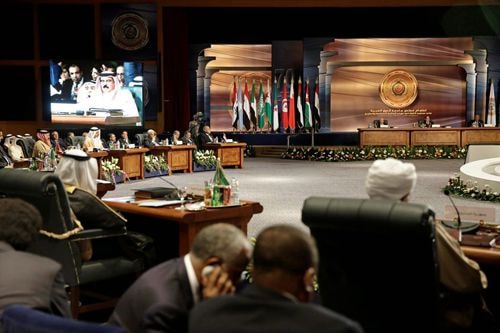 |
| Leaders of the Arab League countries met in Sharm el-Sheikh on March 29. |
Furthermore, adding to the chaotic conflicts in the Middle East are two key factors: Turkey and Israel. Turkey, with a predominantly Sunni Muslim population and a Sunni Muslim leadership, is not part of the Arab world. However, as a regional power, Turkey will certainly not remain passive as the competition for influence in the region intensifies. Israel, on the other hand, has strained relations with the Arab world and a hostile relationship with Iran. Inciting conflict, or even clashes, between the Arab world and Iran is likely part of the Israeli strategy, allowing them to reap the benefits. Therefore, the Arab League's accusations of involvement by Iran, Israel, and Turkey in the Yemen crisis in particular, and the instability in the Middle East in general, are justified.
It is clear that the current civil war in Yemen is no longer just an internal conflict within a single country, but has indirectly become a battleground for overlapping conflicts stemming from external forces. Public opinion fears that the crisis in Yemen will further intensify the struggle for influence among regional powers, and potentially even global powers. Thus, the Yemeni people will continue to bear the consequences of the war. And if the conflicts between external forces continue to escalate, the current conflict in Yemen is unlikely to end.
Nguyen Cao Bien
| RELATED NEWS |
|---|


