
The race to the Arctic heats up again.
(Baonghean) - In an effort to boost tourism and attract international visitors, Russia's Arkhangelsk region has just opened a new border control station in the far north at the Franz Josef Land archipelago in the Arctic. This event will facilitate the control of ocean-going vessels entering Russia's Arctic National Park. However, this move has caused unease among a number of countries around the region - especially the United States - making the race for sovereignty over the unclaimed Arctic territory increasingly intense.
Russia is investing heavily in the Arctic.
Opening border control stations in the Arctic is seen as the latest step by Russia in its strategy to assert sovereignty in a region that is increasingly becoming a hotbed of territorial disputes among several countries. This strategy was actually launched by Russia with the symbolic act of planting a flag on the seabed of the Arctic Ocean in 2007. By early last year, Russian President Vladimir Putin announced that Russia would build a unified network of naval bases in the Arctic to accommodate modern warships and submarines, as part of a plan to strengthen the protection of Russia's interests and borders in the region. In 2014, the Russian Ministry of Defense also announced plans to reopen airports and ports in the New Siberia and Franz Josef Land archipelagos, alongside at least seven runways in the Arctic Circle mainland that had been abandoned since 1993.
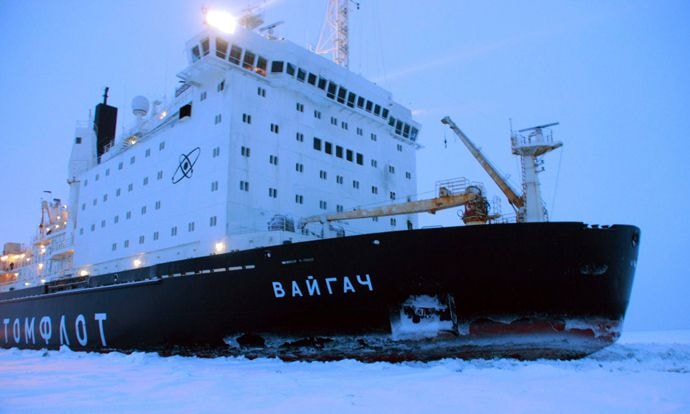 |
| A large Russian icebreaker. (Source: RT) |
In just one year, by December 2014, Russia had taken a significant step forward by commissioning a new Joint Strategic Command, also known as the Arctic Command, based on the forces of the Northern Fleet. Continuing this momentum, in March of this year, President Putin ordered the Northern Fleet, airborne forces, and other military units to participate in exercises to demonstrate Russia's strength against threats from the North. Beyond the military front, in April of this year, Russia launched a new floating scientific research station in the Arctic called "Arctic - 2015." The new station has enough space for 20 scientists and is capable of floating on ice, marking the return of Russian scientific research to the Arctic Ocean. And less than two weeks earlier, Russian paratroopers had successfully landed on an ice floe in the Arctic Ocean for the first time in history, carrying the necessary tools and equipment to establish a base near the North Pole.
The heated race
With Russia's aggressive moves, it's not surprising that the US and a number of countries directly and indirectly involved in the Arctic, such as Norway, Denmark, Canada, Finland, Iceland, and Sweden, are showing great eagerness. This stems from the Arctic region – a land with approximately 4 million people, and most importantly, a wealth of untapped natural gas and oil resources. According to the US Geological Survey, the Arctic currently holds about 13% of the world's oil reserves and 30% of its natural gas reserves, not to mention other oil and gas resources such as hydrocarbons in oil shale and methane on the continental shelf. Fish are also a plentiful resource as global temperatures rise and thaw frozen bodies of water. Melting ice also means that the value of maritime trade and military exchanges in the Arctic will increase.
Some argue that the rate of ice melting is directly proportional to the increasing tension in the race for dominance and the pursuit of sovereignty by countries in the Arctic. Besides Russia, the United States and Canada are two other nations taking significant strategic steps in the region. While the US Congress authorized its military to implement a strategic plan for Arctic development starting in 2020, Canada has announced plans to establish a fleet worth approximately $3.2 billion to patrol the area. Meanwhile, although not directly bordering the Arctic, China cannot ignore its interests there.
This is a roadmap that has even been planned since the 1980s, along with expeditions and investments in polar research. India, since 2013, has also planned to purchase icebreakers to conduct Arctic exploration. However, the current race seems uneven, as recently, the Commander of the US Coast Guard, Paul Zukunft, had to admit that Washington cannot compete with Moscow. The reason is that while the US only has one operational icebreaker, Russia has a fleet of six massive nuclear icebreakers.
Who is the winner?
However, superior military power does not automatically guarantee Russia's dominance in the Arctic. Once the ice begins to melt, the seas in and around the Arctic will be governed by international law applicable to all other oceans, specifically the 1982 United Nations Convention on the Law of the Sea (UNCLOS). This will require a long process involving surveys, inspections, and other measures for the countries involved to resolve overlapping claims. According to the regulations, surrounding nations have the right to exploit resources such as oil, gas, and minerals within 200 nautical miles of their respective coastlines. To date, there are no regulations concerning sovereignty or exploitation rights in the Arctic for any nation, including Russia or the United States. Therefore, it can be asserted that the race for Arctic interests has only just begun.
Phuong Hoa


