
The 1974 Battle of the Paracel Islands: A Look Back After 40 Years
Le Van Cuong- Major General, Associate Professor, PhD, former Director of the Institute of Strategy and Science, Ministry of Public Security
(Baonghean) - From July 20, 1954, the Hoang Sa and Truong Sa archipelagos (abbreviated as Hoang Sa and Truong Sa) of Vietnam were administered by the Government of the Republic of Vietnam (Saigon). In January 1974 (January 19), China used a large (overwhelming) force to occupy the Hoang Sa archipelago of Vietnam, which was administered by the Republic of Vietnam. From January 20, 1974, the Vietnamese people and the Vietnamese nation temporarily lost the Hoang Sa archipelago (illegally occupied by China). After April 30, 1975, the North and South were unified, but the territory of the Fatherland was not yet complete, and the Hoang Sa archipelago - a sacred land, sea, and airspace of the Vietnamese nation - remained occupied by China.
After 40 years, what are our thoughts on the event of our nation losing the Paracel Islands in January 1974? To date, there has been no in-depth, comprehensive research on this event. Vietnamese historians and scholars still owe a debt to the Vietnamese nation regarding the events of January 1974. The author of this article is unable to repay this debt, but would like to briefly outline some issues for discussion: 1. The Paracel Islands belong to Vietnam; 2. The nature of the January 1974 conflict; 3. The historical context of the January 1974 events; 4. Things that need to be done.
1. The Paracel Islands belong to Vietnam.
- Dozens of books, hundreds of monographs, and thousands of articles by historians, geographers, scholars, and politicians from Vietnam and many countries around the world, including many Chinese historians and scholars, have written about the East Sea, about the Paracel and Spratly Islands, and they all confirm that the Paracel and Spratly Islands have belonged to Vietnam for more than 300 years.
This article only provides a very general overview of this issue to help readers understand it better.
In Vietnam, the official national histories and many historical and geographical books by renowned scholars (Le Quy Don, Phan Huy Chu, Nguyen Van Thong), written sporadically and continuously over more than 300 years (from the 16th century to the end of the 19th century), all cite information and events confirming that the Vietnamese feudal dynasties, from the Nguyen Lords to the Nguyen Dynasty, had organized the management and protection of the Paracel and Spratly Islands.
In China, there is not a single geography book or map published by the Chinese feudal state over the past thousand years (since the Northern Song Dynasty, 960-1127) that identifies the Paracel and Spratly Islands as belonging to the "Heavenly Dynasty".
According to Pham Hoang Quan: China has 24 official historical records (the official histories of the Chinese feudal dynasties), of which 6 relate to the history and geography of Vietnam and 7 relate to the South China Sea, but none of them identify the Paracel and Spratly Islands as belonging to China.
Conversely, in China, for over a thousand years (since the Tang Dynasty, 618-970), dozens of history and geography books published by the Chinese feudal state, as well as numerous scholarly works, compilations, memoirs, and essays by Chinese scholars, including textbooks (such as the "Geography Textbook" published by the Qing Dynasty in 1906), have directly or indirectly confirmed that the Paracel and Spratly Islands belong to Vietnam.
No geographical maps published by the feudal Chinese state identified the Paracel and Spratly Islands as belonging to China; all maps asserted that the maritime territories of the Song, Ming, and Qing dynasties only extended to the southernmost point of Hainan Island. Conversely, more than a dozen maps drawn by Chinese officials and scholars during the Ming and Qing dynasties directly confirmed that the Paracel and Spratly Islands belonged to Vietnam (such as the "An Nam Map" drawn by Deputy Commander-in-Chief of Qiongzhou Cliff (Hainan) Deng Zhong in 1608, during the reign of Ming Shenzong 1572-1620).
In Western Europe, there are dozens of books and over a hundred maps written and drawn by maritime geographers, scholars, politicians, merchants, admirals, military generals, bishops, and missionaries in Vietnam, scattered from the 17th to the 20th centuries. All of these directly or indirectly confirm that the Vietnamese feudal state managed and controlled the Hoang Sa and Truong Sa archipelagos from the mid-17th century.
Most notably and valuable is the monograph "Sovereignty over the Paracel and Spratly Islands" by Professor of Public Law and Political Science at the University of Paris VII, Monique Chemillier Gendreau, published in Paris in 1996. Professor Monique Chemillier Gendreau was formerly President of the French Association of Democratic Lawyers and President of the European Lawyers Association. In her monograph "Sovereignty over the Paracel and Spratly Islands," Professor Monique Chemillier Gendreau cited numerous reliable circulars, documents, and materials to convincingly demonstrate that the Paracel and Spratly Islands belong to Vietnam's sovereignty.
- From a legal standpoint.
China has consistently claimed to have a legal basis for asserting its sovereignty over the Paracel and Spratly Islands. However, when the world asks what this legal basis is (agreements, treaties, etc.), for 65 years, Chinese leaders and scholars have been unable to provide an answer.
Throughout the 19th and 20th centuries, only one international legal document addressed sovereignty over the Paracel and Spratly Islands: the Geneva Accords of July 20, 1954. With these accords, the international community, including China, France, the United States, Great Britain, and the former Soviet Union, solemnly declared their respect for Vietnam's independence, sovereignty, and territorial integrity. Article 4 of the Geneva Accords of July 20, 1954, stipulated that the Democratic Republic of Vietnam (Hanoi) administered the sea and islands north of the 17th parallel, and the Republic of Vietnam (Saigon) administered the sea and islands south of the 17th parallel, including the Paracel and Spratly Islands.
Therefore, considering all aspects (historical, actual administration, cultural, legal, etc.), the Paracel Islands belong to Vietnam's sovereignty. This is self-evident and undisputed.
2. The nature of the naval battle of January 1974.
The Paracel Islands are under the sovereignty of Vietnam.
This forms the basis for explaining the nature of the naval battle in January 1974 in the Paracel Islands.
From July 20, 1954 (according to the Geneva Accords), the Paracel and Spratly Islands were administered by the Republic of Vietnam (Saigon), or more accurately, the Republic of Vietnam, on behalf of the Vietnamese nation, administered the Paracel and Spratly Islands, including the islands, adjacent waters, and airspace above them – sacred land, sea, and sky inherited from our ancestors.
On January 19, 1974, the Chinese authorities used (overwhelming) naval forces to seize the Paracel Islands from Vietnam.
There is absolutely no other way to put it; this is a war of aggression, and the aggressor is China.
The Republic of Vietnam (Saigon) was a country that was invaded.
Numerous sources confirm that: The officers and soldiers of the Republic of Vietnam who directly participated in the fight against the invasion in the Paracel Islands on January 19, 1974, were determined to fight to protect the sacred land of the Vietnamese Fatherland, and many bravely sacrificed their lives (not a single person surrendered or fled with the enemy).
Essentially, the battle to defend the Paracel Islands in January 1974 was a war fought by the Vietnamese people, by the Vietnamese nation, against foreign aggression. Therefore, the time will come when we need to consider recognizing and honoring the officers and soldiers of the Republic of Vietnam (Saigon) who sacrificed their lives in the battle to defend the Paracel Islands in January 1974. The question is when to do so, what form, procedures, and level of recognition are appropriate to the principle of "drinking water, remembering the source" and to gain greater national consensus.
History teaches us that patriotism, hatred of foreign invaders, and a willingness to sacrifice oneself to protect every inch of sacred land inherited from our ancestors have been the driving force behind the connection, consensus, and unity of all Vietnamese people with different lifestyles and political views, uniting them into a single bloc for the survival and development of the nation. Political ideologies may differ, but patriotism and national pride are one and the same.
3. Historical context of the events of January 1974.
From 1972 onwards, the war in South Vietnam began to develop in a direction advantageous to the revolutionary forces, while the government of the Republic of Vietnam (Saigon) increasingly sank into a passive defensive position and suffered successive defeats on almost all fronts.
The US government was also caught in a dilemma both domestically and internationally at the time. The American people strongly protested and demanded that the White House quickly withdraw its troops from South Vietnam; the whole world demanded that the US end the unjust and immoral war in Vietnam.
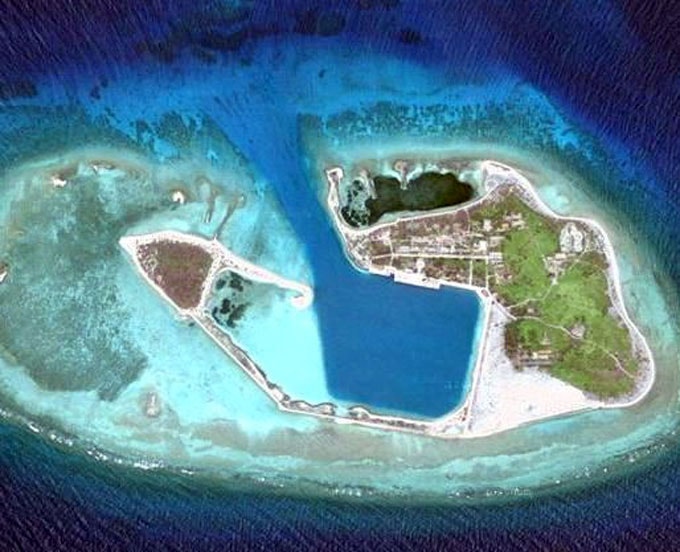 |
| Satellite image of Quang Hoa (Duncan) Island - the site of the 1974 Paracel Islands naval battle. |
In the "dilemma" faced by the US and the "exhausted state" of the Republic of Vietnam (Saigon), Chinese leaders invited US President Nixon for an official visit (the first since October 1, 1949) and signed the Shanghai Communiqué in February 1972. While we do not have the full text of the Shanghai Communiqué of February 1972 between the US and China, it is certain that many of the Sino-American agreements in the Shanghai Communiqué related to the Vietnam War in a way that benefited the US and the Republic of Vietnam (Saigon), causing significant losses to the Vietnamese people's struggle against foreign aggression and for national liberation. The US wanted to use the Shanghai Communiqué to reverse the situation both on the battlefield and at the negotiating table in Paris.
Following the Shanghai Communiqué, the US blockaded Hai Phong Port to cut off all Vietnamese maritime trade routes with the world, heavily bombed North Vietnam, culminating in the devastating bombing of Hanoi by B52s in December 1972, aiming to break the Vietnamese people's will to fight and win, and to withdraw from Vietnam "honorably." The Vietnamese people in both North and South Vietnam shed much more blood, and countless outstanding sons and daughters of the nation sacrificed their lives as a result of the Shanghai Communiqué.
But they were wrong.
The Shanghai Communiqué only caused more bloodshed for the Vietnamese people, but it could not reverse the tide of war, either on the battlefield or at the negotiating table in Paris; more importantly, it could not dampen the fighting spirit and determination of the Vietnamese people, nor could it hinder or stop the development of the Vietnamese nation. The Vietnamese people firmly grasped and decided their own destiny. Any bargaining or exchange at the expense of Vietnam would sooner or later fail. What had to happen has happened. Practice has proven the correctness of Ho Chi Minh's prophecy: "Fight to drive the Americans out, fight to overthrow the puppet regime."
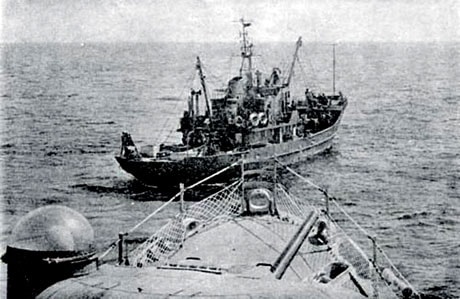 |
| Chinese armed fishing boats obstruct Vietnamese warships from entering the Paracel Islands. (Archival photo) |
Please note: Prior to the Shanghai Communiqué of February 1972, the US Seventh Fleet in the Asia-Pacific had declared that the Paracel and Spratly Islands were not included in the Seventh Fleet's strategy of deploying outpost islands. After the Paris Agreement of January 1973, the Seventh Fleet withdrew its troops, weapons, and military equipment from the Paracel Islands area. This was a once-in-a-lifetime opportunity for China to launch a naval attack to seize the Paracel Islands from Vietnam. In other words, the US bears significant responsibility for allowing China to seize the Paracel Islands from Vietnam.
4. Tasks that have not been done or have not been done properly must be done seriously to protect the sovereignty and territorial integrity of the Fatherland.
These are things that have not been done, or have not been done adequately, in the cause of protecting the sovereignty, unity, and territorial integrity of the Fatherland. Initially, I'm raising a few issues for discussion with readers, and also as recommendations to the agencies responsible for formulating and directing the implementation of national policies.
- Firstly, quickly add to the national standard curriculum (general education, secondary education, university, postgraduate education; curricula for long-term training courses, short-term political and professional training courses for senior and mid-level leaders and managers...) specialized topics on the historical process of the Vietnamese nation in managing and protecting its sovereignty over the sea and islands of the Fatherland, especially over the Hoang Sa and Truong Sa archipelagos.
It is a rather regrettable fact that Vietnamese youth and students currently have very little understanding of this issue. A significant number of officials and Party members, including some high-ranking officials, also lack the necessary understanding of this matter.
We always declare that the Paracel and Spratly Islands belong to Vietnam, but textbooks at all levels fail to present fully, accurately, and objectively the process of our struggle and the bloodshed we shed to protect our country's seas and islands. This means we are contradicting ourselves. Meanwhile, some neighboring countries have no sovereignty over the Paracel and Spratly Islands, yet they include them in their national standard curricula, claiming them as theirs?!
Secondly, the mass media system (newspapers, radio, television, publishing, etc.) needs to closely monitor all developments and actions in the South China Sea to provide timely, objective, and accurate information to the 90 million people in the country and 5 million Vietnamese people abroad in particular, and more than 8 billion people worldwide in general. The Constitution affirms that citizens have the right to information, and the State must fulfill this right as enshrined in the Constitution.
There are two fundamental issues that need to be communicated to Vietnamese people both at home and abroad, as well as the international community: 1. Vietnam does not ally or form alliances with any country against a third country; Vietnam always maintains friendly and peaceful relations with all nations; 2. Vietnam does not incite nationalism to oppose other countries. Educating and raising awareness among the people about threats, intimidation, and foreign activities that infringe upon the independence, sovereignty, and territorial integrity of the Fatherland is a normal practice that all countries undertake; there is nothing "sensitive" about it.
- Thirdly, we must promote and expand research on the sea and islands in all fields and at all levels. The State must prioritize and create favorable conditions, including financial resources, for those undertaking master's theses and doctoral dissertations on the East Sea in general, and on the Paracel and Spratly Islands in particular. Research institutes, academies, and universities must proactively expand international cooperation in research on the East Sea (geology, hydrology, ecological environment, biological resources, non-biological resources, anti-piracy, search and rescue, maritime security, etc.). The State should honor and reward valuable research works on the East Sea.
Fourth, quickly establish a government-affiliated South China Sea Research Center.
Currently, research on issues related to the South China Sea is highly fragmented. Nearly a dozen ministries, departments, and agencies at the central level conduct research on the South China Sea, and more than two dozen institutes, academies, and universities organize research on the South China Sea from different perspectives and fields. Due to the lack of a central coordinating center, collaborative research on the South China Sea faces considerable difficulties.
From every perspective, the East Sea has always existed alongside the Vietnamese nation, being a particularly important part closely linked to the cause of national construction and defense. Therefore, building a sufficiently strong national-level center is absolutely necessary, meeting both immediate urgent needs and having long-term strategic significance for the cause of national construction and defense.
Fifth, make the South China Sea issue a central focus of people-to-people diplomacy.
The State needs to create all conditions to rapidly expand people-to-people diplomacy to serve the cause of national construction and defense. Many issues are difficult to address in state diplomacy, but significant results can be achieved through people-to-people diplomacy. Scholars, professional associations, and non-governmental organizations (NGOs) have the ability to create many forums in diverse forms to exchange views with foreign partners on most issues related to the East Sea, with the goal of making the international community understand Vietnam and support Vietnam in its struggle to protect its sovereignty, sovereign rights, and national jurisdiction over the sea and islands of the Fatherland.
In conclusion, let me state five points: 1. National territorial sovereignty is sacred and inviolable. Therefore, protecting the independence, sovereignty, and territorial integrity of the Fatherland must be placed at the highest position in all activities of the State; 2. We must not "drive out the tiger through the front door only to let the leopard in through the back"; 3. Only social consensus and national unity can create the strength to protect the independence, sovereignty, unity, and territorial integrity of the Fatherland; 4. For each nation, when there is a truly clean, strong, and dedicated state that works for the interests of the people and the development of the nation, no foreign power will dare to provoke or infringe upon the independence, sovereignty, and territorial integrity of that nation; 5. When narrow-minded nationalism still dominates foreign policy, genuine internationalism has no place to flourish, exist, and develop. The proverbs "Trusting a friend can cost you your wife" and "Entrusting eggs to a hawk" still hold true as a stern warning to all Vietnamese people, especially those directly and indirectly involved in planning and implementing national policies.
Hanoi, January 17, 2014.


