
Going to Cờn Temple at the end of the year.
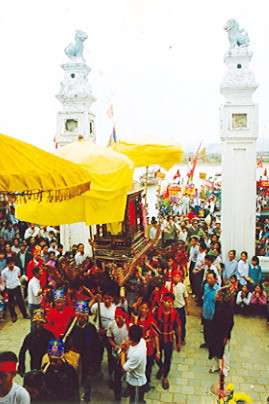 |
| Cờn Temple Festival |
Nearly 80 kilometers from Vinh City, we traveled along sun-drenched roads. Along the way, farmers in Dien Chau and Quynh Luu were busy planting. The dry, parched land smelled of frost. Rice seedlings, green and sheltered from the cold, were covered with plastic sheeting. Occasionally, yellow and white butterflies fluttered among the flowering cabbage plants. The people of Quynh Phuong (Quynh Luu) seemed to have been eagerly awaiting this sunshine after the harsh monsoon, excitedly drying their seafood. The air was filled with the salty scent of salt and the pungent aroma of shrimp and fish... But I knew that this distinctive flavor always warmed the hearts of the people from this coastal region.
Crossing the Cờn Temple Bridge (before the bridge existed, people often had to cross by ferry; this bridge helped Quỳnh Phương and some other coastal communes no longer feel like isolated islands), you arrive at the main temple (Inner Temple) dedicated to the Four Holy Mothers. Seeing "travelers from afar," many locals at the shops near the temple excitedly greeted and "marketed" some local seafood products. A few entertainment stalls could be seen scattered around the temple area. Outside, the Mai Giang River flowed peacefully, clear and blue, with the murmur of motorboats carrying coal. In the temple courtyard, white frangipani blossoms still in bud sat contemplatively. A few strangers curiously observed a banana tree in the courtyard with over a hundred bunches growing. In silence and reverence, everyone seemed to have cast aside all worries and burdens after a busy year of work, turning their hearts towards a belief in another realm. In the tranquil yet warm atmosphere of incense smoke, amidst the murmuring prayers and the clinking of coins used for divination, people today are seeking wealth and prosperity. Typically, at the beginning of the year, people visit Cờn Temple to pray for good fortune in the coming year, and they return again at the end of the year to offer thanks.
According to the local geography, Cờn Temple is built in the shape of a phoenix's head. The two "phoenix eyes" are the Đò well and Đình well on the two hills behind the temple. In the past, this strip of land at the mouth of the sea had a small shrine dedicated to the Goddess, and people embellished the legend of a Chinese princess who, due to some injustice, jumped into the sea to commit suicide. Heaven and Buddha transformed her into a piece of wood that drifted into Cờn estuary... From the shrine of the sacred piece of wood to a temple dedicated to the Four Deities, countless changes have taken place. The four deities worshipped at the temple are known through many oral traditions, currently recorded at the temple as follows: The Southern Song Dynasty (China) fell to the Mongol Empire. The king, his ministers, along with the Empress Dowager, the Queen, two princesses, and generals boarded a ship to flee south. The ship sank in a storm, and only the Empress Dowager and her four children were fortunate enough to cling to the mast, drifting to this area, where they were rescued by a monk. But then, contemplating the loss of their country and home, the Empress Dowager and her four children jumped into the sea to commit suicide. Their bodies drifted into Cờn creek and were buried by the villagers. The Emperor bestowed upon the Mother Goddess the title of Nam Hai Phuc Than (Goddess of the South Sea), governing the twelve sea gates. From then on, the local people in this coastal region prospered and built temples to worship the four holy goddesses...
Mr. Ho Ngoc Huan, a retired math teacher from Quynh Phuong, now the head of the management board of Corn Temple, shared with me his memories of a village that, though poor, was rich in temples, pagodas, and shrines. He mentioned the Ong Ca Temple, the Than Nong Temple, and other pagodas... Even Corn Temple itself, which used to have five buildings – seven in the inner temple and three in the outer temple – has lost its original form after years of change, bombs, and numerous renovations. I went to the outer temple, located right at the mouth of the sea, dedicated to Emperor Tong De Bing and the monk who helped care for the Empress Dowager and her four children. I encountered a seascape of crashing waves and sunshine. People say that two stone steps carved with dragons, intact from the Le Dynasty, still remain. Now, many seafood restaurants have sprung up. Down by the sea, people still hunched over, wading with clams and fish. The sound of powerful motorboats mingled with the roar of the waves. Mr. Ho Ngoc Huan said that his hometown has undergone so many changes. The dilapidated thatched houses, once home to people whose "souls hung on the mast," battered after the raging sea storms, have now been replaced by high-rise buildings, powerful motorboats, and people who have learned many new trades: handicrafts, mechanics, seafood processing, services... He also told me about the annual Cờn Temple Festival, held from the 19th to the 21st of the first lunar month, with its announcement ceremonies, the enthronement ceremony, the procession of palanquins from the Inner Temple to the Outer Temple and back again by both land and water routes, the grand ceremony at the Inner Temple, the thanksgiving ceremony, and various games such as card games, human chess, cockfighting, and especially the boat race... He proudly mentioned that his famous temple was awarded the National Historical and Cultural Monument status in 1993.
I listened to his lament, amidst the rising and falling prayers of the shamans. Someone was asking for peace... A feeling of relief suddenly came over me. I thought about the S-shaped strip of land before the sea, the land that "shields against storms in the morning and protects against the scorching sun in the afternoon," about the vicissitudes of life, the legends associated with each village, mountain, and river. And here I stand, this sacred land is also connected to King Tran Nhan Tong's dream of conquering the South. Somewhere, there was the battle of Grand Tutor Tran Quang Khai against Toa Do's army; somewhere, the Tran and Le dynasties' armies crossed the sea to fight Champa and quell rebellions and stopped? Where did Hai Thuong Lan Ong sit and write the couplet on his way back to the capital to treat Trinh Can's illness: "The Great Song Dynasty's foundation is filled with eternal regret / The Southern Dynasty's universe is filled with spring in all four seasons"? Where, then, did the great poet Nguyen Du, inspired by the beautiful scenery, compose the poem "From the View of the Seaside"?... And I remembered a line from his poem, "The Tale of Kieu," when I stopped at this seaport: "The roaring sound of waves surrounds my seat..."
Thuy Vinh


