
At the end of the year, go and study journalism, my friend.
(Baonghean)Not content with the achievements made over half a century of development and growth, the staff and reporters of Nghe An Newspaper continue to ponder and explore a new image, a new way of expression that is youthful yet upright and profound, so that the newspaper will increasingly be in the expectations of its readers. Learning from the best practices of other newspapers, refining and refreshing itself, is a path in the long journey of accompanying its readers.
In the final days of 2011, amidst a multitude of pressing tasks, the Nghe An newspaper delegation set out to "seek guidance" from other newspapers. Whether by chance or design, this trip to gather valuable insights during the year-end was certainly marked by a delicate charm: selecting the precious experiences of those who came before, as the old year drew to a close, so that the newspaper could have a fresh perspective on the arduous yet glorious journey ahead.
The "banyan tree" of the journalism village by Ho Gươm Lake.
The Nhan Dan Newspaper was our first destination. On a chilly winter day, the ancient building at 71 Hang Trong Street, overlooking Ho Guom Lake, seemed even more solemn and classic. Originally the residence of the Governor-General of Indochina during the French colonial period, it now houses the Nhan Dan Newspaper, the "elder brother" of the Party's press. Upon seeing the Nhan Dan Newspaper, we were immediately overwhelmed by its antiquity, with the ancient banyan tree at the center serving as a symbol. It's also worth mentioning a little about this historical banyan tree, which the late architect Ta My Duat once ranked as "number one in Indochina." The banyan tree is over 300 years old, with a trunk circumference of about 20 meters and six large root systems, reaching a height of over 30 meters. Near the base of the tree is a plaque commemorating the glorious battle fought on the night of December 24th to 25th, 1946, by the soldiers of the National Guard. Around the base of the banyan tree, there are now three additional main trunks with hundreds of small roots intertwining and spreading out in three directions, symbolizing longevity and stability. Veteran journalist Thanh Phong told us that these three main trunks were created thanks to the efforts of writer and journalist Thép Mới, former Deputy Editor-in-Chief of Nhân Dân Newspaper. He meticulously grafted hundreds of small secondary roots, dividing them into three new trunks around the mother tree, nurturing them to create a magnificent banyan tree. Stepping into the editorial office grounds, one feels as if they are reliving the rich history of the 60-year-old newspaper. From its first issue on March 11, 1951, to the present day, Nhân Dân remains steadfast, representing the voice of the Party, the State, and the people of Vietnam. The daily Nhân Dân, Nhân Dân Weekend, Nhân Dân Monthly, Nhân Dân Online, and Nhân Dân English editions have all been launched to meet the demands of innovation in the new information age. This rejuvenation and renewal was further confirmed by the launch of the Thời Nay (Today's Times) publication in early 2010.
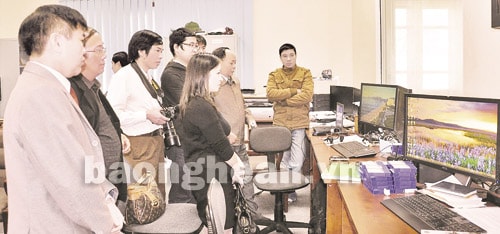
Leaders of Nghe An Newspaper visit the Nhan Dan Online Newspaper Department.
Coming to the Nhan Dan Newspaper editorial office to see firsthand and learn from the journalistic practices of our senior colleagues is a heartfelt desire for each of us. We learn from their mature, serious, and intellectual approach. We learn from the working style and news handling of a newspaper that brings together many distinguished writers from the past and present of the journalistic world. And we also learn from the rich history of an editorial office that has twice received the Ho Chi Minh Order, the First Class Labor Order, the Golden Star Order, the title of Hero of the People's Armed Forces, and Hero of Labor during the đổi mới (renovation) period.
Despite the age difference, the staff at Nhan Dan Newspaper were extremely enthusiastic, sharing their concerns, anxieties, aspirations, and experiences in journalism with us. The newspaper's maturity began right from the Photo Department. Photographs from all corners of the country, important trips of Party and State leaders to foreign lands, and hot events constantly unfolding daily were all gathered in a small double room of only about 20 square meters. Through the editing and selection of experienced editors and technicians, these bright, beautiful, and vibrant photos spread far and wide through the newspaper. "In charge" of this department is journalist Khac Huong, a renowned name in the photography world with the title of Outstanding Photographer E.VAPA, E.FIAP. The newspaper's photo department has eight people. Their meticulousness and adherence to standards in their work perhaps need no further explanation, as evidenced by what has been presented on every page of the newspaper over the years. Readers and colleagues alike have come to know the photo section of Nhan Dan as a model of seriousness and composure in every aspect of its presentation.
The editorial secretariat, considered the "heart" of any newspaper, is no exception to Nhan Dan. With a three-shift system per day, the newspaper's departments—article review, computer work, layout, proofreading, etc.—are constantly under immense pressure due to the sheer volume of articles. Professionalism and dedication are essential for the newspaper to maintain its popularity with readers. We found similar practices in other professional departments regarding standardized journalistic practices. Writer and journalist Le Manh Tuan, Head of the Nhan Dan Weekend Edition, explained that the weekend edition often features prominent and well-known writers, and many potentially dry topics are "softened" when published in this edition. This is also what journalist Quang Hoan, Head of the Nhan Dan Monthly Edition, revealed to us. A crucial department for Party newspapers is the Party Building Department. The editorial board, comprised of nine people led by journalist Pham Dao, consistently produced three pages per week, or twelve pages per month. This was no small feat, as writing about Party building was not easy. Those in charge of this section of the newspaper put considerable effort into ensuring each article resonated deeply with people, almost like the daily stories of each Party branch in the neighborhood, village, or hamlet.
We came to learn journalistic techniques from our seniors, and we all share the same desire: that Nhan Dan newspaper will endure forever with the country and be a model party newspaper in our nation's party journalism landscape.
The newspaper, still in its original "fresh" condition.
On October 24, 2012, Hanoi Moi newspaper celebrated its 55th anniversary since the publication of its first issue. However, the newspaper always seems "new," and this is considered its guiding principle and purpose, ensuring it remains a dynamic and vibrant publication in its thinking and actions in the thousand-year-old land of Thang Long (Hanoi).
In the elegant reception room with its Gothic architectural style, the Editor-in-Chief of Nghe An Newspaper, Pham Thi Hong Toan, engaged in lively and youthful conversation with journalist To Quang Phan, Editor-in-Chief of Hanoi Moi Newspaper, and other members of the editorial board. They shared stories about the process of receiving, processing news articles, and publishing newspapers with great enthusiasm.
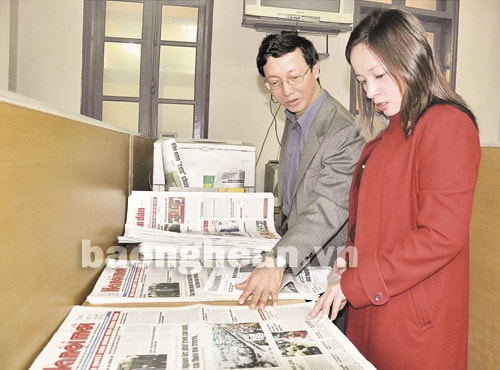
Pham Thi Hong Toan, Editor-in-Chief of Nghe An Newspaper, held a professional exchange with journalist Nguyen Tuan Duc, Deputy Editor-in-Chief of Hanoi Moi Newspaper.
Hanoi Moi, along with Saigon Giai Phong, were the first two local Party newspapers in the country to implement an independent economic accounting mechanism. The newspaper launched many publications for readers: Hanoi Moi daily, Hanoi Moi weekend, Hanoi Today supplement... with diverse and multi-faceted information in the spirit of innovation, openness, and democracy... In addition to daily sections such as: A Story a Day, Reader's Opinions, Market Prices... there are also sections on Law and Life, Arts and Culture, The Market Needs No Tears... Or sections with a fixed term according to the nature of the issue such as: Drug Overview, Events Commentary... Notably, the newly launched Hotline section has promptly resolved pressing complaints from the people, reduced pressure on the city, been highly appreciated by city leaders, and attracted the attention of a large number of readers, building public trust.
To manage such a substantial workload, the newspaper's editorial secretariat has a team of up to 40 people, headed by journalist Quoc Cuong, out of a total of nearly 230 staff and reporters. Each publishing shift, in addition to editors, editorial secretaries, typewriters, and graphic designers, also includes a member of the editorial board responsible for certain tasks. News articles, after being edited on the computer in the specialized departments, are sent to the editorial secretariat, where the editorial secretary edits them, and the editorial board leaders approve them before they are sent to the printing house. "The important thing is that each person on duty must master the information and clearly define the style and format for the upcoming issue in order to handle issues quickly and efficiently," journalist Quoc Cuong shared.
Let me also mention a little about the Hanoi Moi Weekend publication. It's considered a small "editorial office" with a full complement of editors, graphic designers, typewriters, etc., but it's impressive that it only has 8 people. Journalist Phung Huy Thinh, head of the weekend section, says that each page in the weekend edition is meticulously planned. For example, page 1: Current events and commentary, page 2: Feature stories, pages 3-4: Socio-economic issues, 10-11-12: Literature and art, page 15: Stories from the commune/ward. The stories from the weekend edition are also compiled and published as a book titled "Hidden Corners of Life," edited by journalist Huy Thinh.
Although our meetings were brief, we gained a great deal of new and valuable insights from your newspaper. Sitting with our colleagues from the capital city on the banks of the vast Red River, we suddenly realized that journalism is like rivers, flowing endlessly, passing through all the shores of life, gathering silt before drifting towards the sea, towards the ocean of life, purifying and enriching the vast sea of existence. Bidding farewell to the journalists in the heart of the nation on the last day of the year, our baggage includes the maturity and classicism of our predecessors, "Nhan Dan," and a youthful, dynamic, yet profound "Hanoi Moi" in every page.
Tran Hai


