
Returning to the rice fields at the end of the year.
One day at the end of the year, the Song Dinh Arts and Culture Association was invited by the Yen Thanh District People's Committee to conduct a field trip to assess the district's production situation. This is an annual activity of the district for the Arts and Culture Association. As usual, with great enthusiasm, the members, especially the older members such as Ngo Duc Tien, Phan Ba Ham, Phan Van Tu, Phan The Phiệt… were present at the District People's Committee headquarters very early.
(Baonghean)One day at the end of the year, the Song Dinh Arts and Culture Association was invited by the Yen Thanh District People's Committee to conduct a field trip to assess the district's production situation. This is an annual activity of the district for the Arts and Culture Association. As usual, with great enthusiasm, the members, especially the older members such as Ngo Duc Tien, Phan Ba Ham, Phan Van Tu, Phan The Phiệt… were present at the District People's Committee headquarters very early.
Therefore, during this field trip, members of the branch association will have the opportunity to see firsthand the most exemplary mushroom cultivation models in the district.
Hearing this, everyone was excited and enthusiastic, because for a long time they had read and heard a lot in the press about mushroom farming in Yen Thanh, but they had never "seen" the process firsthand. Crossing the Dao River and going up to the hills of Nam Thanh commune is the mushroom farming model of Mr. Nguyen Tho Hanh. Mr. Hanh is currently the Chairman of the Farmers' Association of the commune.
Leading the group into the thatched-roofed area where over 10,000 bags of oyster mushrooms were hanging, Mr. Hanh explained the mushroom cultivation process. He said that straw is ideal as a raw material, but sawdust from rubber wood can be used instead. The first step is sterilizing the bags in an oven, then mixing them with other materials to create the bags and inoculate them with mushroom spawn. The bags are hung indoors to prevent leaks, and the floor is always clean and disinfected by sprinkling lime powder. After hanging the bags, they are sprayed daily with a fine mist (using a pesticide sprayer). After about two months, the mushrooms begin to grow and are ready for harvest. Regarding the concern that growth stimulants are necessary, Mr. Hanh explained that the water used for daily spraying must be clean (from a well), and no other chemicals are allowed. He added that if the technical procedures are not strictly followed, the mushrooms will be ruined.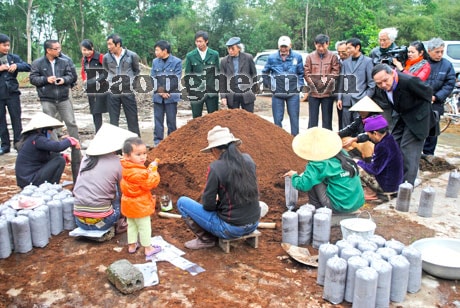
The Song Dinh Arts and Culture Association visited the mushroom cultivation facility of Mr. Le Van Son in Ly Thanh commune.
Last year, after completing a mushroom cultivation training course organized by the district in collaboration with Bac Giang Mushroom Company, he was given the opportunity by the commune to borrow the area of the old primary school to start his business. His first batches of mushrooms failed repeatedly due to lack of experience and failure to strictly follow technical procedures. "Failure is the mother of success," and today his mushroom farm is arguably the most successful in Yen Thanh district.
Mr. Phan The Trung, Chairman of the People's Committee of Nam Thanh commune, was delighted to hear that the delegation was visiting and enthusiastically greeted them, saying: This year, the commune has built four more large-scale mushroom cultivation models, bringing the total number of households and groups cultivating mushrooms in the commune to over 10 models, providing employment for about 40 workers with stable incomes. During the year, the locality also completed the land conversion from small plots to larger ones. After the land conversion, many families registered to build livestock farms, with some investing 500-700 million VND to build farms for raising ducks and fish.
In Ly Thanh commune, the delegation also visited the new mushroom cultivation model of Mr. Le Van Son in Hamlet 10. In the large open space in front of his house, more than 10 men and women sat around a pile of materials, bagging the mushrooms for cultivation. At the sterilization furnace, two young male workers were taking hot mushroom bags out of the furnace and transporting them to the inoculation area. Ms. Le Thi Minh said that being hired by Mr. Son for a daily wage of 100,000 VND was very good. The daily work here is not strenuous, very suitable for female workers, and the owner is very caring and provides mushrooms for daily consumption, so everyone is comfortable and works diligently.
Pointing to several bags densely packed with pristine white mushrooms, Mr. Son confidently stated: "Oyster mushrooms that are this white are good. This area used to be the site of an old secondary school, abandoned by the commune for a long time, overgrown with decaying trees, and no one dared to set foot here. Three months ago, I asked the commune to let me use this area to develop a straw mushroom farming model, and they immediately agreed."
The new mushroom farm started producing mushrooms about a week ago, with 600 bags (currently containing 2 tons of raw materials). Every day, we harvest 20-30 kg of mushrooms, and they sell out as soon as we harvest them. Local people also place orders for weddings, funerals, etc., unless we supply the district. Currently, many customers in Vinh City are calling to place orders, but we don't have any to sell.
Mr. Nguyen Sy Hung added: Thanks to the implementation of Project 1959 on vocational training for farmers, Yen Thanh has successfully developed mushroom cultivation and expanded it throughout the district. To meet the local demand for mushroom spawn, the district has built a mushroom spawn farm in the town. To date, 14 communes in the district cultivate mushrooms, with 5 types: oyster mushrooms, button mushrooms, wood ear mushrooms, reishi mushrooms, etc. In 2012, the entire district produced 350 tons of various types of mushrooms, of which about two-thirds were sold to food processing companies outside the province. Most importantly, a new profession has been transferred to farmers, creating regular jobs for hundreds of workers. The district's goal is to develop this profession in all communes, aiming to produce a large volume of mushroom products annually to supply the market. Another positive development in Yen Thanh this year is the direction of localities in building new rural areas, with the pioneering work of land conversion in 16 communes. After the conversion is complete, each household will have an average of 1.5 plots of land.
The five districts are also actively cooperating with Japan to accelerate the construction of the garment industrial cluster in the town, with the plan to complete it in 2013. In phase 1, the company will recruit 1,000 skilled workers. Phase 2 will involve the production of computers and high-tech goods.
Xuan Hoang


