
Saving the life of a Laotian patient with a tumor in her "genital area"
(Baonghean.vn) - To save the life of a female patient with a vaginal choriocarcinoma, doctors at Nghe An Friendship General Hospital had to perform emergency surgery and continuously transfuse 24 units of blood for many hours.
On July 23rd, patient Xong Nang Kha (Lao nationality) was receiving intensive treatment at Nghe An Friendship General Hospital after doctors performed emergency surgery to save her life.
Previously, on July 16th, Nghe An General Hospital admitted patient Xong Nang Kha (50 years old, from Bolikhamxay province, Laos) to the emergency room with severe abdominal pain accompanied by continuous vaginal bleeding, pale skin, pale mucous membranes, and a very weak physical condition. After examination, interdisciplinary consultation between Obstetrics and Surgery, and clinical and pathological diagnosis, it was discovered that Ms. Kha had choriocarcinoma (a type of trophoblastic tumor) of the vagina, with deep metastasis and spread to the lungs. The choriocarcinoma had grown large, causing significant intra-abdominal bleeding, resulting in severe blood loss and dizziness. Without timely treatment, Ms. Kha could die quickly.
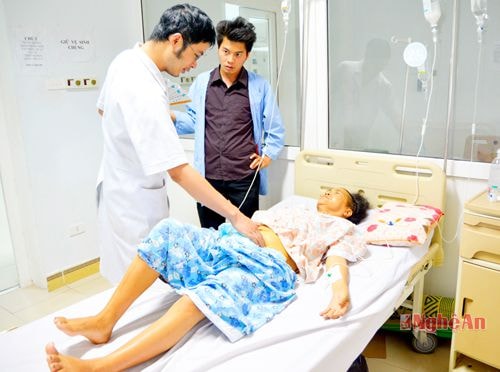 |
| Master's degree holder Dinh Van Sinh - Head of Obstetrics Department, examines patient Kha. |
Recognizing the critical nature of the Choriocarcinoma, the Obstetrics and Gynecology Department and the Surgical Intensive Care Unit of Nghe An General Hospital held a consultation to plan intensive resuscitation and continuous blood transfusions to prioritize the patient's recovery and stabilization before planning surgery to remove the tumor. However, on July 21st, the patient experienced uncontrollable vaginal bleeding. Assessing the patient's critical condition, the Obstetrics and Gynecology surgical team immediately decided on an emergency surgery – a life-or-death situation. In this emergency surgery, a race against time, Dr. Nguyen Danh Linh, the lead surgeon, quickly ligated the two hypogastric arteries and separated the cancerous tumor from the patient's vagina. After nearly an hour, the surgery was successful, notably without causing massive postpartum hemorrhage – a complication the surgeons feared in large Choriocarcinoma surgeries.
Due to prolonged blood loss and a dangerous surgery, the hospital had to continuously mobilize nearly 6 liters of blood (red blood cells, plasma) from the Hematology and Blood Transfusion Center, equivalent to 24 units of blood for transfusion to the patient.
Mr. Gia Ba Long, son of patient Kha, said: “Fifty days ago, my mother (Patient Kha) was admitted to Vientiane Hospital (Laos) with a diagnosis of ovarian cysts and underwent a total hysterectomy. However, 25 days later, my mother experienced heavy and prolonged vaginal bleeding, and her health deteriorated, so the family decided to travel 500km to transfer her from Vientiane to Nghe An General Hospital for treatment.”
Currently, patient Kha has regained consciousness and is under continuous post-operative monitoring. Simultaneously, the Obstetrics Department and the Oncology and Nuclear Medicine Department are working closely together to develop a further treatment plan for patient Kha, preventing the tumor from metastasizing. It is known that patient Kha comes from a difficult background, working in agriculture, and her husband passed away early, leaving her with 10 children to raise. Therefore, the Board of Directors of Nghe An General Hospital is providing all possible support to the patient in her treatment.
Choriocarcinoma, also known as placental cancer, is a malignant tumor that develops from trophoblastic cells. It is the most severe form of choriocarcinoma associated with pregnancy; it can occur after normal pregnancy, miscarriage, stillbirth, abortion, ectopic pregnancy, or molar pregnancy. Of these, molar pregnancy is the most common cause, accounting for 70% of choriocarcinomas. The lesion usually originates in the uterus and metastasizes through the bloodstream to various parts of the body, including the vagina, lungs, pelvis, liver, and brain. |
Hoang Yen


