
Member of Parliament: Having a separate office for each agency is wasteful.
Members of Parliament believe that the Government and relevant ministries need to sit down together to agree on a model for centralized administrative management, applicable nationwide.
During group discussions on the draft Law on the Management and Use of State Assets (amended), many National Assembly deputies argued that this law is necessary because the draft law includes provisions on leasing office buildings and public facilities, and conducting business with public assets.
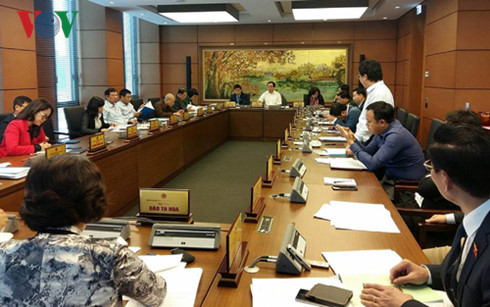 |
| National Assembly delegates from Hanoi discuss the draft Law on the Management and Use of State Assets (amended) in their group meeting. |
Having a separate office for each agency is extremely wasteful.
Representative Tran Thi Quoc Khanh (Hanoi delegation) suggested that the Government and relevant ministries and agencies should sit down together to agree on a model for centralized administrative management, applicable nationwide.
Ms. Khanh said that in Malaysia, eight ministries are housed together in a twin tower, while in Vietnam, each ministry is in a different location.
This representative also suggested reconsidering the issue of Da Nang's centralized administrative complex. The 2 trillion VND building had a very good design concept, but now it's being said that it doesn't meet technical standards – who will take responsibility?
Commenting on the construction of joint administrative areas, delegate Nguyen Thi Quyet Tam (from Ho Chi Minh City delegation) suggested that further assessments of the actual impact are needed.
 |
| Representative Nguyen Thi Quyet Tam |
Previously, the government had the idea of building a centralized area for central government agencies with representative offices in the South, but it couldn't be implemented because none of the ministries wanted it; everyone wanted their own separate headquarters.
Ms. Tâm also noted the issue of recovering assets after agencies moved to new headquarters. Many headquarters were left vacant but could not be recovered.
Deputy Speaker of the National Assembly Phung Quoc Hien stated that there is a situation where public assets are being exploited for business purposes without proper control. According to Mr. Hien, many assets belonging to agencies, from the central to local levels, include land, buildings, and even sidewalks, but it is difficult to know whether the revenue generated goes into the state budget or into personal pockets.
Mr. Hien noted that it is necessary to classify assets and premises that can be leased, and to identify which types cannot be leased even if they are not being used to their full capacity at times.
Representative Van Thi Bach Tuyet (from Ho Chi Minh City delegation) proposed that public assets, especially office buildings, should be made public. Specifically, she requested information on which agency manages the land and buildings, where they are located, and who uses them.
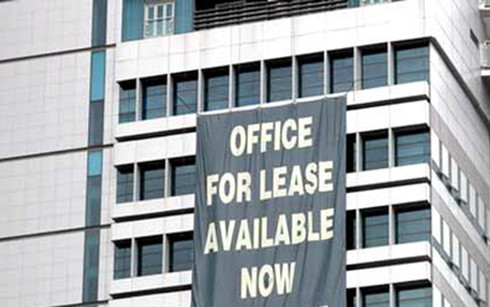 |
| In reality, it is very difficult to manage revenue from leasing public assets (Illustrative image: Internet) |
Ms. Tuyet stated that many public assets are used under the guise of partnerships, collaborations, or leasing. Many buildings, when viewed by citizens and even officials, appear to belong to businesses, but in reality, they are leased to businesses by a particular ministry, department, or public service unit.
Representative Nguyen Thanh Hai (Hoa Binh delegation) expressed the view that unused assets should be leased out to generate additional revenue for the struggling budget. However, strict regulations are needed to monitor this practice.
Some delegates also expressed concern that if regulations are not strict, people might design a huge, spacious headquarters, and then, when it's operational, claim they don't use all of it and rent it out.
Representative Pham Quang Thanh (Hanoi delegation) emphasized: It is necessary to combat waste and inefficiency, and to effectively utilize public assets to generate profit… Assets that are not being used to their full capacity can be put into business.
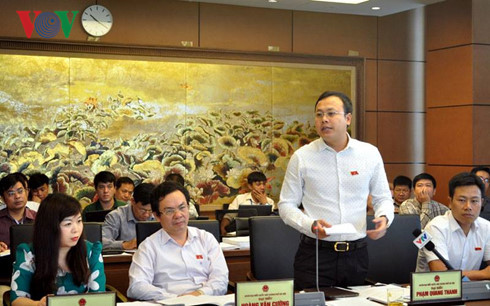 |
| Representative Pham Quang Thanh |
However, this representative also pointed out the reality: Negative practices could arise at the unit responsible for allocating assets, because based on the initial carefully calculated allocation, where would the surplus come from to rent out for business purposes?
Building a new headquarters is very expensive, and if we rely solely on the budget, it could take a decade or more to complete. Therefore, according to Mr. Thanh, it is necessary to promote the public-private partnership model to leverage resources, combat waste, and save state budget funds.
According to VOV


