
Great Poet Nguyen Du: His Last Days
In 1813, after returning from his first diplomatic mission, Nguyen Du was renowned as a talented diplomat and was specially promoted by the king to the position of Right Deputy Minister of Rites. In the year Canh Thin (1820), Gia Long died, King Minh Menh ascended the throne, and the court decided to appoint Nguyen Du as the chief envoy to China for the second time to seek investiture.
(Baonghean)In 1813, after returning from his first diplomatic mission, Nguyen Du was renowned as a talented diplomat and was specially promoted by the king to the position of Right Deputy Minister of Rites. In the year Canh Thin (1820), Gia Long died, King Minh Menh ascended the throne, and the court decided to appoint Nguyen Du as the chief envoy to China for the second time to seek investiture.
This journey was short, and in the middle of autumn, so to avoid obstacles along the way, Nguyen Du had his entourage fully prepared with means of transportation, provisions, and medicine. Furthermore, he wanted to depart early so that he could stop in Thang Long (Hanoi) to celebrate the Mid-Autumn Festival – his birthplace and the place where he had many memories. The group consisted of 20 people, with horses, palanquins, and sedan chairs ready for departure, and the king's decision had been entrusted to Nguyen Du. At this time, a major cholera epidemic was spreading rapidly. The historical records of the Nguyen Dynasty at that time clearly state: "A cholera epidemic spread from Cambodia to the Ha Tien region and reached the north of Hue. Wherever the epidemic spread, villages were devastated. Seeing the gloomy scene of death and suffering, the king released a quantity of gold, silver, and medicines from the treasury to supply the people, and also ordered local authorities to set up altars for rituals to pray for relief. But people continued to die; that year's epidemic claimed 200,000 lives." Inside the citadel, funeral processions silently followed one another. Phu Xuan, the capital city, lived in gloom and anxiety during the autumn of the year of the Dragon (1960). Nguyen Du and some members of his entourage also contracted the epidemic, forcing Nguyen Du to postpone his trip. In the early days, he considered it a normal and simple illness, resting for a few days to regain strength before continuing his journey. He received treatment at his workplace in the Phu Xuan palace, but his condition did not improve and worsened in the following days. The old man was emaciated, his eyes sunken, his strength weakening. The diplomatic mission was impossible, so he sent someone to inform the king to arrange a replacement. Back home, his family also learned of his serious illness, but due to the long distance, none of his wife or children could visit him. His younger brother, Nguyen Uc, and his nephew, Nguyen Thang, stayed by his bedside during his illness. When his condition worsened, he was moved to the residential area for court officials, located behind the Hue Citadel gate. In his final days, his health seemed to be completely depleted. Lying in bed, his children and grandchildren brought him medicine, but he refused to take it. When his family touched his hands and feet and said, "They're all cold now," he calmly and serenely replied, "That's enough." After saying this, a few hours later, he quietly closed his eyes, without uttering another word of farewell. Nguyen Du passed away on September 16, 1820 (which is the 10th day of the 8th lunar month), at the age of 55.
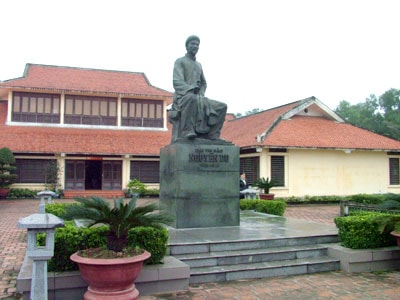
Statue of the great poet Nguyen Du at the historical site in Nghi Xuan - Ha Tinh.
Photo: Internet
Upon receiving news of Nguyen Du's death, the king was deeply saddened and bestowed upon him the posthumous name "Trung Thanh". In addition to the prescribed death benefit, the king also granted 20 taels of silver, two pieces of red silk, 30 kg of beeswax, 300 kg of lamp oil, and a couplet as a memorial.
A man of exceptional talent, whether as an envoy or a minister, his life was not without its flaws;
A century-long career, a free homeland at home and in the country.
Meaning: A life of talent, sometimes serving as an envoy, sometimes as a minister, lived without shame;
A century of dedication to both family and nation leaves a lasting legacy even in death.
Those two couplets are still inscribed on the front of his temple today. In addition, the king's mother, his younger brother Kien Anh Cong, and all the court officials mourned his passing and offered condolences. His body was placed in a coffin made of yellow heartwood. A few days later, the court and his family held his burial in the Bau Da field, in An Ninh commune, Quang Dien district, Thua Thien Hue province. This is a beautiful cemetery with a high and dry location, reserved for court officials and members of the royal family at that time.
The funeral procession for Nguyen Du was quiet, with very few mourners, due to the cholera epidemic that was terrifying everyone. Moreover, as the procession left the city gates, a torrential downpour struck, flooding the streets and causing ripples on the tranquil Perfume River...
Nguyen Xuan Bach


