
Yen Thanh, the land of rice, is steeped in history and culture.
(Baonghean) - Yen Thanh unfolded before our eyes with its peaceful villages and lush green rice fields. In the distance, majestic mountain ranges surrounded more than 517 historical sites and scenic spots from ancient times, still bearing the imprint of this land of outstanding people and rich history...
Yen Thanh is known as an ancient land. From the Early Le Dynasty and the Ly Dynasty, many migrations and land reclamation efforts established prosperous villages and hamlets. By the Tran Dynasty, fertile fields had formed. Therefore, Yen Thanh is considered the cradle of rice civilization, chosen as the administrative center and famous as the rice granary of the Chau Hoan region.
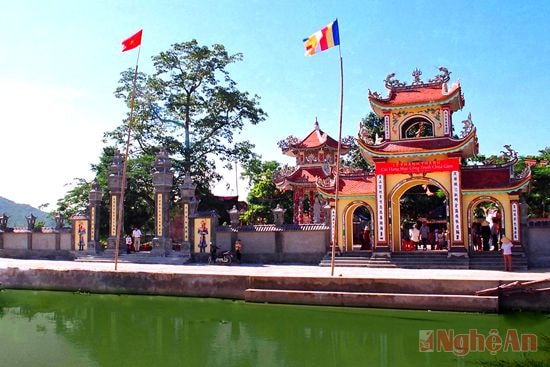 |
| The triple-arched gate of Gam Pagoda in Xuan Thanh commune. Photo: Ngo Kien |
Leading me along National Highway 7, Ms. Phan Thi An, Head of the District's Culture Department, told me: Yen Thanh is famous as a land of culture and studiousness. From the Tran Dynasty to the Nguyen Dynasty, Yen Thanh district had 22 people who passed the highest imperial examinations, from the top scholar to the second-highest rank, such as the top scholar Bach Lieu. Three generations of father, son, and grandson were all top scholars: Ho Tong Thoc, Ho Tong Don, and Ho Tong Thanh, creating a unique phenomenon in Nghe An province. Besides that, Yen Thanh is a revolutionary place, a revolutionary base of the Can Vuong movement against the French led by Mr. Nguyen Xuan On and Mr. Le Doan Nha. In this movement, we also know the hero Nguyen Van Ngoi, also known as Mr. Tac Bay, a skilled general of Nguyen Xuan On with the ability to "fly over rooftops."
Of the 517 historical sites and scenic spots, 200 have been cataloged and managed, with 21 recognized as national historical sites. Among these sites, I was guided by a cultural official to visit Duc Hoang Temple. It was the lotus blooming season, and the lotus ponds on either side of the road leading to the temple resembled a traditional ink painting. Within this painting, an ancient temple stood amidst the lush green mountains and clear blue waters, blending harmoniously with nature to create a sense of tranquility and serenity. According to historical records, Duc Hoang Temple is a cultural and spiritual structure built by the people to worship General Hoang Ta Thon, a general who contributed to the war against the Mongol invaders in the 13th century, bringing peace to the country and the nation. We heard from the temple's abbot that Duc Hoang Temple was built on a high mound amidst a dense forest of lim trees on the edge of Dieu Oc Lake, next to Thung Vien Thanh Tich Pagoda. The temple is famous not only for its picturesque scenery but also for its sacredness. Even on non-weekly or holiday days, locals and tourists still flock to visit the temple. There have been visitors from as far away as Thanh Hoa and Quang Ninh provinces who came all the way to Nghe An just to worship at the temple, because for them, coming here helps them resolve their worries and misfortunes...
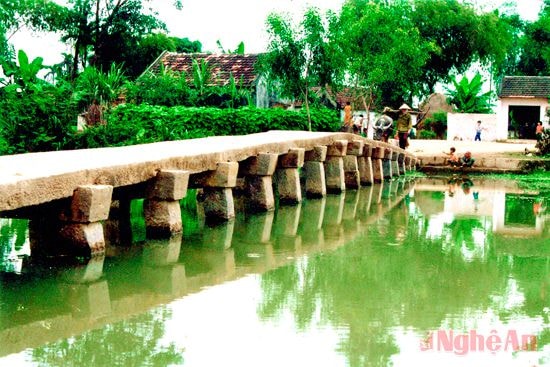 |
| Stone bridge in Nam Thanh commune (Yen Thanh district) |
We visited Gam Pagoda, which is currently under rapid construction and nearing completion of its main components. Gam Temple and Pagoda is a religious and spiritual site, a place of worship and commemoration of deities who have contributed to the nation and its people. These include celestial and human deities revered by the people, such as Tran Hung Dao Dai Vuong, Cao Son, Cao Cac, Hoang Ta Thon, the Four Holy Mothers, the Three Great Kings, the Buddha Shakyamuni, and various Bodhisattvas. This is a unique complex of relics in Nghe An province that combines both a temple and a pagoda. This demonstrates the harmony of the Three Religions (Buddhism, Confucianism, and Taoism). When I asked why this place was chosen as a highlight of the Yen Thanh tourist itinerary, Ms. An explained: “Previously, the temple and pagoda often held festivals on the 15th day of the second lunar month. People from the villages would flock to the festival. On major holidays, the temple grounds would often host cultural performances such as puppet shows and traditional opera…”
However, after the August Revolution, due to various reasons, the ritual gradually faded away, only existing in the memories of the elderly in the village. In 2013, the People's Committee of Nghe An province issued a decision agreeing to allow the People's Committee of Xuan Thanh commune and the temple to restore and organize the festival according to traditional rituals from the 14th to the 16th of February in the lunar calendar. The Gam Temple and Pagoda Festival is solemnly organized with two parts: the ceremonial part and the festive part, both extremely solemn and vibrant. The ceremonial part includes the opening ceremony at Gam Temple and Pagoda, and the announcement ceremony at the temple on the top of Ru Gam mountain. Especially noteworthy is the solemn procession of palanquins from Gam Temple and Pagoda to Ru Gam Temple and back, with the participation of tens of thousands of visitors from all over and people from the district. Therefore, Gam Temple and Pagoda is the largest gathering place for descendants from near and far, and visitors from both the North and South.
Traveling along National Highway 7, we visited historical sites such as the Ho Chi Minh Memorial Area commemorating his visit to Vinh Thanh, and the Trang Ke historical site (My Thanh) – which records the heroic deeds of 72 Soviet soldiers from Nghe Tinh who were executed by the French… each place is a location steeped in history and culture.
During this short trip, I had the opportunity to witness the richness of diverse biological communities such as the Gam green forest, the Lang Thanh primeval lim forest, and Hau Thanh, giving Yen Thanh a wild and captivating beauty that enchants any visitor… In addition, according to the cultural officer who acted as my “guide,” Yen Thanh also has 220 rivers, lakes, and dams of varying sizes winding along the cliffs and protected forests, which will be attractive ecotourism destinations such as the Ve Vung dam, Quan Hai lake, and Lo Noi dam, with their year-round clear and tranquil waters. During this trip, I also learned about unique cultural aspects found only in Yen Thanh, such as the improvisational performance of a local person spontaneously creating a theatrical performance. The Ke Gam theatrical performance is a distinctive cultural feature preserved from ancient times, and even today, amidst the hustle and bustle of modern life, theatrical clubs here continue to exist and develop as an indispensable spiritual activity. Through this experience, I also had the opportunity to learn that Yen Thanh has traditional opera clubs in Lang Thanh, and folk song clubs specializing in the Ví and Giặm styles.
Within a radius of 20-70 km, visitors can head towards the coast to Dien Thanh beach, visit Cuong Temple, swim and relax at Bai Lu Resort, Cua Lo beach, go to Nam Dan to visit President Ho Chi Minh's birthplace, or head west to Giang Son hot springs and Pu Mat National Park… This is an attractive invitation for tourists to visit Yen Thanh to explore and enjoy.
Thanh Nga


