
Residents are outraged because of pollution caused by pig farm.
(Baonghean)For over three months, residents of Hamlet 15, Dien Yen Commune, have been living amidst a pungent stench caused by a pig farm at the foot of Hon Tro Mountain. Residents have repeatedly gone to the farm to demand that the owner take remedial measures, but to no avail.
Sitting dejectedly in his closed house at the beginning of Hamlet 15, Dien Yen Commune, Mr. Nguyen Van Van and many other residents expressed their frustration when talking about the pig farm at the beginning of the hamlet. Hamlet 15 is located next to National Highway 48, surrounded by the Hon Tro mountain range. Since 2012, Mr. Le Duc Hung, a resident of the commune, came here to request permission to build an industrial-scale pig farm in the valley at the foot of the mountain. After completing the barn system, in early 2013, the owner of the facility brought pigs in to raise. From then on, air pollution in Hamlet 15 began to occur. “Around 7 PM, a strong, foul smell rises and lasts until the next morning.”
"Many days we have to keep the doors and windows tightly closed, but the stench still wafts into the house. The children can't study, and even with the electric fans running at full power, we can't stop the smell," Mr. Nguyen Van Van said angrily. Because of the stench, some households near the pig farm have had to "evacuate" to other places. For more than two months now, Ms. Nguyen Thi Tham and her two young children, who live near the pig farm, have had to stay at her parents' house. Village head Le Quang Hao said that many nights, residents have surrounded the farm, but nothing has been resolved.
Upon inspecting the pig farm, we observed that, in addition to the three solidly constructed pig pens, the wastewater treatment system was quite makeshift. Below the biogas system, covered with tarpaulin, were three adjacent ponds filled with black, murky water. None of these ponds had sturdy concrete embankments or drainage ditches. The pig farm is situated in a mountain valley, with houses and rice fields below. If heavy rains occur and the ponds overflow, the pig waste will spill into the villagers' rice paddies…
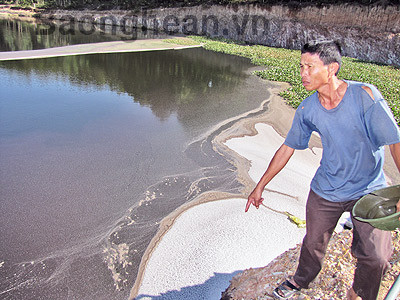
The wastewater holding ponds lack concrete embankments, making them highly susceptible to overflow during heavy rains.
Mr. Le Duc Hung, the owner of the pig farm, said that the farm was built on a modern scale with 3 enclosed pig pens and a biogas digester system using Thai technology and covered with tarpaulin. According to him, each pen can raise 300-500 pigs, with a total investment of 3 billion VND, of which over 300 million VND was spent on the wastewater treatment system. Currently, the farm raises nearly 1000 pigs and is in the process of being ready for slaughter. Mr. Hung acknowledged that the farm does emit a foul odor as reported by residents of Hamlet 15. The cause of the pollution is not due to the pig farm directly discharging waste into the environment, nor is it because the pig herd is too large compared to the farm's design capacity. Instead, during the first two months of operation, the tarpaulin covering the biogas digester system was damaged and torn, causing the odor to emanate. After the problem was resolved, the combustion system of the biogas digester malfunctioned, causing gas to escape and pollute the environment. In addition, on some days the workers don't clean the pens properly, causing foul odors to rise from the pens and spread into the air. If the weather changes, these odors can spread throughout the village, creating an unpleasant smell…
According to Mr. Duong Dang Hoi, Chairman of the People's Committee of Dien Yen commune, Mr. Hung's pig farm is solidly built on an area of 2.8 hectares, capable of raising 1200 pigs. Upon receiving the investment proposal for this project, the local authorities were very concerned and cautious, given the recent incident at the pig farm in Dai Son commune (Do Luong district). Therefore, they required the investor to commit to an environmental protection plan to avoid affecting the lives of local residents. However, since the pig farm began operating, residents have complained about significant pollution. The commune government has repeatedly conducted inspections to assess the pollution situation, reported the findings to the relevant district authorities, and requested the farm owner to promptly take measures to resolve the environmental pollution. "In the coming time, if the pollution is not rectified, we will request the pig farm owner to cease operations to address the pollution issue and stabilize the lives of the local people," the Chairman of the People's Committee affirmed.
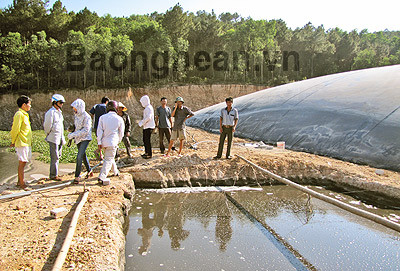
Residents of Hamlet 15, Dien Yen Commune, are upset because the pig farm is causing pollution.
The fact that people are investing in industrial-scale livestock farming and legitimately enriching themselves on their homeland is commendable and should be replicated. However, during the development of farm economics and investment in production and livestock breeding, environmental protection must be prioritized to avoid disrupting people's lives. For a long time, we have talked a lot about environmental pollution in industrial production, but haven't paid enough attention to ensuring environmental hygiene in the agricultural sector.
Since 2007, the People's Committee of Nghe An province has issued Decision No. 74/2007/QD on "Regulations on environmental protection in Nghe An province," which emphasizes that socio-economic development must be linked to environmental protection to ensure sustainable development. The regulations also clearly state the responsibility for environmental protection in agricultural production, especially in concentrated livestock farming areas. In the future, relevant agencies in Dien Chau district need to take measures to work with pig farm owners to thoroughly address environmental pollution issues, strengthen supervision of production and livestock farming processes, and improve the waste treatment systems of pig farms to prevent pollution from affecting people's lives as it currently does.
Text and photos: Nguyen Khoa


