
How powerful are the new anti-tank rounds produced by Vietnam?
The RPG-7 (B-41) is the standard squad-level anti-tank weapon of the Vietnam People's Army.
In the Vietnamese People's Army's arsenal, along with the AK submachine gun, the RPG-7 (B-41) anti-tank rocket launcher is the most "favored" weapon, having left many marks on battlefields from South to North.
The standard RPG-7 round still used by Vietnamese soldiers is the PG-7V, an 85 mm HEAT (Heat-Explosive) round weighing 2.2 kg, with an effective range of 300 m and capable of penetrating 260 mm of homogeneous steel.
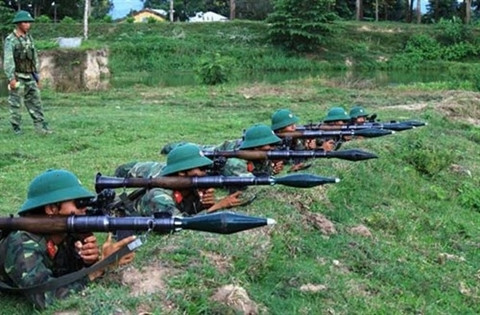 |
| Vietnamese People's Army soldiers train to use RPG-7 launchers; the ammunition shown in the photo is PG-7V. |
Currently, the PG-7V ammunition is proving outdated, lacking sufficient penetration power to counter modern armored vehicles and tanks; therefore, equipping the B-41 gun with newer, more advanced ammunition is necessary.
Based on recently leaked images, Vietnamese troops have begun receiving PG-7VS ammunition manufactured by domestic defense factories.
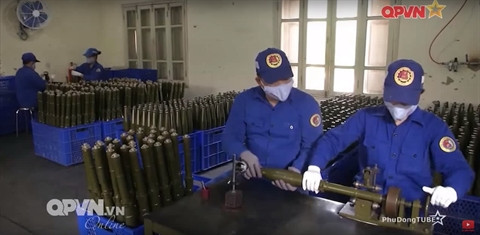 |
| Anti-tank ammunition production at Factory Z131. |
The most significant change between the PG-7VS and PG-7V was the reduced caliber of the projectile to 72 mm, a weight of only 2 kg, but thanks to the more powerful okfole explosive, its armor penetration capability increased to 400 mm.
In addition, the new projectile reduces the diagonal angle of the stabilizing fins from 10 degrees 40 minutes to 8 degrees, and the rocket nozzle is perpendicular to the projectile's axis (in the PG-7V projectile, the rocket nozzle angle is 3 degrees 40 minutes).
The projectile's rotational speed around its axis is reduced from 5,000-6,000 rpm to 2,000-3,000 rpm, which reduces the dispersion of the penetrating stream by slowing down the focal point.
At the same time, the concave shell funnel was also replaced from 40X steel sheet material to V-95 aluminum alloy.
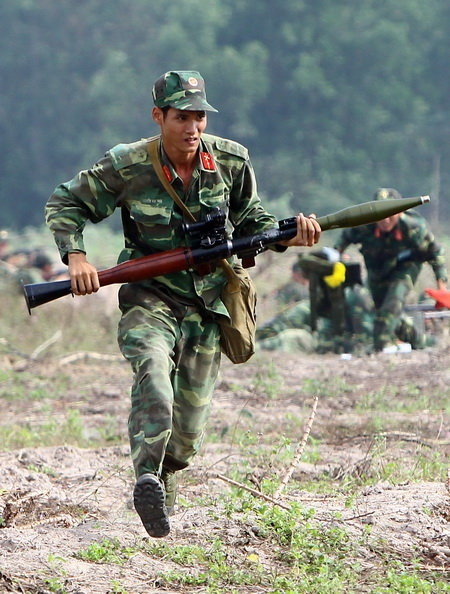 |
| A Vietnamese Army soldier carrying an RPG-7 loaded with PG-7VS ammunition. |
Compared to the PG-7VL round currently used by the Russian Army, this round has increased in size to 93 mm, allowing it to penetrate 500 mm of homogeneous armor. However, the round's weight has also jumped to 2.6 kg, resulting in reduced maximum velocity and effective range.
Vietnam's choice to prioritize the PG-7VS over the PG-7VL is also reasonable, as more difficult targets to deal with, such as tanks with explosive reactive armor, would be handled by the PG-7VR or PG-29V dual-stage armor-piercing rounds.
According to Baodatviet
| RELATED NEWS |
|---|


