
People trust and follow officials because they are "eloquent speakers and skilled in action."
(Baonghean.vn) - For many years, Lieutenant Lau Ba Nenh, a member of the Community Mobilization Team at the Muong Tip Border Guard Post, Ky Son District, has volunteered to live in the village, determined to change the perceptions and lives of the local people. Throughout his long time working closely with the people, guiding them step by step, he has contributed his efforts and resources to bringing about positive changes and progress in the lives of the Mong people in Huoi Khi village, Muong Tip commune…
We arrived at the Muong Tip Border Guard Post just as the unit was holding its weekly flag-raising ceremony. Today, Lieutenant Lau Ba Nenh, a member of the Community Mobilization Team, had the honor of standing under the national flag and reciting the Ten Oaths of Honor for soldiers. Lieutenant Lau Ba Nenh's clear and resonant voice during the ceremony was also his farewell to his comrades. Although he was only temporarily away from the unit to perform his duties in the area, it would undoubtedly be an unforgettable experience because the place where he was assigned to work was Huoi Khi village, the most difficult area in the commune and a 24-hour walk from the Post.
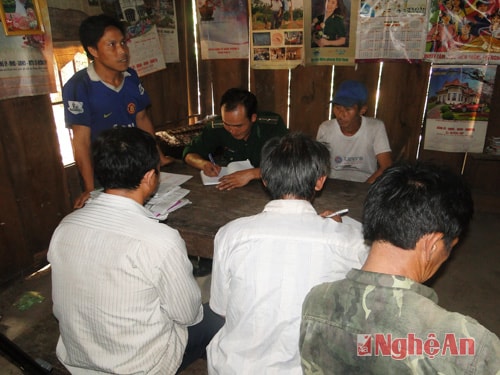 |
| Party branch meeting of Huoi Khi village |
After leaving his unit, Lầu Bá Nênh arrived at Huồi Khí village, Mường Típ commune, Kỳ Sơn district. His belongings as a soldier stationed in the village were simple: a backpack on his shoulder and a wealth of knowledge and experience in mobilizing the Hmong people, acquired during his more than 10 years of military service. His first meeting with the village management board coincided with a regular Party branch meeting. With the border guards present, Party branch secretary Lầu Bá Lầu felt compelled to confide in him. Bá Nênh quietly listened as the secretary recounted the difficulties the village Party branch and its people were facing. Difficult roads, harsh climate, widespread hunger, and many children not attending school had led some families to seek refuge in Laos in the hope of a better life.
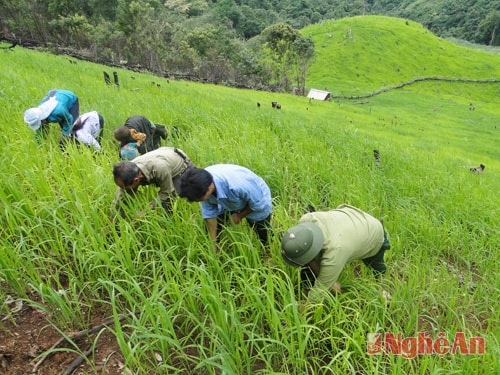 |
| The rice field of old man Xia in Huoi Khi village - Muong Tip commune, Ky Son district. |
To find a basis for persuading other families, Lau Ba Nenh decided to visit the family of Lau Nhia Vu, a young man who intended to move his entire family to Laos. Born and raised in this land, Lau Ba Nenh understood the difficulties of his people better than anyone. After many sleepless nights of reflection, he realized that the fundamental reason why people in the high-altitude border region remained trapped in poverty was due to outdated customs and limited awareness, preventing them from knowing how to make a living. What could he do to help them change their lives?
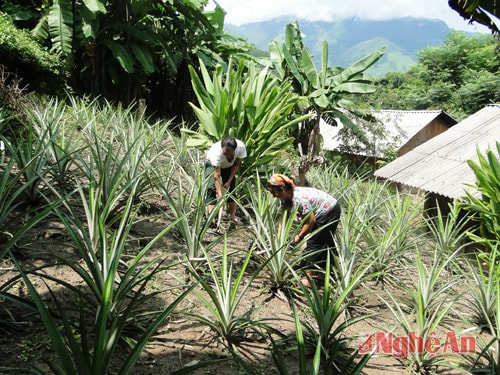 |
| Lieutenant Lầu Bá Nênh encouraged people to plant pineapples. |
Every night, Lầu Bá Nênh went from house to house talking to the Hmong villagers. Sometimes it was a few dozen minutes, other times it could last for hours. His first task was to persuade Lầu Nhia Vừ to stay in the village, at least to see if he could help alleviate the poverty and suffering of the villagers. Lầu Nhia Vừ agreed to stay. However, a new difficulty arose when 90% of the households in Huồi Khí village and the cluster of Chà Lạt, Huồi Khói, and Huồi Phe villages were classified as poor.
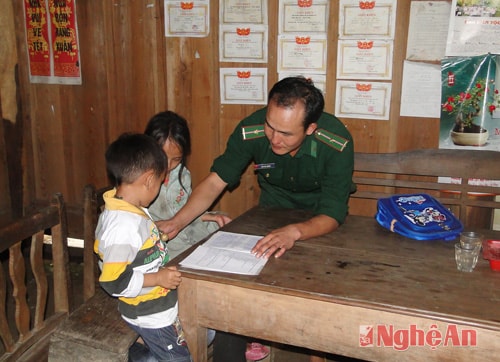 |
| Lầu Bá Nênh encouraged children to go to school. |
Despite facing difficulties, with faith and perseverance, Lau Ba Nenh went from house to house, and today his footprints can be found throughout the highlands of the border region. He helped the villagers with small tasks like bringing buffaloes back from the forest and repairing barns, to larger ones like participating in agricultural production to alleviate poverty and rebuild houses. Wherever people faced hardship, Lau Ba Nenh was there, and the villagers of Huoi Khi, Huoi Phe, and others began to look at him with friendlier and more affectionate eyes. They believed that since Ba Nenh's arrival, the lives of the Hmong people in this highland region had a chance to change. Mr. Lau Dua Cho, the head of Huoi Khi village, said: "Since Comrade Lau Ba Nenh joined the Party branch, he has been enthusiastic in helping the people learn how to do business, and security and politics have changed significantly."
By eating, living, working, and speaking the local language with the people, the border guards understood and shared the difficulties the Hmong people still faced. To ensure stable livelihoods for the Hmong people here, the only solution was to help them escape poverty. Using the same amount of reclaimed land, but to alleviate hunger and hardship, Ba Nenh boldly advised the Hmong people in Huoi Khi, Huoi Phe, Huoi Khoi, and Cha Lat to change their crop structure. Before long, high-yield ginger, cassava, and corn were grown on the Hmong people's fields, and in the very first harvest, the people had enough to eat and save.
However, in this area, not every family can grow galangal or ginger. Recognizing the abundance of arable land and limited manpower, Lầu Bá Nênh discussed the matter with the village secretary to develop a resolution to help villagers access capital for livestock development. He decided to pool three months' salary to lend 30 million VND to three households in the Chà Lạt residential cluster without interest for five years, enabling them to purchase breeding cows and develop their livestock. Lầu Vả Lỳ, from Huồi Khí village, Mường Típ commune, Kỳ Sơn district, who received the loan from Lầu Bá Nênh to buy cows, shared: "My family was struggling and impoverished due to a lack of capital for livestock development. With a 10 million VND loan from Mr. Nênh, my family bought a breeding cow, and it has now given birth to two calves. Now, all we need to do is expand and develop the herd."
The duty of a border guard stationed in a remote village is to assist the Party branch with Party and political work; at the same time, to advise and guide the people in poverty alleviation, economic development, and border security. Ba Nenh shouldered all these responsibilities and fulfilled them completely. Even the simplest task, moving from one residential cluster to another, is not something everyone can do. Ba Nenh regularly crossed mountains and forests for days on end to spread awareness, mobilize support, and assist the people. Because of the difficult roads and impoverished living conditions, many families in the Chà Lạt, Huồi Khói, and Huồi Phe residential clusters had their children drop out of school. Deeply aware of the consequences of this, Lau Ba Nenh went to each household to persuade their children to return to school. And the soldier in green uniform became a teacher for the students in this border region.
Noticing the changes in the village, village elder Lầu Nhia Hùa shared: thanks to Nênh's propaganda and mobilization efforts, the villagers have abandoned outdated customs, including funeral rites, drinking, and wedding ceremonies. The people of our village now believe in and will build their lives according to Nênh's teachings.
After three years in the village, Ba Nenh helped 9% of the Mong ethnic minority households escape poverty. Furthermore, many families have built and developed commercial farm models with annual incomes ranging from 50 to 60 million VND; the security and political situation in the border region has stabilized. In 2013, no households had any intention of migrating to Laos; the Huoi Khi Party branch, which was previously weak, was recognized as a clean and strong Party branch. Lieutenant Nenh has become a shining example of the Nghe An Border Guard Force in mobilizing the masses and studying and following the moral example of President Ho Chi Minh in the high-altitude border region.
According to Ha No Thai, Vice Chairman of the People's Committee of Muong Tip commune: "The people respect Officer Nenh; they listen to him because he keeps his word. The people in the village have achieved what they have today thanks to listening to his wise advice and following his skillful hands. Our Mong people are also proud to have such a Border Guard officer."
Lầu Bá Nênh confided: "Now many people in the village are less hungry and less suffering, but to keep hunger far away from the villagers, the well-off will help the poor, and the whole village must unite to build a new life." True to his word, every night, Lầu Bá Nênh goes to each house to talk and discuss with the Hmong people in Huồi Khí, planning crop conversion and preparing for a bountiful harvest in the new production season.
Hai Thuong


