
Folk dance of the Northwestern Thai people
(Baonghean) - The art of the Thai ethnic group in general, and the folk dances of the Northwest Thai people in particular, have long been formed from the realities of life, driven by the aspiration for freedom, prosperity, and happiness, and giving wings to and breathing life into love. These folk dances suddenly become vibrant and enduring through the flow of time.
By the end of 1968, 36 traditional dances of the Northwest Thai people had been collected.
While the "xé vóng" dances – the circle dances, performed collectively – are powerful and energetic, the smaller circle dances are equally refined. It can be said that the circle dance is the most primitive and ancient dance in the Thai folk dance system.
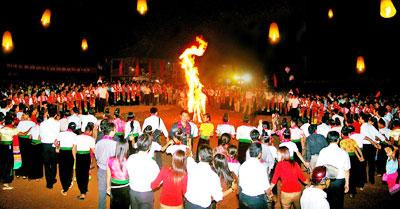 |
This is a group dance that requires no rehearsal. All members of the community, from the elderly to women and children, can participate. The dance movements are simple; everyone enthusiastically holds hands to form a circle, then moves forward and backward rhythmically to the 2/4 beat of the drums and gongs. Sometimes, while dancing, the dancers sing in a call-and-response style, improvising poetry. One person sings, and everyone joins in, creating a very lively atmosphere. The singer then switches to reciting poetry, humming a couple of lines and chanting, with everyone joining in, making the poetry sound clear and cheerful. The circle dance and poetry singing can last all night around the bonfire.
Gradually, the rudimentary forms of dance developed further, incorporating dances depicting daily life activities such as: "Xe cup" - hat dance, "Xe tang chai" - bottle dance, "Xe kep phac" - vegetable picking dance, "Xe vy" - fan dance, "Xe cap" - bamboo pole dance, "Xe lang xe pen" - shield and wooden dance... Over time, these dances were adapted and enhanced by artisans, such as: "Xe to cay" - cockfighting dance adapted from "Xe vy" - fan dance, "Xe nhum hua" - boat pushing dance adapted from "Xe khan" - scarf dance, "Xe tang xa" - racket dance adapted also from "Xe khan" - scarf dance...
With the "Nhum Hua" dance, a dance of the White Thai people, the belief is that the soul can leave the body and ascend to heaven to enjoy pleasures not found in the earthly realm. The dancers, using scarves as props and their powerful foot movements, depict a fantastical boat gliding on the Ta Khai River – a legendary, treacherous river where a soul would surely die if it fell. On the journey to the promised land, the boat encounters numerous dangerous rapids and whirlpools, yet the people remain steadfast, rowing the boat to Then – the heavenly harbor. Drawing inspiration from mythology and adapting it to the reality of the Da Giang river region, the artists have stylized each dance step, making the audience feel as if they are witnessing their own lives. The artists also skillfully incorporate songs and poems to further highlight the contrast between the power of nature and the ingenuity of humanity, creating a beautiful, cosmic image.
"Our country is in turmoil, with surging waves."
At the ferry landing, the water laps against the shore.
The sound of the waterfall cascading down from above could be heard.
The foam surged and swirled like a large house.
"Each wave surged up and then dissolved into a white foam, like the stars in the sky..."
With the "xe to pet" dance – the figure-eight dance, an ancient dance of the Thai people of Muong Lo – accompanied by the poignant, inviting sound of the bamboo flute, dancers from opposite sides, young men and women, advance and form alternating rows, one male and one female, then create two circles like the number eight. In their hands, the dancers hold "mac hinh" – musical balls – which they shake as they sway their feet and hands, producing lively sounds like the call of spring, love, and the wish for complete happiness.
Rooted in life, the folk dances of the Northwest Thai people endure through time, serving as an indispensable source of spiritual nourishment. Through each dance step and each night of the Xoe dance, people become more optimistic, more loving towards others, and more confident in stepping into a better new day. Therefore, Thai dances have become a precious cultural asset, a source of pride for the Northwest Thai people and the Vietnamese nation.
Tran Van Hac


