
Behind the Japanese Prime Minister's visit to Europe
(Baonghean) - Japanese Prime Minister Shinzo Abe's lengthy visit to Europe, with its packed agenda, is a noteworthy diplomatic event in recent days, especially in the context of volatile regional security. Beyond promoting diplomatic, economic, and security relations with the "old continent," Prime Minister Abe's trip also carries a larger purpose: strengthening Japan's role and position in many areas.
(Baonghean) - Japanese Prime Minister Shinzo Abe's lengthy visit to Europe, with its packed agenda, is a noteworthy diplomatic event in recent days, especially in the context of volatile regional security. Beyond promoting diplomatic, economic, and security relations with the "old continent," Prime Minister Abe's trip also carries a larger purpose: strengthening Japan's role and position in many areas.
Japanese Prime Minister Shinzo Abe embarked on a 10-day tour of several European Union (EU) countries, including Germany, the United Kingdom, Portugal, Spain, France, and Belgium, and visited the EU and NATO headquarters in Brussels. Strengthening economic cooperation was one of the most obvious objectives of Abe's trip. And it must be said that in this area, Abe was successful, as agreements and commitments on economic cooperation were reached at each stop. At his first stop in Germany, where he met with Chancellor Merkel, both sides expressed hope that negotiations between the EU and Japan on a free trade agreement could be completed next year. In fact, while difficulties have prevented breakthroughs in negotiations for the Trans-Pacific Partnership (TPP) with the US, the smooth progress in free trade agreement (FTA) negotiations with Europe is seen as a significant step in Prime Minister Abe's Abenomics policy. The Japanese economy and the 27 EU members account for approximately 30% of global GDP and 40% of world trade. If the EU-Japan FTA is finalized next year, bilateral trade is estimated to increase by an additional €29 billion ($36 billion), equivalent to a 50% increase. Furthermore, Japan wants Europe to abolish tariffs on electronics and industrial goods, especially Japanese cars, while Europe wants Japan to ease tariffs on agricultural products from Europe.
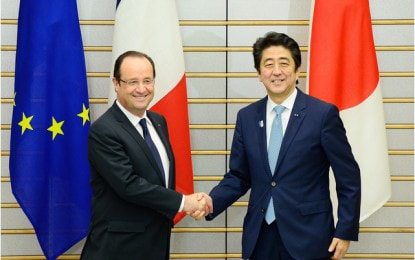 |
| Japanese Prime Minister Shinzo Abe met with French President Francois Hollande. |
Cooperation on civilian nuclear technology was also one of the topics discussed during Shinzo Abe's visit to France. A highlight was the Japan-France cooperation plan to develop a new generation of nuclear reactors for use in nuclear power plants, which are expected to be operational by 2040. In the UK, the two sides also signed an investment project worth £200 million to rebuild the UK's nuclear industry, particularly in the Northwest region.
Beyond economics, security and defense cooperation between Japan and European countries is also entering a new phase following Prime Minister Abe's visit. Analysts suggest that, in the field of security, Tokyo is not just now turning to Europe, but rather reclaiming its role on the continent. In fact, throughout this trip—London, Berlin, or Paris—Prime Minister Abe emphasized the importance of security issues in Japan-Europe relations, both in Asia and internationally. This trend could lead to increased cooperation on military equipment, especially after Japan, in early April, decided to lift its nearly half-century-old arms export ban. This allows Japan to develop more military cooperation programs with partners other than the US, and European countries will be an ideal market.
Beyond the obvious objectives, the Japanese Prime Minister is seeking to garner support from European and NATO leaders for his proposed constitutional amendments that would allow Japan to conduct military operations outside its borders. Prime Minister Shinzo Abe has introduced a new concept, "active pacifism," to explain his determination to strengthen Japan's military capabilities and free itself from the constraints imposed by its current constitution. This is the reason for his visit and key speech on Tokyo's defense policy at NATO headquarters in Brussels. This move is entirely understandable, given the escalating territorial disputes between Japan and China, and Japan's hope for global support.
Furthermore, Japan also seeks to enhance its position and role in a region already facing numerous security issues, including those related to the Ukraine crisis. As a member of the G7 group of industrialized nations, discussing steps with partners regarding the Ukraine crisis and responses to Russia will draw more attention to Japan's role. Another noteworthy point is that Japan also seems unwilling to lag behind China in its engagement with Europe in many areas. Evidence of this is Prime Minister Abe's visit, which followed Chinese President Xi Jinping's successful European tour in early April, opening a new chapter in Sino-European cooperation. It can be said that in a world constantly changing and reshaping international relations, Japan not only wants to open its doors to partners but also hopes to rebuild its established position in important regions of the world. This is what the French newspaper Libération calls the "campaign to find allies beyond the Pacific" that the Japanese Prime Minister is currently undertaking. And Prime Minister Abe's trip can be considered a success in reaching out to partners on the Atlantic coast.
Thanh Huyen


