
Reversing strategic calculations in Idlib (Syria)?
Amid escalating fighting in Idlib, the Kurds have become a key factor in both Russia's and the US's calculations to influence Ankara's stance.
The escalating conflict has left Türkiye reeling between stern warnings from Russia and urging action from the US, as it maintains pressure on Syrian forces to withdraw from the Idlib de-escalation zone. Amidst this stalemate, the Syrian Kurds are becoming a key factor in both Russia's and the US's calculations to change Ankara's stance.
|
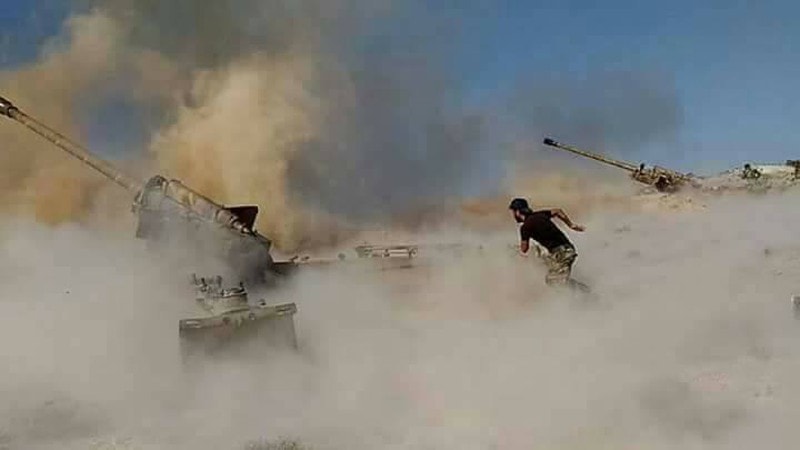
| Syrian army attacks rebel group in Idlib. Photo: AMN. |
Bargaining chips
The Trump administration is reportedly considering options to support Türkiye's military campaign in Idlib. In a move to appease Ankara, Washington has warned the Kurds to stay out of the conflict. For its part, Russia appears to be seeking to draw the Kurds into the conflict, albeit discreetly at this time, in a way that goes beyond restoring dialogue between the Kurds and Damascus.
Recently, Kurds have been concerned that Russia, in an attempt to steer Türkiye toward Syria, might allow Ankara to control the Kurdish border city of Kobani in exchange for concessions in Idlib. This concern is not unfounded, given the close cooperation between Moscow and Ankara on the Syrian battlefield. However, in the context of a shifting situation, with the Russia-Turkey relationship fractured following the attack that killed several Turkish soldiers in early February, the Kurds feel that Russia may be opening doors for them to an extent they never imagined.
According to Fehim Tastekin of the newspaper.According to Turkey Pulse, the Kurdish position can be summarized as follows: they want to maintain their partnership with the US, continue to view the Turkish military presence as the main threat, and while seeing Russia as the guarantor of negotiations with the Damascus government. The Kurds still remember that Russia's strategic interests may compel them to adapt to Türkiye, as happened in 2018 when they allowed Türkiye to take over Afrin.
However, the priorities in the Kurdish approach have shifted since Türkiye launched Operation Peace Spring in northeastern Syria in October 2019. The view that the Syrian government is the main force in resolving the Kurdish issue has become a common strategic option for the Kurdish-led autonomous administrations in northern and eastern Syria. In late December 2019, Russia met with Kurdish representatives at the Khmeimim air base, after which Moscow arranged a dialogue between representatives of the Syrian government and the Kurds in Damascus. This dialogue led to an agreement to establish joint committees with the vision of further advancing negotiations in the future.
Changing Kurdish strategy
Tensions in relations between Russia and Türkiye in Idlib have led to changes in the Kurdish tactical choices. Al-Monitor, citing several sources, reported that the Kurds are cooperating with the Syrian army in several operations in Aleppo province, northwestern Syria, specifically in areas along the border with Afrin. The expansion of the Syrian army's offensive towards Afrin may include Kurdish participation.
Two other potential fronts emerging at the moment are Tel Rifaat, where the Kurdish People's Protection Units (YPG) deployed after withdrawing from Afrin in 2018, and Manbij – where Russian and Syrian forces have been in control since the US withdrawal. Meanwhile, east of the Euphrates River, controlled by the Turkish army and its allies, the Syrian National Army (SNA), along with nearby areas of Tel Tamer and Ain Issa on the M4 highway connecting Latakia and Aleppo, are also considered key areas where fighting could occur. In fact, sporadic but controlled clashes still occur in these locations. However, if fighting breaks out between Syrian and Turkish forces in Idlib, they could become a major battleground.
Although joint Russian-Turkish patrols along Türkiye's border with Syria have resumed after being temporarily suspended following an attack in Idlib in early February that killed several Turkish soldiers, the agreement reached in Sochi is at risk of collapsing. This means that Russia – the guarantor of the ceasefire – will no longer act to contain the Kurdish-led Syrian Democratic Forces (SDF) and the Syrian army in the region.
The American factor cannot be ignored.
However, according to analysts, this assessment seems premature at the moment, as another factor, the United States, must be mentioned. The US has warned the Kurds that they will not receive any support from the US if they fight against the Turkish army. “A senior US official emphasized that the YPG has been clearly informed that the US will not choose them over Türkiye in the event of a conflict,” Turkish journalist Murat Yetkin reported on February 18th.
According to this journalist, Turkey's Operation Peace Spring in October 2019 appears to have accomplished two objectives: establishing a military presence in northeastern Syria and demonstrating that the US would not stand up to protect the Kurds.
Regarding the situation in Idlib, journalist Yetkin stated that US forces will not directly intervene in the Idlib conflict, but they will support Ankara in various areas, from providing intelligence to specialized equipment when needed.
Previously, Türkiye had requested the US to deploy two Patriot missile defense batteries to its southern border to facilitate retaliation against any future attacks by Russian-backed Syrian forces. Al-Monitor, citing several sources, reported that Turkey is capable of deploying up to 45,000 troops to the region in a short period, while "neither Russia nor Syria is capable of doing so."
A clear lesson
It can be said that the current situation in Idlib is very complex, where cooperation, conflict, and clashes between the US and Türkiye, between Turkey and Russia, and between Russia and the US coexist. However, Russia's role as a mediator and guarantor of negotiations has become more significant (for the Kurds) after the US expressed support for Türkiye's Operation Peace Spring.
Furthermore, the deep rift between Moscow and Ankara means that Russia will pay closer attention to cooperation with the Kurds, and that could offer a solution that benefits them. The escalating tensions in Idlib between Russia and Turkey are now developing “according to a worst-case scenario,” Elena Suponina, a Middle East expert, told Bloomberg. According to her, by providing air support to the Syrian army, Russia has demonstrated its willingness to retaliate harshly if Türkiye does not exercise restraint.
However, it is still too early to talk about the prospects for cooperation between Russia and the Kurds, as it cannot be ruled out that Russia does not want to engage in a full-scale confrontation with Turkey because the Russia-Turkey relationship is of "strategic importance" and closely tied to each side's interests. Furthermore, Russia has also learned a clear lesson from the US. The inconsistency in US policy – a country that cooperated with two sworn enemies, Türkiye and the Kurds – caused Washington to lose two important allies simultaneously and quickly lose its influence in Syria.


