
An Bang Island
(Baonghean)It's unclear who named the island An Bang, perhaps hoping to maintain peace in this part of the nation's maritime territory. The island is small, but the waves are high almost year-round.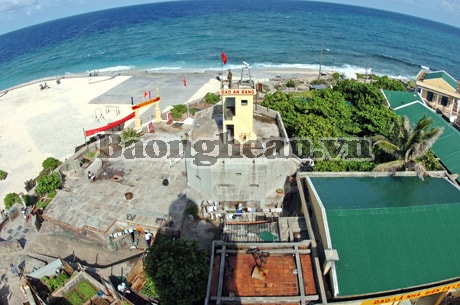
An Bang Island. Photo: Tran Hai
According to official documents, An Bang Island experiences up to three hundred days a year with high waves, level five or higher. From the coral reef, a white sandbar connects to the island's shore. This sandbar is constantly changing and transforming, appearing and disappearing, moving with the northeast and southwest monsoon winds. During the northeast monsoon season, fierce waves crash against the sandbar towards the southwest of the island. During the southwest monsoon season, waves churn the sand towards the north of the island. Currently, it's the southwest monsoon season, with some southeast winds as well. After a few days, the dolphins, perhaps very familiar with the 996 transport ship, followed the vessel, leaping up on both sides, then leaping to the front, acting as messengers for the soldiers.
Sitting in the cockpit near the main helmsman, Hien whispered: "The sea is about to get rough. The dolphins have warned us several times. Go back to your cabin and rest; the rocking in the hold is less intense." Early in the morning, the ship 996 dropped anchor far offshore from An Bang Island, where the sea was rough. The small boat, towed by a speedboat carrying the delegation's leaders and a large number of reporters, moved slowly, cutting through the waves, waiting for the self-propelled XQ speedboat, which the naval soldiers called "MEC" (mecxedec) of Truong Sa, to tow it to the island. Large waves splashed water onto the front rows of seats. The speedboat, familiar with the route, cut through the water, ignoring the isolated coral reefs dimly visible at the bottom. The boat, heavily laden with people and equipment, was towed north towards the sandy beach. Waves continued to surge around the large, old-fashioned boat. The soldiers in their navy uniforms, wearing orange life jackets, stood in a line on the shore. The order was given: "All personnel, pay attention and carry out your duties!" The island soldiers rushed into the water. Another order was given:
- The soldiers on An Bang Island helped carry the audiovisual equipment. The male reporters and writers went to the island on their own. The soldiers on An Bang Island carried the female reporters and female officials ashore…
I had read many times in the newspapers about the scene where, due to rough seas, ships couldn't reach the island, and our soldiers had to wade out to bring the female performers to the island. Today, I witnessed it firsthand and participated in this strange encounter on An Bang Island, and I didn't hear a single word of disapproval. Instead, I heard bursts of laughter, sighs of regret, and shouts of "Sister!", "Brother!", "Sister!", all echoing in my ears, blending with the sound of the crashing waves.
I sat on the steep northern bank of the island, a sturdy stone embankment, with salty water splashing against me. A young soldier came and sat beside me. I learned his name was Nguyen Van Tung, from Thanh Linh commune, Thanh Chuong district. Tung was born in 1982 and had served in the army for nine years, eight of which were on the island. He specialized in chemical defense and had previously served on Da Lon Island and Son Ca Island before being assigned to chemical defense duties on An Bang Island.
I told him that during the war against the Americans, I had been hospitalized at Military Hospital No. 4, which had been evacuated to Thanh Cat commune. Tung exclaimed in surprise:
- The Military Hospital of Military Region IV currently has a medical team stationed in An Bang. They just performed emergency surgery on several cases of acute appendicitis, and the results were excellent. You should meet them.
"Where are they?" I asked.
Please come up to the auditorium.
I stepped into the spacious courtyard where the singing and dancing had just finished. The courtyard was crowded with people, and several generous benefactors were climbing trees searching for square-fruited Terminalia catappa fruits for the women. They were even breaking off branches with unripe fruits. The poetess Nguyen Thuy Quynh suddenly appeared and whispered in my ear:
- Brother, picking the fruit like this will ruin the tree! You have to say something! People are calling for bringing trees to green the Truong Sa Islands, but here they're picking unripe banyan fruit, picking flowers and buds, breaking branches and taking them back to the mainland, causing damage to the island's ecological environment?!
I said this so both brothers could hear:
- The other day, at the meeting of delegation leaders, someone from security suggested that the selection of the delegation needed to be more careful. I'll mention this to musician Dinh Tham later.
The poet Thuy Quynh, in her own unique way, went alone and silently, interviewing soldiers privately and taking notes. I followed the stairs up to the second floor and into the assembly hall. The island's command was reporting on the soldiers' living conditions, training, and combat readiness. An Bang was the ninth island the delegation had visited and listened to. The above-water and submerged islands share some commonalities, such as a lack of water and vegetables. However, the soldiers' living conditions have improved compared to before. The island has quite a lot of greenery, a better living environment, less heat, less sun, less thirst, and now has wind and solar power… Nevertheless, each island has its own advantages and disadvantages, its own unique culture that we must observe carefully, empathize with, and share in order to truly understand An Bang's unique characteristics. There are urgent issues that need to be reported to higher levels, possibly the highest level. The responsible members of the delegation listened, absorbed, systematized, and presented the official report on behalf of the delegation.
The head of the delegation took the podium to speak, his voice still youthful, resonant, and full of enthusiasm, he said:
- "An" means peace, maintaining peace; the "peaceful island" is a sacred part of our homeland's territory. The commander of the armed forces has issued a call: "Be ready, be even more ready to fight. Be even more vigilant. Stockpile more fresh water, more vegetables, more meat and fish, and proactively provide effective medical care for soldiers and civilians as we have done recently." On behalf of the delegation, I express my admiration and deep emotion for the island's medical team, which, despite lacking resources, successfully performed emergency appendectomy surgeries and other procedures. The Party Committee of the Central Agencies Bloc respectfully donates ten million dong to the medical station to purchase surgical lights, operating room air conditioners, and other essential equipment.
Dr. Bui Manh Ha, head of the Military Medical Unit at Hospital IV, a skilled doctor with golden hands in surgeries, now tremblingly receives a gift from the Party Committee of the Bloc, handed to him by Mr. Hai Duong.
I called poet Bui Thi Tuyet Mai for a quick consultation:
- The Vietnam Writers Association delegation should bring a small gift for the An Bang Medical Station, okay?
Tuyết Mai said loudly:
- I've prepared something; we'll have gifts for every island our group visits!
I followed Dr. Bui Manh Ha to the back of the clinic's assembly hall. Dr. Ha is from Nghia Dan district (Nghe An province). I met medical assistants Le Nguyen Tu, from Nghi Loc district; Nguyen Doan May, from Anh Son district; and Vu Van Minh, from Hung Linh (Hung Nguyen district), all from Nghe An province. They had just finished surgery to remove a fatty tumor from a patient, Lieutenant Tran Huu Hao…
Talking to Dr. Nguyen Manh Ha, I suddenly thought of the immediate rear support for the islands in the Truong Sa archipelago. Like Zone Four, like Nghe An province with its rough seas on An Bang island.
I'll tell Dr. Ha about my stay in Ho Chi Minh City for a few days waiting for the ship. Every morning I ran along Bach Dang Street to exercise behind the statue of National Hero Tran Quoc Tuan. I think someone before erected the statue of Saint Tran here to ward off evil spirits at the Saigon River port. Now the sea is turbulent, outsiders are encroaching, plotting to seize our vast sea and islands, a territory our ancestors have belonged to since time immemorial. In the time when the National Hero led the Dai Viet army and people to victory three times against the Mongol invaders who had trampled and ruled the Central Plains, our Party and State were able to invite him to erect a statue in An Bang, and then the country was peaceful and calm. The schemes of the devils could not deceive him; the envoys of the Yuan dynasty, upon arriving in Thang Long, heard the sound of the bronze drums and their hair turned gray. Even after death, the enemy still feared him. Our people have erected statues of him in Kiet Bac, on An Sinh Mountain, Dong Trieu, and at La Ket Lake, Nam Dinh. The Tran Thuong Temple in Ha Nam, at the mouth of the Saigon River… Now, if we invite him to guard An Bang, Truong Sa, and Hoang Sa, the country will enjoy blessings and peace…
Writer Dao Thang (Hanoi)


