
Digging up ginseng in Pù Chóm Đém
(Baonghean) - In the first month of the lunar year, the weather is bitterly cold with incessant rain. People in the villages of Muong Hinh, Pu Duoc, and Pu Khon in Dong Van commune (Que Phong district) climb Pu Chom Dem hill early in the morning to dig for ginseng roots. Such a trip lasts from 1 to 3 days, some even a week…
These days in Dong Van (Que Phong), the weather is bitterly cold, accompanied by thick fog. It's already 7 a.m., but the motorbike taxi driver still has to turn on his headlights, and students going to school carry torches to signal to passersby. The fog only begins to dissipate at 9 a.m. Passing through the villages of Muong Hinh, Pu Duoc, and Pu Khon, we see that every house is locked and bolted. The villages are sparsely populated with green trees, and the gardens are barren and rocky, with only chickens scratching the dry soil. We searched and searched but couldn't find a single adult, only a few children and elderly people meticulously sewing. Ms. Lo Thi Quang (61 years old), from Pu Khon village, greeted us openly: "The children are at school, the adults are all digging for ginseng. Here and there, we only know how to dig for ginseng and catch fish to make a living." "You don't dig for ginseng, do you? And where do you dig for ginseng?" "I have something to do today, otherwise I would have been out digging ginseng on the hill. The villagers are eager to grow rice and potatoes, they don't want to dig ginseng. But they don't have land to cultivate, so everyone has to dig ginseng roots to sell and earn money. Digging ginseng is hard work, but it's profitable. If you want to go on a trip to see for yourself, stay at my house, we'll go together tomorrow morning."
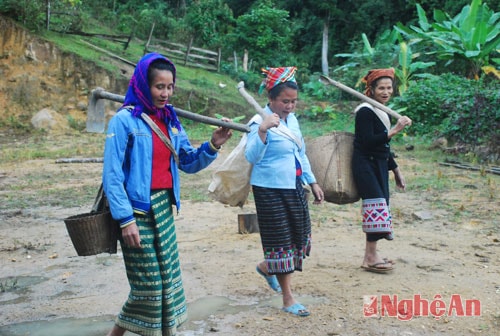 |
| People from Dong Van commune go digging for ginseng on Pu Chom Dem hill. |
The night was still dark. I looked at my watch; it wasn't even 5 a.m. In Mrs. Quang's kitchen, the fire was already blazing, and she had finished cooking a pot of rice. Packing a basket full of rice, enough for about two bowls, she said, "This is enough for a day. On the first day in the forest, everyone brings home-cooked meals, and we cook the next day. Back in the old village, we'd be back home after noon after working in the fields or gathering ginseng. Luckily, the children can manage their own meals; some go with their parents, and the rest stay with their grandparents..."
Mế Quang prepared her luggage for the trip: finely ground salt mixed with dổi seeds, rice, two pots—one already filled with stewed fish. Mế Quang said she had just caught the fish the night before, and that it would last her and her husband five days if they ate sparingly. The other pot was for cooking rice, and the water would be from the Nậm Banh stream below Pù Chóm Đém hill. Every family going on a trip to gather ginseng did the same. "What about sleeping arrangements, Mế?" Mế laughed: "Every house has a 'house' on the hill." Called a house, it was really just a small hut made of forest leaves, just big enough to sleep in. During this cold spell, the villagers brought along thick blankets.
As dawn broke, nearly a dozen people were already loading their luggage onto boats in a corner of the Hua Na hydroelectric reservoir where we were standing. Ms. Quang said, "They're going to collect ginseng." I met a woman in her 40s, named Lo Thi Kim, from Pu Khon village. Her luggage was less, just a basket containing a few knives, an iron shovel about 80 centimeters long, and a bundle wrapped in fresh banana leaves. Ms. Kim said she was only going to collect ginseng for one day. Ms. Quang adjusted her scarf to cover her ears and said, "My family doesn't have a motorboat, we have to rent one. Each round trip costs 300,000 dong. Most families who go to collect ginseng do the same as me; even the shortest trips last two days, some families go for a whole week before returning. Ms. Kim's family has a boat; about 100,000 dong worth of fuel is enough for the round trip."
The motorboat gradually left the village, leaving only the vast expanse of water and mountains. Mế Quang looked up at the mountain before her and said: "Since moving to the new village (my family used to live in Piềng Văn village), every time I go ginseng hunting, I miss the old village so much. The new village has electricity and convenient transportation, but there's no land to farm; all we can do is fish and hunt ginseng, it's so depressing. Luckily, there are a few boats on the lake that serve the villagers' transportation needs. Otherwise, the villagers wouldn't be able to go back to the old village or up to Pù Chóm Đém hill to make a living."
Pù Chóm Đém appeared before my eyes. I caught glimpses of ginseng diggers busily digging and searching, their laughter echoing. Ms. Quang excitedly said, “That bright smile means you’ve found a female ginseng root. It yields many tubers; you can dig up a whole cluster of ginseng weighing almost ten kilograms. Male ginseng only yields rootlets; if there are tubers, they’re very few, small tubers, and even the whole root only weighs about a kilogram.” She happily shared that on lucky days, she might find several female ginseng roots and earn a few million dong, which made her very happy. Therefore, whenever she heard someone shouting, she knew for sure that someone had found a female ginseng root, or at least a squirrel. Female ginseng is very rare; most are just ordinary ginseng roots, each yielding about two or three kilograms.
Digging for ginseng is incredibly hard work. Some ginseng roots are only 20 to 30 centimeters deep, while others are nearly a meter deep. Digging a single root to a depth of one meter takes about 3 to 4 hours. Sometimes, you're exhausted from digging and only find male ginseng. In the hot summer, digging a root to a depth of forty or fifty centimeters leaves you drenched in sweat; in the cold winter, your hands are numb with cold. It's much harder than farming in the fields. Back in our old village, when people found ginseng in the forest or on the fields, they would dig it up as well, going out in the morning and returning in the evening, without having to sleep in the forest like they do now.
Mr. Lu Dinh Thi, from Muong Hinh village, leaned against a tree trunk, looking very tired. He said, "I've dug up several ginseng roots, but all I found were vines and branches. It's so disheartening." I approached him and asked, "When did you start digging for ginseng?" "Since I was very young, I went into the forest with my parents and learned about ginseng roots. Back then, I'd dig them up when I found them in the fields and plantations. My main job was hunting and clearing land." Then he recounted a colorful, legendary story: Below the Pu Chom Dem hill lies the Nam Banh stream. In the middle of the stream, a very large earthenware pot floats above the waterfall. People wanted to retrieve it but couldn't; the pot sank on its own. The stream's water was very sweet, making the rice fields flourish, so people flocked to clear the land for rice cultivation. And strangely enough, the rice grew abundantly, yielding a bountiful harvest every year. Back in the old village, the villagers never ran out of rice to eat. The discovery of the wild yam was purely coincidental. In the early years of land reclamation in Pù Chóm Đém, the villagers dug up wild yams to eat instead of rice to gain strength for clearing the land. They found tubers similar to cassava, growing abundantly on the hills. They tried them and found them fragrant, nutty, and sweet.
Every time he went into the forest, Mr. Thi, like many other villagers, would dig up ginseng to make drinks or soak in alcohol. Over time, people from outside the district started asking to buy it, but back then, they would haggle the price down (in 1995, people started coming to the village to buy ginseng), a kilogram of ginseng only cost 30,000 dong. If he took the trouble to bring it to the district, he could sell it for 50,000 dong. The road from the center of Dong Van commune to the villages of Muong Hinh, Pu Duoc, and Pu Khon is difficult, mainly crossing many hills and streams, so few people bring it to Kim Son town to sell. Mr. Thi once took ginseng to the district to sell during the rainy season and floods; on one occasion, due to sudden floods, the stream water rose so high that he had to wade through it up to his waist. Because of the difficult travel conditions, the villagers would bring the ginseng they dug up back home to brew, soak in alcohol, or bury in the ground in their gardens until someone came to buy it. Now, a kilogram of ginseng costs from 70,000 to 100,000 dong.
Ginseng plants have tuberous roots and thrive underground year-round. Those who dig for ginseng are bound to find some, whether a little or a lot. However, the job of digging for ginseng not only involves irregular eating and sleeping habits but also constant exposure to forest mosquitoes and the risk of illness without timely medical care. Last year, Mr. Dan in Muong Hinh village suffered from a high fever. He took fever-reducing medicine for several days without stopping, yet he continued digging for ginseng. Fortunately, villagers took him to the commune's health station in time. Then, Mr. Sam in Pu Duoc village experienced excruciating stomach pain while digging for ginseng. Medicine didn't help, so he and his wife helped each other down the hillside as darkness fell. Without a boat, they had to stay at the Nam Banh stream. After that painful experience with gallstones, Mr. Sam never dared to dig for ginseng again!
Many people in the villages of Pù Khón, Pù Duộc, and Mường Hinh are also apprehensive and worried about themselves. They worry about what might happen, and about their children at home. Some families only go for a few days, but few families, like Mrs. Quang and Mr. Thi, "go on the ginseng trip" for five days. According to Mrs. Quang, Mr. Thi, and many others, they just want to make one more boat trip, one more day of work, and try to stay as long as possible.
And, the people in the Hua Na Hydropower resettlement area have chosen ginseng digging as a temporary solution while they lack land for production. They still hope to have land for farming and livestock raising; ginseng digging should only be a secondary occupation.
Text and photos:Thu Huong


