
Vocational training is linked to practical needs.
(Baonghean) - Over the past three years, implementing Resolution 01 of the District Party Committee and Project No. 745/DA of the District People's Committee on vocational training and job creation for the period 2011-2013, in conjunction with the new rural development program, more than 15,000 laborers in Quynh Luu district have received vocational training, raising the percentage of trained laborers from 32.7% to 46.9%...
(Baonghean) - Over the past three years, implementing Resolution 01 of the District Party Committee and Project No. 745/DA of the District People's Committee on vocational training and job creation for the period 2011-2013, in conjunction with the new rural development program, more than 15,000 laborers in Quynh Luu district have received vocational training, raising the percentage of trained laborers from 32.7% to 46.9%...
The resolution is practical and relevant.
As a predominantly agricultural commune, during the process of building new rural areas, the Party Committee and government of Quynh Dien commune have always focused on vocational training linked to practical needs while exploiting the potential and strengths of the locality. Based on the successful development of the traditional rattan and bamboo weaving craft village of Dong Van in Hamlet 1, which provides regular employment for over 200 workers with an average income of 1.7 - 1.8 million VND/month, the commune's Party Committee issued Resolution 26 to develop craft villages in Hamlets 2 and 4, attracting approximately 300 workers.
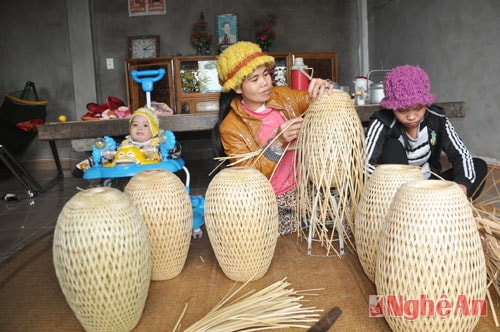 |
| Production of rattan and bamboo products in Quynh Dien commune (Quynh Luu district). |
Mr. Le Van Long, Vice Chairman of the People's Committee of Quynh Dien commune, said: "Every year, the commune monitors market information, develops plans for on-site vocational training, and improves the skills of workers in the field of export-oriented rattan and bamboo weaving with new products. The People's Committee also has a joint venture with Duc Phong Company to supply raw materials and guarantee the purchase of products from farmers. In addition, they invest in building workshops, warehouses, and offices for craft villages, allowing them to stockpile raw materials for production and organize vocational training classes. This helps create jobs during the off-season and increase household income." Ms. Le Thi Luu from Hamlet 1 said: "Thanks to the guaranteed market for our products, many families started working from the 2nd and 3rd day of Tet (Lunar New Year). For Ms. Luu's family, the rattan and bamboo weaving craft provides an additional monthly income of about 2 million VND, improving their living standards…"
To create jobs and increase income for young workers, the commune has also developed the fine art woodworking industry with 9 production facilities, contributing to vocational training and job creation for hundreds of workers. In addition, political organizations such as the women's association, youth union, and farmers' association regularly organize vocational training classes and short-term workshops on farming and livestock raising to effectively utilize the 615 hectares of natural land and promote the development of integrated farming models combining livestock raising and crop cultivation.
Not only in Quynh Dien, but also in many other communes, following the district's policy, vocational training and job creation models linked to the construction of new rural areas, suitable to the local potential and strengths as well as the regional economic development orientation, are being replicated. Accordingly, in the riverine and mountainous areas, vocational training focuses on farming and animal husbandry such as: organic duck farming in Quynh Hung commune; free-range chicken farming in Tan Thang and Quynh Thang; clean vegetable farming in Quynh Luong and Quynh Minh communes; agricultural machinery repair and veterinary services in Quynh Tan and Quynh Tam; development of rattan and bamboo weaving villages in Quynh Thanh and Quynh Thach; fine art woodworking in Quynh Hung and Quynh Ba; and household electrical repair in Quynh Hau.
In coastal communes such as Quynh Nghia, Quynh Long, and Tien Thuy, training focuses on professions such as captain and engineer, aquaculture, seafood processing, shipbuilding and repair, and food preparation for tourism. The town area concentrates on mechanical repair, refrigeration, electrical work, services, tourism, and fashion design. From these areas, many local workers have received vocational training and found employment. In addition, several woodworking, shipbuilding and repair, and mechanical and automotive repair businesses in the area provide on-the-job training and employment for hundreds of local workers. A prime example is the fine art woodworking workshop of veteran Nguyen Van Quang in Hamlet 4, Quyet Tien, Quynh Ba commune, which, in collaboration with the Provincial Small-Scale Handicraft School, has opened three vocational training classes for nearly 100 students. Mr. Quang's carpentry workshop currently provides regular employment for 30-50 workers, with incomes ranging from 5-7 million VND per month, and annual revenue exceeding 3 billion VND.
To address the issue of vocational training linked to job creation and increased income for the people, Quynh Luu district has recently focused on building and developing more craft villages through investment in rural infrastructure, providing financial support for vocational training, and passing on skills to workers. As a result, most craft villages have been effective, with the district's annual production value estimated at over 200 billion VND, contributing to the creation of jobs for nearly 10,000 local workers, with salaries ranging from 2 to 2.5 million VND per person per month. To date, the district has 26 craft villages recognized by the Provincial People's Committee and 6 craft villages at the district level. In addition to implementing on-site training, the district also plans to organize access to vocational training for workers at vocational schools in the province and district. In coordination with vocational schools and large companies such as Canon Vietnam Co., Ltd. and NiSSxay Company, vocational training counseling is organized in clusters of communes and towns; creating conditions for laborers after vocational training to access loan sources to develop their economy and establish themselves in their hometowns.
Vocational training linked to job placement.
After three years of implementing Resolution 01 of the 26th District Party Committee, the total number of trained workers in the district is 15,754, of which approximately 11,000 were trained in the industrial, construction, and service sectors, accounting for 69.8%; and about 4,700 were trained in agriculture, forestry, and fisheries, accounting for 30.2%. Thanks to focused coordination in effectively carrying out propaganda, vocational training counseling, and job placement, over the past three years, approximately 7,000 to 7,200 workers in the district have found new jobs. Of these, 1,855 people were sent abroad for work, an increase of over 270 workers per year compared to 2010, reaching 130-142% of the provincial target of 650-700 people/year and 92-95% of the resolution's target. In 2013 alone, nearly 2,400 workers found employment.
In a discussion with us, the leaders of Quynh Luu district stated: Resolution 01 of the 26th Party Committee of the district, concretized by Project 745 of the District People's Committee, has been implemented relatively synchronously with the participation of the entire political system. Thanks to this, it has gradually contributed to improving the quality of labor, creating jobs, increasing income, improving the quality of life for the people, promoting the regional economy, and contributing to a rapid reduction in the district's poverty rate from 15.4% at the end of 2010 to 7.1% at the end of 2013. The rate of trained laborers increased by approximately 5.2%, raising the total rate of trained laborers in the district from 32.7% in 2010 to approximately 46.9% currently (the Resolution's target for 2015 was approximately 40-42%). The awareness of the people has undergone positive changes, and the number of rural laborers registering for vocational training is increasing. The number of students who completed high school and lower secondary school and then enrolled in vocational training was higher the following year than the previous year.
However, according to Mr. Kieu Ngoc Thanh, Deputy Head of the Labor, War Invalids and Social Affairs Department of Quynh Luu District, due to the large population (approximately 264,300 people), the number of workers receiving vocational training annually is currently low compared to the workforce needing training in the area. Vocational training facilities in the district do not meet the demand for high-level vocational training, especially in key sectors to supply the market with quality labor and some new professions introduced to the district, thus affecting the results of vocational training and job placement. Furthermore, while vocational training oriented towards specific regions has improved, there are still limitations such as the failure to encourage workers to learn skills in processing and preserving seafood; producing, processing, and preserving clean vegetables for markets, tourism services, and restaurants and hotels; and the limited provision of local employment for workers.
To promote vocational training, address employment issues, and increase the percentage of trained workers in the entire district to approximately 49%, and to strive to reduce the poverty rate to below 5.5%, Quynh Luu district focuses on improving the quality of career guidance for students after graduating from high school and junior high school; effectively implementing professional and vocational training streaming; strengthening the direction of communes and towns to continue implementing the Prime Minister's decision; the district's resolution and plan on vocational training for rural laborers; paying attention to communes that have not organized vocational training classes in the past three years such as Quynh Hong, Son Hai, Tan Thang, and Tan Son; selecting training in occupations and occupational groups suitable to the district's situation; paying attention to the labor force serving craft villages and villages with traditional crafts; paying attention to the transfer of science and technology, selecting crop and livestock structures, and economic development projects according to regional characteristics…
Text and photos:Khanh Ly


