
Land of Rehabilitation
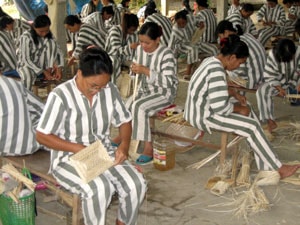 |
Prisoners at the camp are being taught handicrafts. |
The old place, now...
Before being relocated to Hanh Lam commune, Thanh Chuong district, on December 16, 1946, at Ben Hoi, Huong Son commune, Tan Ky district, Prison Camp No. 6 was established with the task of managing, detaining, and re-educating individuals involved in reactionary organizations, acting as agents for imperialism, and engaging in other subversive activities.The prison was involved in activities against the revolution and other criminal offenses. In 1949, it was moved from Tan Ky to Yen Son, now part of Hanh Lam commune, where it remains to this day. After six changes in administrative levels, on July 1, 1996, Prison Camp No. 6 was under the management of Department V6 - Ministry of Public Security. From 1946 to 1954 was the most difficult period, stationed in a rugged mountainous area, and in the following years, it had to move to many places, all of which were difficult to access and prone to disease, especially malaria. The living and working quarters for officers and soldiers, and the prison for prisoners, were all makeshift bamboo structures. During the anti-American war period of 1965-1966, the camp was bombed three times by the US Air Force. Comrade Tran Van Bao bravely sacrificed his life, six officers were wounded, and more than 100 prisoners were killed or injured by American bombs. From 1975 to 1986, the camp was assigned new tasks. This was also a time of great economic hardship for the country, especially in Nghe Tinh province, with food shortages and extremely complex social security and order issues. After overcoming numerous difficulties, the camp has now been established with three sub-camps located in three areas, totaling over 500 hectares. The desire and concern of the Party Committee and officers and soldiers of the camp was to create a spacious and comfortable working and detention facility for prisoners. Through their efforts and the support of higher authorities, from 1993 to the present, the camp's infrastructure has gradually been upgraded and rebuilt, including living and working quarters for officers and soldiers, and prisoner detention areas. The working area and the supervisory board's administrative building have been newly constructed with many modern multi-story buildings. The transportation system is paved, and the national power grid, communication, and water supply have been fully integrated to each sub-camp. Lieutenant Colonel Truong Quang Bich, who has over 20 years of experience here, led us to visit Sub-camp 1, which he is in charge of. Surrounding the grand, modern, and aesthetically pleasing assembly hall are spacious, airy two-story cells with tiled floors, housing over 1,000 inmates. There are also facilities such as a kitchen, a canteen selling essential goods on a deposit basis, a library, a vocational training workshop, and a twenty-bed infirmary.
Of the 575 hectares managed by the prison camp, primarily used for forestry and agricultural production, over 300 hectares have been newly planted with forest, most of which are now ready for harvesting. Over the years, in addition to exploiting the potential of existing land resources, the camp has also developed projects to establish a 20-hectare aquaculture production facility in Trinh Mon, Quynh Luu district, providing regular employment for 150 inmates, as well as stone quarrying and aquaculture facilities in Nam Giang (Nam Dan), and brick and tile production in Thanh Duong (Thanh Chuong)... These production and vocational training facilities have generated billions of dong in total revenue, exceeding 1.741 billion dong in 2006 alone, contributing to the construction of infrastructure for sub-camps and improving the lives of officers and inmates.
"A special teacher teaches special students."
Speaking about the work of educating and rehabilitating prisoners, Lieutenant Colonel Le Trung Hieu, Deputy Superintendent, said: "Over the years, the prison has received and managed thousands of prisoners for education and rehabilitation. Currently, the prison has 2,739 prisoners, of whom more than 60% are convicted of illegal possession and trafficking of narcotics. The prison always prioritizes prisoner management, and the work of rehabilitation and education is a continuous task in helping prisoners reform. To successfully complete the assigned tasks, the officers and soldiers of the prison are always instructed to be exemplary in complying with the law and understanding the policies and guidelines of the Party and the State, and to be officers who are both politically sound and professionally competent. Over the years, the prison has accumulated much experience and innovated its methods." Strengthening activities such as competitions to learn about the law, ethics, lifestyle, HIV prevention, and the harmful effects of drugs... Through emulation movements among inmates, implementing performance scoring within teams and cells, weekly, monthly, and quarterly learning sessions, ranking, considering sentence reductions, and publicly granting paroles... creating a good environment for rehabilitation. For inmates performing heavy labor, the unit allocates 3-5 kg of food per month per person, and those who are sick and receive treatment at the infirmary and hospitals are provided with 3,000-5,000 VND per day, eliminating the stigma of "being in prison and eating meager rations." Improving the spiritual life of inmates through cultural and sports activities, and accessing information through books, newspapers, and television... Annual meetings are organized with the families of inmates who have reformed well and those who have not, creating a collaborative approach in educating and rehabilitating inmates. The prison wardens and officers regularly organize direct dialogues with inmates, fostering closeness and thus eliminating bullying, gang-related activities, and escapes. Since 2000, Prison No. 6 has not experienced any complex incidents. Hundreds of inmates have received literacy certificates, and tens of thousands have been trained and equipped with cultural knowledge, skills in handicrafts, mechanics, and carpentry. Deputy Warden Phan Đình Thành stated that a special visitor recently returned to the prison: Mr. Phạm Văn Cường, born in 1972, from Hải Phòng city, who spent 30 months there. After completing his sentence in 2004, Cường continued his studies at university and graduated with a law degree in 2005, working at a petroleum company in Ho Chi Minh City. He returned to thank everyone and donated over 20 books to the prison library.
Along with building the unit and rehabilitating and educating prisoners, for many years, Prison No. 6 has forged close relationships with Party committees, government agencies, and mass organizations at all levels, actively participating in helping localities build dozens of kilometers of rural roads, supporting poverty alleviation funds and scholarship funds in various localities... From 2004 to the present, the prison has built and donated 8 houses of compassion and solidarity to policy beneficiary families, two cultural houses for two hamlets where the prison is located, and contributed hundreds of millions of dong to charity and poverty alleviation funds...
For over half a century of construction and development, Prison No. 6 has continuously grown stronger in all aspects, receiving many prestigious awards from the Party, the State, the Ministry of Public Security, and various sectors and levels. We are confident that the officers and staff of Prison No. 6 will always uphold the qualities of a People's Police officer, "For the nation, sacrificing oneself; for the people, serving wholeheartedly," strictly adhering to the six teachings of President Ho Chi Minh, and continuing to excel in fulfilling their assigned tasks.
Text and photos: Minh Thu


